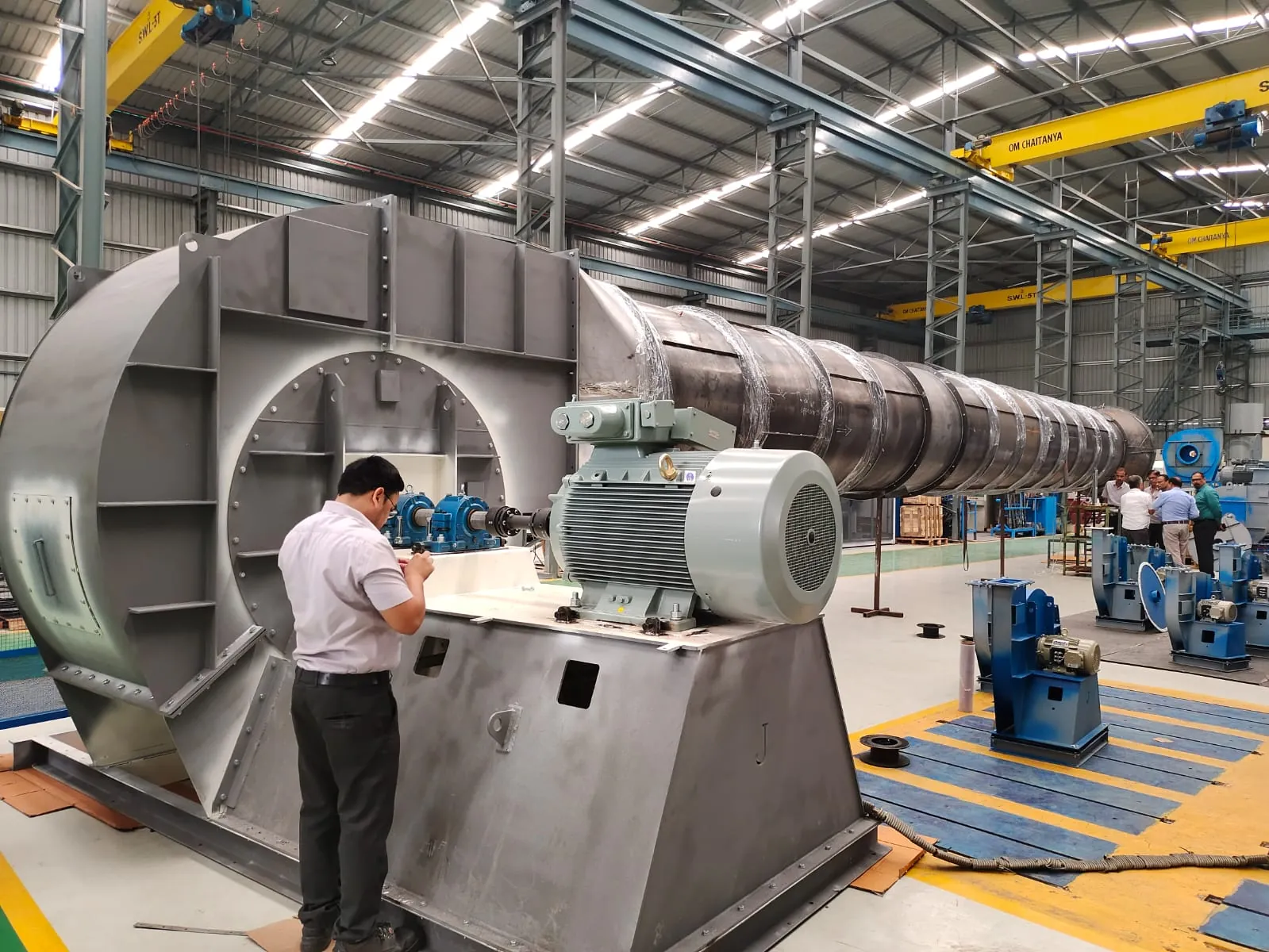
Rubber bushes or elements that wear out repeatedly are telling you the two shafts are not in line. The coupling is absorbing the misalignment you did not correct, and it wears in proportion. The usual causes are alignment done cold and never rechecked at operating temperature, soft foot under the motor or the pedestal, and a spacer gap outside the coupling maker's tolerance. Replacing the element alone just resets the clock.
On a direct-driven centrifugal fan the flexible coupling is the only elastic link between motor shaft and fan shaft. It absorbs small residual misalignment, and it is a wear part — deliberately the weakest element in the chain, so it fails before the shaft or the bearings do. When the bushes chew out, the fuse is doing its job and telling you something about the machine. This guide is about reading that message correctly. It applies to any pin-and-bush coupling on any make of fan.
Sound. The dominant first symptom, almost always reported as "noise" or "abnormal sound" rather than as a coupling problem. A worn pin-and-bush coupling gives a rhythmic knock at running speed (1×) that rises with load, usually audible well before any vibration alarm trips.
Vibration. Misalignment and coupling wear read strongest at 2× running speed; high axial amplitude is the classic misalignment tell. Screen the overall reading against ISO 14694 fan vibration limits — and state the mounting condition, because the limits differ:
| Mounting (BV-3 category) | Commissioning acceptance | Alarm | Shutdown |
|---|---|---|---|
| Rigidly mounted | 4.5 mm/s r.m.s. | 7.1 mm/s | 9.0 mm/s |
| Flexibly mounted | 6.3 mm/s r.m.s. | 11.8 mm/s | 12.5 mm/s |
Keep ISO 14694 separate from the ISO 10816 / 20816 machine-vibration zones — different standards, different boundaries, and mixing their numbers in one report is how arguments start.
Visual. The most direct confirmation, and the one most often skipped: rubber crumbs and black dust under the guard, bright witness marks where a guard has been rubbing, ovalised bush bores, cracked or hardened rubber, damaged coupling bolts.
Motor current. A bound coupling loads the motor. Repeated tripping — reported as an electrical fault — is regularly a mechanical problem at the coupling. Compare starting and running current against nameplate FLA before you blame the starter.
Temperature. Misalignment feeds load straight into the adjacent bearings. Expect a drive-end temperature rise; left alone, the failure walks downstream into the plummer block.
Ranked by what turns up on site:
A fan leaves works run-tested and vibration-checked, which is why the higher prior sits on the lifecycle events — transport, installation, commissioning, operation, wear, or a bought-out component. That is where the evidence usually lands; it is not a way of closing the file. A mismatched coupling bore, an unbalanced hub or a wrong element size is a works escape, and if alignment, guard clearance and mounting all check out good, that is where you look next — against the GA drawing and the balance report.
Two misdiagnoses worth naming: reading every noise complaint as a bearing failure, and treating "motor tripping" as purely electrical. Inspect the coupling and guard before condemning either.
1. Isolate first. Lock out, tag out, confirm zero speed. Nothing below happens on a live machine.
2. Inspect the guard before you touch the coupling. Check its inner face for bright rub witness and rubber dust. If the cover is contacting the element you have your answer — and you will destroy the evidence by pulling the guard off carelessly. Do this first, every time.
3. Bump the coupling by hand. Feel for lost motion between the hubs; excessive rotational free play means worn pins and bushes. Inspect every bush for ovalised bores, cracking, hardening (heat) and swelling (oil or chemical attack).
4. Check bolts and hubs. Coupling bolt torque against spec; hub grub-screws and keys for slip. Loose bolts both mimic and accelerate element wear.
5. Measure alignment. Dial gauge or laser: angular and parallel (offset) misalignment plus axial float / DBSE. Compare against the coupling maker's limit — pin-and-bush types are forgiving, not unlimited; hold parallel offset to roughly 0.05–0.1 mm as a working target. Record soft-foot at all four motor feet.
6. Check the foundation. Firm, level, grouted bedplate; foundation bolts tight. A springy or cracked foundation re-imposes misalignment after every fix you make.
7. Run up with an instrument. Capture overall velocity (mm/s r.m.s.) and a spectrum. Log running current.
8. Decide. - Rubber worn + guard rub marks → guard fouling. - Rubber worn + 2× dominant, high axial + alignment out of limit → misalignment. - Backlash + guard intact + alignment on spec → end-of-life bush wear. - Tripping but no coupling wear → look upstream at the electricals and the process load.
Transport & handling. Corrosion on packed drive components in transit or long storage seizes fasteners and pits hub bores, which later bind the coupling. Confirm: inspect as-received parts for rust and check the packing/VCI condition before install.
Installation. Guard set with insufficient running clearance (confirm: rub witness, rubber dust). Misalignment left in at install (confirm: dial/laser out of limit). Soft foot or springy foundation (confirm: soft-foot check, foundation bolt torque).
Commissioning. Improvised drive arrangements are a recurring cause — on one 40 HP, 27,000 CMH high-temperature process fan an end user rigged an alternate drive method and ran it 10–12 hours, taking out bearing and coupling together. Confirm: interview the site; look for non-standard drive hardware.
Operation & process. Overload and repeated tripping stress the coupling (confirm: running current vs FLA, trip logs). Heat conducted along the shaft or radiated from a hot casing hardens the rubber — but the coupling sits in ambient air, not in the gas stream. A 500 °C process duty is not the coupling's environment: measure the actual temperature at the coupling and drive-end bearing against the element's rating.
Maintenance & wear. End-of-life pins and bushes — fatigue, ovalised bores, backlash. Loose coupling bolts unnoticed between services. On belt drives, pulley and bush loosening or damage.
Jitamitra services fans of any make, not only our own — on-site vibration diagnosis and balancing, alignment, bearing and coupling replacement, and re-rating where the duty has moved away from the machine. If a fan keeps eating couplings and the alignment keeps drifting back out, the cause is usually the foundation or the process, and that is worth a site visit rather than another set of bushes.
Contact: sales@jitamitrablowers.com · Jitamitra Help Desk +91 8329172325
Jitamitra Electro Engineering Private Limited. Fans are performance-tested to IS 4894 / ISO 5801 / AMCA 210 method and balanced to ISO 21940 (typically G6.3). Quality system ISO 9001:2015 certified. CE and ATEX (Zone 2/22) conformity is self-declared.
— Jitamitra Electro Engineering · Technical Services
Engineered for Every Application.
A coupling does not fail from being coupled. It fails from being coupled to a machine that is not sitting flat, and the two checks below catch nearly all of it.
Do the soft foot first. Aligning a machine that has a soft foot means aligning it to a shape it will not hold, and it will walk back out within days — which is why the second alignment visit so often finds what the first one "fixed".
Flow, static, gas temperature, application — or attach a spec, GA drawing or a multi-fan schedule. Engineer to engineer.
ISO 9001:2015 quality system · performance-tested to IS 4894 / ISO 5801 / AMCA 210 method · witnessed FAT on request.
*For our standard range. ATEX and special projects need 5 to 7 working days.
This site sets no cookies of its own. Google Analytics loads only if you accept. It sets two cookies, so we can see which fan topics people actually read. Decline and no analytics loads — the site works exactly the same. What we collect →