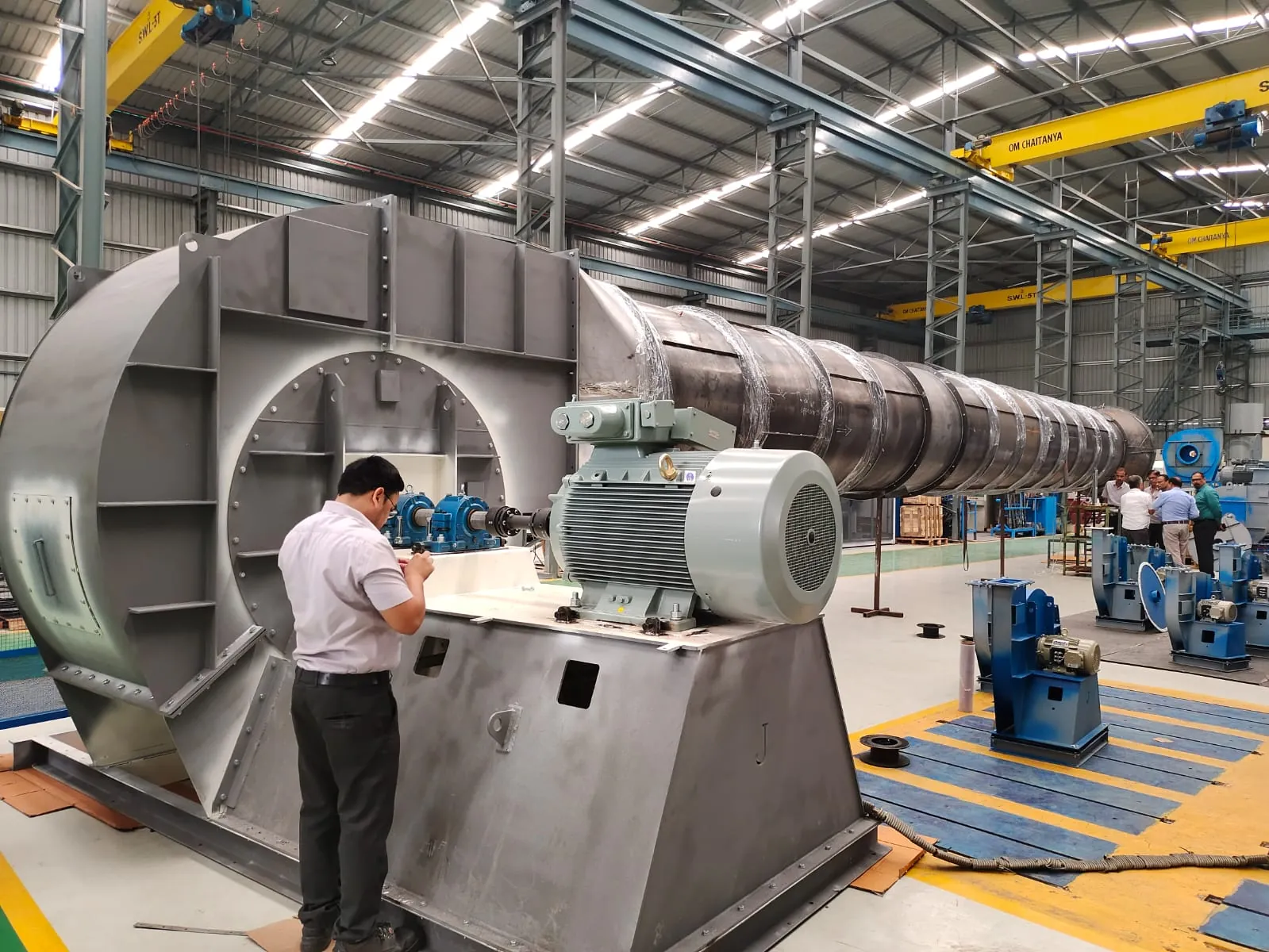
A centrifugal fan leaves the works assembled, balanced and run-tested. Between that test bench and its first start on your foundation it is lashed to a truck, lifted two or three times, sometimes trans-shipped, and often parked in the open for weeks. Much of what a fan suffers, it suffers in that window. This guide is about finding that damage before you energise the motor.
Two quite different presentations.
Visible mechanical damage — no run needed. A dented or crushed motor/fan cover. A bent silencer section. A deformed inlet cone. A torn expansion bellow. A cracked mounting foot, a bent shaft guard. Thin sheet-metal accessories are the first casualties because they protrude and they are light — the pressure casing and the rotating core usually survive what the cover does not. Rust bloom on machined faces and shaft extensions after weeks of unprotected outdoor storage belongs here too.
Consequential dynamic symptoms on start-up. The unit runs, but not as it did on the test bench: broadband noise, a scrape or rub, elevated vibration, running current above nameplate FLA with no process change, or motor protection tripping on start.
Reach for numbers early, and state the mounting when you quote them. Vibration acceptance to ISO 14694, general-purpose category BV-3:
| Mounting | Commissioning acceptance | Alarm | Shutdown |
|---|---|---|---|
| Rigid | 4.5 mm/s r.m.s. | 7.1 mm/s | 9.0 mm/s |
| Flexible | 6.3 mm/s r.m.s. | 11.8 mm/s | 12.5 mm/s |
Two more thresholds worth having in the notebook: bearing-housing temperature rise above roughly 40 °C over ambient, and oil weep at a plummer block. Balance grade is a separate question under a separate standard — ISO 21940, G6.3 typical for this class of rotor.
Ranked by how often it turns out to be true in the field:
Isolate first. Lock out and tag out the motor supply, confirm dead, let the impeller come to rest. Nothing below needs a running machine until step 8.
One misdiagnosis to avoid: blaming ducting (system effect) or condemning bearings when a clearance rub — broadband noise plus a strong 1× line — is staring at you. Confirm the mechanical clearance first. Ten minutes, and it settles the argument.
Transport and handling — Unsecured load, road shock: thin covers and silencers dent or crush; confirm by crush direction plus a dispatch photograph showing the part intact. Rough offloading: bent cones, cracked feet, disturbed coupling, with impact marks at the lift and contact points. No crate or edge protection: protruding light parts take the hit. Handling that closes a running clearance: cone-to-impeller-ring rub, presenting as noise and vibration — confirm by gap measurement against the drawing, after ruling out runout. Typical of the pattern: on a 4,250 CMH / 1,220 mmWC / 40 HP blower for a pharma process-equipment OEM, the silencer and motor cover arrived crushed while the casing and rotor were untouched.
Installation — Erection or storage without the structural support: bellow tear, plummer-block leak, base strain. A 91,800 CMH / 178 mmWC / 100 HP project fan on an oil-and-gas site, run roughly a year on incomplete supports, tore its expansion bellow and wept oil at the plummer block. That is an installation finding, and it is preventable. Improper slinging: local deformation, sling marks visibly off the lifting lugs. Reassembly of transport-split parts done wrong: a misaligned cover or silencer forcing a rub.
Commissioning — starting before the cone gap, hand rotation and alignment have been re-verified post-transport. That converts a repairable deformation into a wrecked impeller in about four seconds.
Operation and process — rarely the origin, but a handling-induced rub left uncorrected accelerates into bearing and impeller wear, and eventually motor tripping.
Maintenance and wear — damage during shifting for maintenance, or a refit after service with no re-check of clearance and alignment. Same mechanism as install-stage handling; it just happens later.
Jitamitra services fans of any make, not only our own. If a unit arrives damaged, or comes up rough after a shift and you would rather have the diagnosis than the argument, we do on-site vibration diagnosis and balancing, bearing and coupling replacement, clearance and alignment correction, and re-rating where the duty has moved. Performance is verified to IS 4894 / ISO 5801 / AMCA 210 method; our quality system is certified to ISO 9001:2015, and CE / ATEX (Zone 2/22) conformity is self-declared.
Contact: sales@jitamitrablowers.com · Jitamitra Help Desk +91 8329172325.
— Jitamitra Electro Engineering · Technical Services
Engineered for Every Application.
Flow, static, gas temperature, application — or attach a spec, GA drawing or a multi-fan schedule. Engineer to engineer.
ISO 9001:2015 quality system · performance-tested to IS 4894 / ISO 5801 / AMCA 210 method · witnessed FAT on request.
*For our standard range. ATEX and special projects need 5 to 7 working days.
This site sets no cookies of its own. Google Analytics loads only if you accept. It sets two cookies, so we can see which fan topics people actually read. Decline and no analytics loads — the site works exactly the same. What we collect →