A real ~40,000 CMH furnace fan running at 350°C, and the design discipline that keeps it from tripping on a cold morning.
Reviewed by Jitamitra application engineering
Share on LinkedIn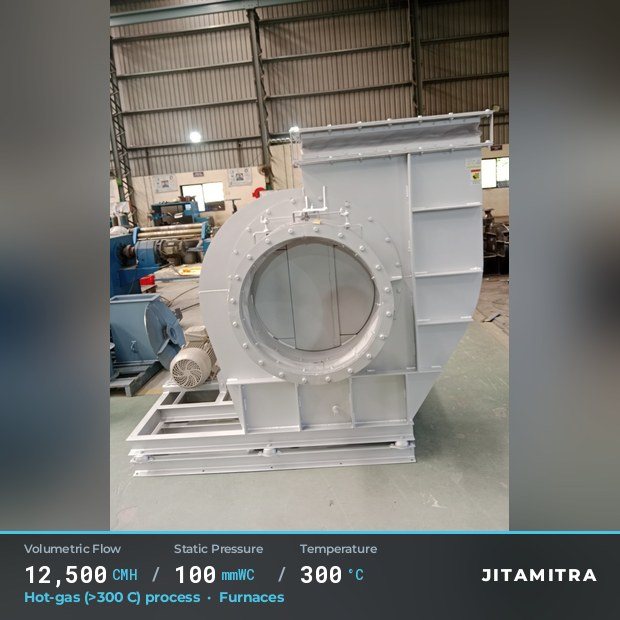
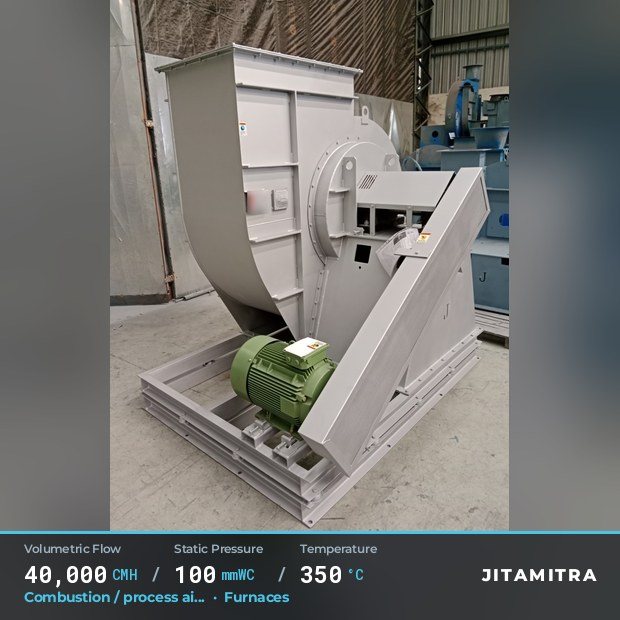
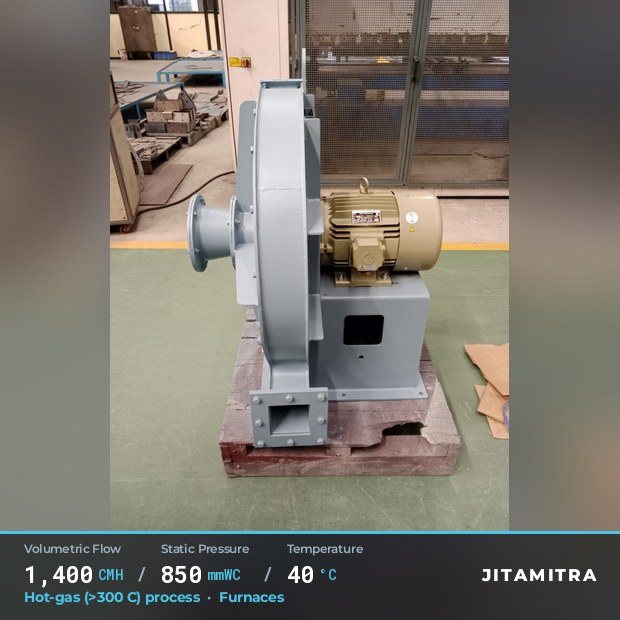
Representative builds from our own floor — illustrative, not the customer’s own unit.
A furnace exhaust fan spends its life pulling thin, hot gas — but it gets tested in a cold shop, and it gets switched on for the first time on a cold morning. Those two facts, not the running duty, are what decide whether the fan trips its motor on start-up. Here is how we sized and started one real furnace fan — built for a heat-treatment OEM — so it neither over-current trips nor over-stresses the moment someone hits the button.
It is a backward-curved centrifugal fan handling furnace exhaust — an induced-draft (ID) arrangement pulling combustion products off the heat-treatment line, rather than a forced-draft (FD) fan pushing cold combustion air in. The running duty is unremarkable until you notice the temperature:
| Parameter | At the hot running duty |
| Volume flow (actual, at temperature) | ~40,000 CMH |
| Fan static pressure | 100 mmWC |
| Operating temperature | 350 °C |
| Gas density at 350 °C | 0.564 kg/m³ |
| Gas density at 20 °C (cold start) | ~1.20 kg/m³ |
| Impeller power, hot (350 °C) | 13.9 kW |
| Impeller power, cold open (20 °C) | 29.6 kW |
| Motor | 25 HP |
At 350 °C the gas is less than half as dense as the air the same fan would move cold. That single number drives everything below.
We cannot put 350 °C gas through a shop test bay. So the fan is performance-tested cold — at ambient, standard-density air — to the IS 4894 / AMCA 210 method, with the impeller balanced to the ISO 1940 G2.5 grade and vibration recorded against ISO 14694 BV3 tolerances. The catalogue and the witnessed test curve are therefore cold curves.
The hot operating point is derived from those cold curves by the fan laws. Pressure and shaft power both scale linearly with gas density at a fixed speed and flow — this is the density law, the sibling of the speed-cube relationship covered in the cube law. To deliver 100 mmWC of hot static pressure at 350 °C, the cold test curve must show the same duty flow at a proportionally higher pressure; the hot absorbed power falls in the same proportion. Get the density basis wrong and you have quoted a different fan — which is exactly why we state the duty as static pressure at temperature, not a bare "100 mmWC" (see static, velocity & total pressure).
Run the density law the other way and the problem appears. Cold, dense air at 20 °C is about 2.1× denser than the 350 °C process gas. If this fan were allowed to run wide open on a cold furnace, it would absorb the cold power, not the hot power:
The motor is a 25 HP frame — comfortably above the hot running demand, hopelessly below the cold-open demand. Start this fan cold and open and it draws far past its rating and trips (or, worse, holds on and cooks the windings). The dense cold-start figure — not the hot duty — is the number that governs the start.
You resolve a cold-start spike one of two ways: fit a motor big enough to swallow the full cold-open power, or control the start so the fan never sees it. Fitting a ~50 HP motor to a fan that needs 14 kW hot means it idles half-loaded for its whole service life — poor power factor, poor economics. So this fan is a hot-start design, started under a defined procedure:
The damper is doing double duty here — start-up protection and running control. That trade-off between a damper, IGVs and a VFD is its own decision, covered in damper vs IGV vs VFD.
For any kiln or furnace exhaust fan, three lines on the RFQ change the design: the operating temperature, the cold-start temperature, and the intended start procedure. Give us those and we size the motor against the real governing case and specify the start — rather than discovering the cold-start spike at commissioning. If you only remember one thing: a hot-gas fan is sized by the coldest air it will ever move, not the hottest. That is the heart of specifying the duty point.
Talk to us about a furnace or kiln exhaust fan →
Jitamitra Electro Engineering · Fan-engineering notes, written for the engineer.
Sources & basis. Grounded in a real furnace-exhaust fan we built for a heat-treatment OEM: a ~40,000 CMH, 100 mmWC, 350 °C backward-curved centrifugal fan on a 25 HP drive. Duty, densities and the cold-vs-hot impeller power (13.9 kW hot at 350 °C vs 29.6 kW cold at 20 °C) are taken from the fan's technical data sheet and selection curve; the damper-closed, soft-start hot-start procedure is the datasheet's stated starting condition. Customer name, model/type codes and job number withheld for confidentiality. Tested to the IS 4894 / AMCA 210 method; balanced to ISO 1940 G2.5; vibration to ISO 14694 BV3 — methods, not third-party certifications.
Because it is being started on dense air. At 350 °C the gas is less than half as dense as the air the same fan would move cold — cold air at 20 °C is about 2.1× denser than the process gas. On this furnace fan the impeller draws 13.9 kW hot, but 29.6 kW cold and wide open. The dense cold-start figure governs the start, not the hot duty.
We cannot put 350 °C gas through a shop test bay, so the fan is performance-tested cold, at ambient standard-density air, to the IS 4894 / AMCA 210 method. The hot point is derived from that cold curve by the fan laws: pressure and shaft power both scale linearly with gas density at fixed speed and flow. Get the density basis wrong and you have quoted a different fan.
You can, but it buys a permanently oversized machine. Fitting a ~50 HP motor to a fan that needs 14 kW hot means it idles half-loaded for its whole service life — poor power factor, poor economics. The alternative is to control the start so the fan never sees the cold-open power. That is what a hot-start design does, on a 25 HP frame.
Damper closed, on a soft starter. A fan on a closed outlet damper absorbs far less power than one running out on its curve — the cheapest possible protection against the cold spike — and the damper is opened only as the system comes up to temperature and the gas thins. Star-delta is mandatory here on a motor above 5 HP. Never started stone-cold and open.
Three lines change the design: the operating temperature, the cold-start temperature, and the intended start procedure. Give us those and we size the motor against the real governing case and specify the start, rather than discovering the cold-start spike at commissioning. If you only remember one thing: a hot-gas fan is sized by the coldest air it will ever move, not the hottest.
They come from a real furnace-exhaust fan built for a heat-treatment OEM — a ~40,000 CMH, 100 mmWC, 350 °C backward-curved fan on a 25 HP drive. The duty, densities and impeller powers come from its technical data sheet and selection curve; the damper-closed, soft-start procedure is the datasheet's stated starting condition. Customer name, model/type codes and job number are withheld; the standards named are methods, not third-party certifications.
Flow, static, gas temperature, application — or attach a spec, GA drawing or a multi-fan schedule. Engineer to engineer.
ISO 9001:2015 quality system · performance-tested to IS 4894 / ISO 5801 / AMCA 210 method · witnessed FAT on request.
*For our standard range. ATEX and special projects need 5 to 7 working days.
This site sets no cookies of its own. Google Analytics loads only if you accept. It sets two cookies, so we can see which fan topics people actually read. Decline and no analytics loads — the site works exactly the same. What we collect →