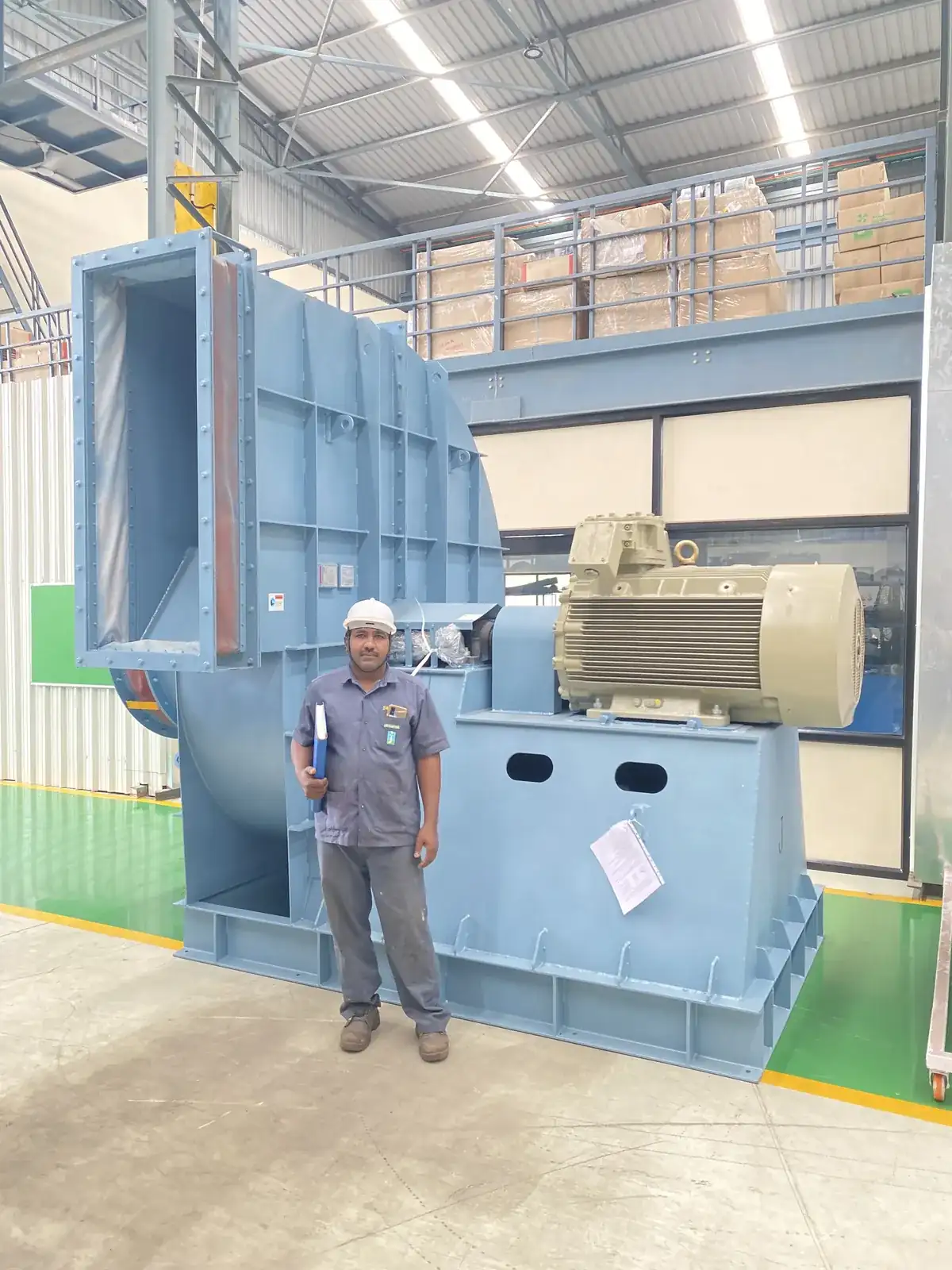
Fan assembly on the Jitamitra shop floor at MIDC Ahilyanagar
Home  /  Services  /  EC fan retrofit
Services

Retrofitting an AHU or plug fan to EC — what we check before we quote

A retrofit to EC backward-curved fans is usually the cheapest energy project available on a ventilation system, because you are not re-ducting anything — you are changing the machine inside a box that already exists. It is also the project most often quoted badly. This page is the survey we walk around your AHU with, and what we need from you before we will put a number on it.

8checks before we quote
0belts, 0 drive panels
40,000 hL10 min at 40 °C ambient
3working days to quote*
The survey, not the sales pitch

Retrofitting an AHU or plug fan to EC

Most air handling units in Indian plants still move air with a belt-driven AC centrifugal fan, or with an AC plug fan running flat out against a damper.

Both are retrofit candidates, and a retrofit to EC backward-curved fans is usually the cheapest energy project available on a ventilation system — because you are not re-ducting anything, you are changing the machine inside a box that already exists.

It is also the project most often quoted badly. A fan that fits on paper does not fit through the access door; the supply available in the plant room turns out to be wrong for the model selected; the BMS wants a protocol the fan does not have. So this page is the survey, not the sales pitch. It is what we walk around your AHU with, and what we need from you before we will put a number on it.

Jitamitra Electro Engineering Private Limited is JUPI Air Technology (Nanjing) Ltd.’s Exclusive Authorized Distributor — EC Backward Curved Centrifugal Fans, India, under authorisation J26D061701IN dated 17 June 2026. You buy from us, we are your supplier of record, and the selection, installation, commissioning and field service are ours.

The mechanism

Why the retrofit case is usually strong

A ventilation fan almost never sits at its design duty. It runs throttled — by a damper, by a loaded filter bank, by a shift pattern, by the season. Flow falls with speed, pressure with the square of speed, and shaft power with the cube. That is the whole mechanism behind every energy claim made for a speed-controlled fan, and it is a fan law, not a feature.

An AC induction motor has to induce its own rotor field and loses efficiency as you slow it. A permanent-magnet EC motor does not, and its controller is built into the fan — so the drive panel, the long motor cable and the separate commissioning step all disappear along with the belt, the pulleys, the alignment and the belt guard. In a paint booth or a cleanroom, taking the belt out of the air path upstream of a surface that has to be flawless is worth something on its own.

One documented job

A retrofit the manufacturer published in full

One belt-driven AC centrifugal fan replaced by five EC high-static fans of the Ø450 frame size, in a wall.

The manufacturer’s own record of the job shows the sequence — fan out, motor out, then the diffuser plate and the sheet metal — which is what a real retrofit looks like from the inside.

As published by the manufacturer — one air handling unit, before and after
AirflowInput powerNotes as published
Before26,600 m³/h18.8 kWNo intelligent control, complicated installation
After39,600 m³/h11 kWIntelligent control, easy installation

The manufacturer headlines this as an energy saving of up to 41.5%. That figure is simply the drop in input power, 18.8 kW to 11 kW. Airflow rose 49% at the same time, so it is not a like-for-like comparison and we will not present it as one. The honest figure is the better one anyway: expressed as energy per cubic metre of air actually moved, the retrofit cut consumption by about 61%, from 0.707 to 0.278 kW per 1,000 m³/h.

Two other things came with it, and they matter more than the kilowatts on some sites. The belt drive is gone. And a wall of five fans keeps running when one stops — in a paint line the expensive event is not the failed fan, it is the stopped booth.

The manufacturer also reports an annual electricity saving, computed on 8,760 running hours and CNY 1 per kWh. We are not going to convert that into rupees for you, because a saving calculated on someone else’s tariff and someone else’s running hours tells you nothing about your plant. We do not publish a payback period. Give us your rate, your hours and your throttling pattern and we will do that arithmetic with you, on your numbers.

The survey

The eight checks

This is what we walk around the unit with. Send what you have and we will work the rest out on a call or a site visit.

1. Space envelope, inside and on the way in

We need the internal plenum dimensions, the fan chamber depth, and the width of every door and passage the fan has to pass through. This is the single most common reason a retrofit is possible at all: several small fans in an array will go through a standard doorway where one large replacement fan cannot be craned in. It is also the most common reason a quoted retrofit fails on site.

For scale, the manufacturer’s specification for the Ø450 sample we hold gives a 630 × 630 mm mounting plate with eight Ø11 fixing holes, an overall depth of about 463.5 mm, and a fan weight of 60 kg. Mounting-plate loads, lifting arrangements and the man-handling route all follow from figures like those, per model.

2. The electrical supply, model by model

There is no single supply voltage for this range. The manufacturer’s cleanroom catalogue rates every model in it at 220 VAC; the high-static catalogue rates every model in it at 380 VAC. For the Ø450 sample we hold, the specification gives a rated voltage of 380 VAC and an operating voltage range of 380–480 VAC — India’s 415 V nominal sits inside that, and we quote on that basis. All the manufacturer’s published performance data is at 380 V, so we do not publish a curve “at 415 V”, and we confirm the supply and the behaviour against the manufacturer’s data for the specific model, in writing, before order.

What we need from you is what is actually available at the AHU: phases, voltage, the spare way in the panel, cable route and length, and the earthing arrangement. The manufacturer requires wiring to their diagram, an earth connection where required, a standard cable, and an over-current protector.

3. The control signal

For the Ø450 sample we hold, the manufacturer specifies a 0–10 V DC linear speed reference (or PWM), with the usable signal window running from 1.0 ±0.1 V to 9.8 ±0.2 V for a speed range of 600 to 2,550 r/min, and the fan stopping when the signal falls below 0.8 V. There is an auxiliary +10 V DC output, rated ≤22 mA — a signal-level supply, not a power supply. Soft start brings the fan to full speed in under 35 seconds.

For that same model the specification also lists speed feedback over RS-485 and fault feedback as a dry contact or over RS-485. RS-485 is a physical layer, not an application protocol, and no document we hold for any model in our scope names one. So if your BMS expects a specific bus protocol, tell us early: we confirm what a given model actually supports against the manufacturer’s documentation for that model before we write it into a quotation. Where no protocol is available, a 0–10 V output from the BMS controller does the job on most AHUs.

4. Mounting and orientation

The last field of the model code states the mounting the fan is supplied with: F — with frame, R — venturi (inlet ring), G — guard, S — system (guard and frame), N — no accessories. Getting this right is half the retrofit. A venturi fan needs its inlet ring installed to the manufacturer’s requirement or the performance changes; a framed fan needs a flat, stiff mounting face.

The specification for the Ø450 sample shows front-mounted, side-mounted and suspended arrangements. The manufacturer’s own cautions are worth repeating: mount without excessive or uneven force at the mounting points, use anti-vibration mounts there to cut noise and vibration, do not exceed the specified mounting-screw length, install in the required orientation, fit guards, and never use the blades as a handle.

5. The air at the fan

This is clean-air equipment. On the high-static line the impeller is aluminium alloy and the air duct galvanized sheet, with IP54 protection and class F insulation; the cleanroom line includes plastic-impeller frames. A power-electronics package rides on the motor. In a dusty airstream the manufacturer asks for a filter at the inlet to extend life, and it warns specifically against operating in a corrosive gas environment — it names H₂S, SO₂ and NO₂ — or in poisonous atmospheres.

Operating temperature is model-specific and we will only state it against a named model. For the Ø450 high-static model we hold, the manufacturer’s specification gives an operating temperature of −25 to +50 °C. Other models in the range are rated differently, and some stop lower at the top of the band. Send us the air temperature at the fan and we will match it to a model rather than to a range.

6. The plant room around it

The electronics live in the airstream and in the room. The bearing life the manufacturer publishes for the Ø450 sample — 40,000 hours L10 minimum — is stated at nominal supply voltage, full speed and 40 °C ambient. The same model is permitted to operate to 50 °C, and the manufacturer does not publish a life figure at 50 °C. We have asked. So the plant-room temperature is a selection input, not a detail.

The fan protects itself while it is in there: over-temperature shutdown with automatic restart on cooling, over-current protection, locked-rotor detection, and over- and under-voltage protection. None of that removes the need for short-circuit and overload protection designed by whoever does your electricals.

7. Site altitude

The manufacturer’s specification for that same fan gives an applicable altitude range below 1,000 m, and supplies a density-correction formula for altitude and temperature. Whether the 1,000 m figure is an aerodynamic limit or a motor-cooling one, and what derating applies above it, is not stated. We have asked. Until we have the answer in writing, a site above 1,000 m gets raised with the manufacturer rather than guessed at — most of the Deccan plateau sits close enough to that line to be worth checking properly.

8. What the fan is doing today

Duty point at the fan (flow in CMH, static pressure in mmWC or Pa), the existing fan type and motor rating, whether it is belt-driven or direct, whether a VFD is already fitted, filter type with clean and loaded pressure drop, and how many hours a year it runs — and how much of that is throttled. Without the last two there is no energy case, only a price.

Scope of works

What changes, and what does not

Changes

The belt, pulleys, alignment, belt guard and their spares list — gone. The starter or VFD panel, its enclosure, its cooling and its motor cable — gone; the drive is on the motor. A low-voltage control pair arrives at the fan. One fan often becomes several, which buys redundancy the original never had. Commissioning becomes setting a speed reference, not changing a pulley.

Does not change

The duty point — you still select on flow and static pressure at the fan, off a P–Q curve, exactly as before. The ducting, the coils, the filter bank, the dampers and the AHU casing all stay.

Still the same wheel

It is a backward-curved centrifugal impeller — the same aerodynamic family we have built at Ahilyanagar since 2009, non-overloading, selected the same way. The motor changed, not the fan. And your own maintenance discipline on filters does not change either: an EC fan does not forgive a blocked filter bank, it just tells you about it in kilowatts.

Honest limits

When a retrofit is the wrong answer

Some of these rule out EC entirely, and some only mean the money is not there. Both are worth knowing before you spend on a survey.

Wrong duty for these fans

  • Air hotter than the selected model’s rating — oven recirculation, curing, kiln and furnace exhaust
  • Solvent-laden or overspray-carrying paint-booth exhaust, as opposed to the booth supply side
  • Classified or potentially explosive atmospheres of any kind
  • Abrasive or heavily dust-laden air — shot blast, foundry, cement, fly ash
  • The dirty side of any filter or dust collector
  • Corrosive airstreams, which the manufacturer warns against directly

For every one of these we build a purpose-engineered centrifugal fan in our own works, in steel, up to 500 °C. See the fan families →

Right duty, weak case

  • The fan already runs direct-drive with a VFD at a steady full duty. There is no belt to remove and little throttling to recover; the gain narrows to the motor difference alone
  • Very few running hours a year. The arithmetic is driven by hours, not by percentages
  • A single large duty that would need an impractical number of small fans, or a plenum that cannot be opened without pulling the coil
  • Supply or access that cannot be confirmed. We would rather decline the job than quote around an unknown

Both sides of the plant

The clean side of your paint shop and the dirty side need different fans, and we make both. EC on the supply and AHU side; our own fans on the exhaust and the oven, where the air is loaded and hot. That is precisely why we can afford to tell you when the imported fan is the wrong one.

Before we can quote

What we need to quote

Send what you have — we will work the rest out on a call or a site visit.

Duty point

Airflow in CMH, and static pressure in mmWC or Pa, at the fan.

The fan today

Type, motor rating, belt or direct, VFD fitted or not.

Running pattern

Hours per day, days per year, and how much of it is throttled.

Your tariff

Rupees per unit. Without it there is no energy case, only a price.

Filter type

With clean and loaded pressure drop.

Air temperature

At the fan, and the ambient in the plant room around it.

Control need

Fixed speed, 0–10 V, PWM, or a BMS interface — tell us which BMS.

Space

Plenum dimensions, the narrowest door on the route, and the supply available.

Photographs

The fan chamber, the drive end and the panel. One good photograph saves a site visit.

Questions

Frequently asked

Can EC fans be retrofitted into an existing AHU?

Usually yes, and it is often the strongest energy case on a ventilation system. An array of smaller EC fans will pass through a standard door where a single large replacement cannot be craned in, and it gives you redundancy the original single fan never had. We survey the plenum, the access route, the supply and the duty before committing to anything.

Do I need a VFD as well?

No. The speed controller is built into the fan. That removes the drive panel, its enclosure and cooling, the long motor cable and a separate commissioning step.

What supply do I need?

That depends on the model selected. There is no single supply voltage across this range - the manufacturer's cleanroom catalogue rates every model in it at 220 VAC and the high-static catalogue rates every model in it at 380 VAC. For the 450 mm high-static model we hold in full specification, that specification gives 380 VAC rated with a 380-480 VAC operating range, so India's 415 V nominal is inside range. We confirm the requirement against the manufacturer's data for the specific model before order rather than quoting a range-wide figure.

How hot can the air be?

It is model-specific, so we state it against a model. The manufacturer's specification for the 450 mm high-static model we hold gives -25 to +50 degrees C. Other models are rated differently. Tell us the temperature at the fan and we select to it.

How much will it save me, and what is the payback?

We do not publish a payback figure. It depends entirely on your tariff, your running hours and how much of the time the fan runs throttled - a number computed on someone else's electricity price is worthless to you. Send us those three inputs and we will work it through with you.

Will I need to change the ducting or the coil?

Normally no. A retrofit changes the fan and its mounting; the ducting, coils, filters and casing stay. Where the coil has to come out simply to get access, we tell you that at survey stage, not after the order.

Who makes the fans, and who supports them?

They are built by JUPI AirTech - JUPI Air Technology (Nanjing) Ltd. Jitamitra is their Exclusive Authorized Distributor - EC Backward Curved Centrifugal Fans, India, under authorisation J26D061701IN dated 17 June 2026. Selection, landed cost, supply, installation, commissioning, spares and field service all sit with our own teams at Ahilyanagar.

Performance and rating figures on this page are the manufacturer’s published data for the model named against them, measured by the manufacturer. They have not been independently verified by Jitamitra and are subject to the manufacturer’s tolerances. Nothing on this page constitutes a warranty given on the manufacturer’s behalf. The binding specification is the one on our quotation for your duty. The high-static line covers impeller diameters Ø310, 355, 400, 450, 500 and 560 mm; every retrofit is re-selected against your actual duty point before quotation.

Related: EC fans — the range and how they work · EC fan control · Selecting an EC fan · Cleanroom and pharma AHU · Engineering, energy and advisory · Field services · Our own centrifugal fan families

Ready to size one?

Send us the fan you have today.

Duty point, running hours, your tariff, and a photograph of the fan chamber. We will come back with a selection, a landed price and the arithmetic worked on your own numbers — normally within three working days.*

Get a quote Talk to engineering

Jitamitra Help Desk +91 83291 72325 · sales@jitamitrablowers.com
*For our standard range.