Prove what your fan actually delivers — on site, on the test bed and on paper. Field performance testing, witness runs, NDT inspection and audit-ready certification, on any make we build, repair or overhaul.
Yes. Fans are performance-tested in-house on a 200 HP VFD test rig to the IS 4894 / AMCA 210 method, with fans above the rig's 200 HP run at derated speed and scaled to the specified duty by the fan laws. Customer and third-party witness inspection and Factory Acceptance Test are offered at no extra cost on domestic orders and add about three days to the schedule. Field performance testing, vibration and NDT inspection are available on any make. See the standards we work to.
839 service events over 12 years.
Most fan builders will only stand behind the number on their own nameplate. Jitamitra tests and certifies any make of industrial fan. On the installed machine we measure actual flow, static pressure and absorbed power with portable instruments, correct to standard air for temperature, altitude and density (AMCA 203 / ISO 5802 field method), and separate a genuine fan shortfall from system-effect losses in your ducting — so you get a documented answer to the one question that matters: is the fan really delivering the duty it was bought for?
The rest of the group closes the paper trail. Witness the works run and balance test before dispatch — running vibration in mm/s RMS to ISO 14694, balance to ISO 21940 — take in-house dye-penetrant crack detection with UT, MPI and PMI routed to qualified NDT vendors, and receive audit-ready document packs of GA drawings, test certificates, material certs and documented repair records. We stay explicit about what is done in-house versus engineered on request, and we never dress a portable field test up as an accredited-lab certificate.
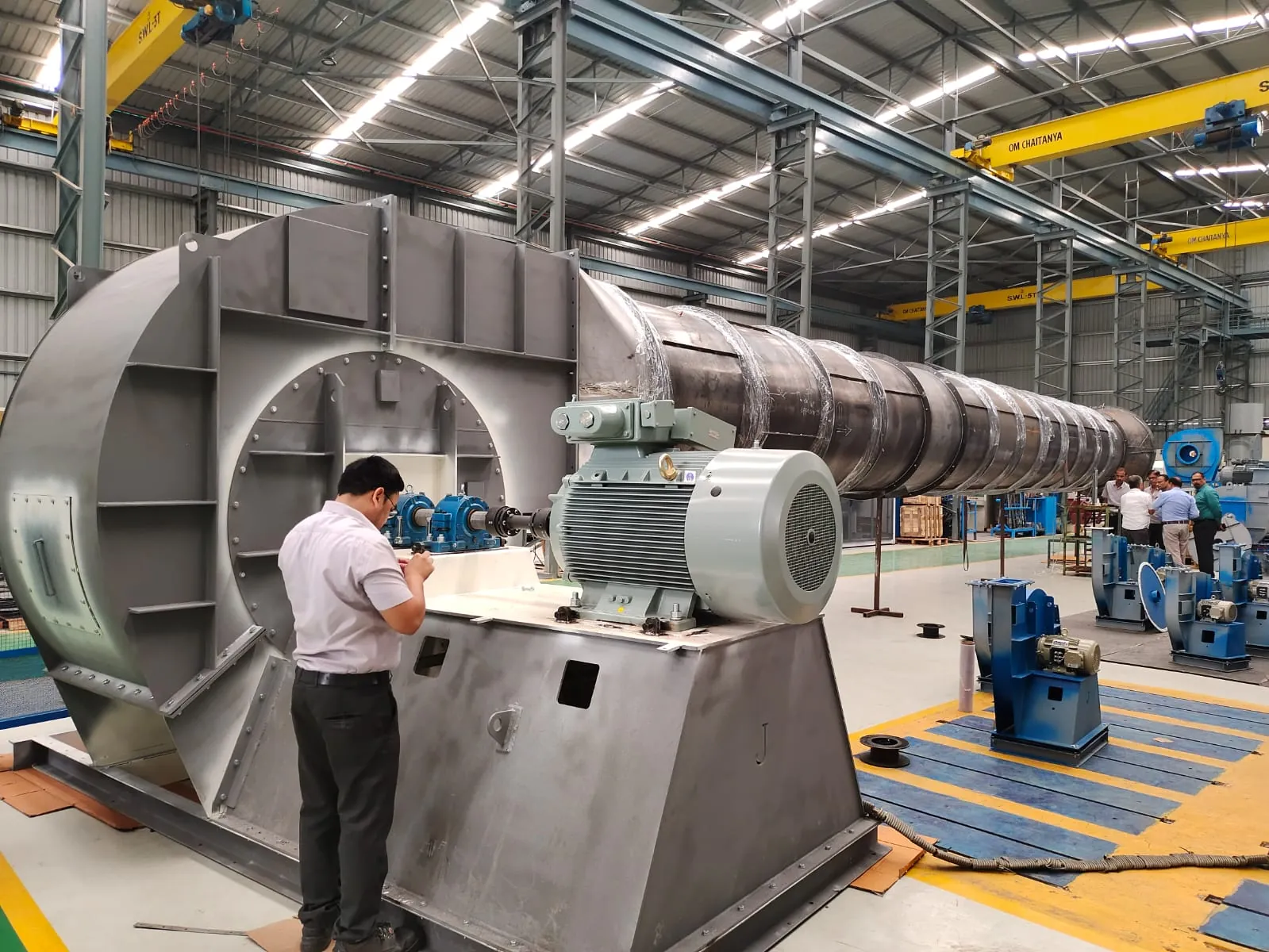
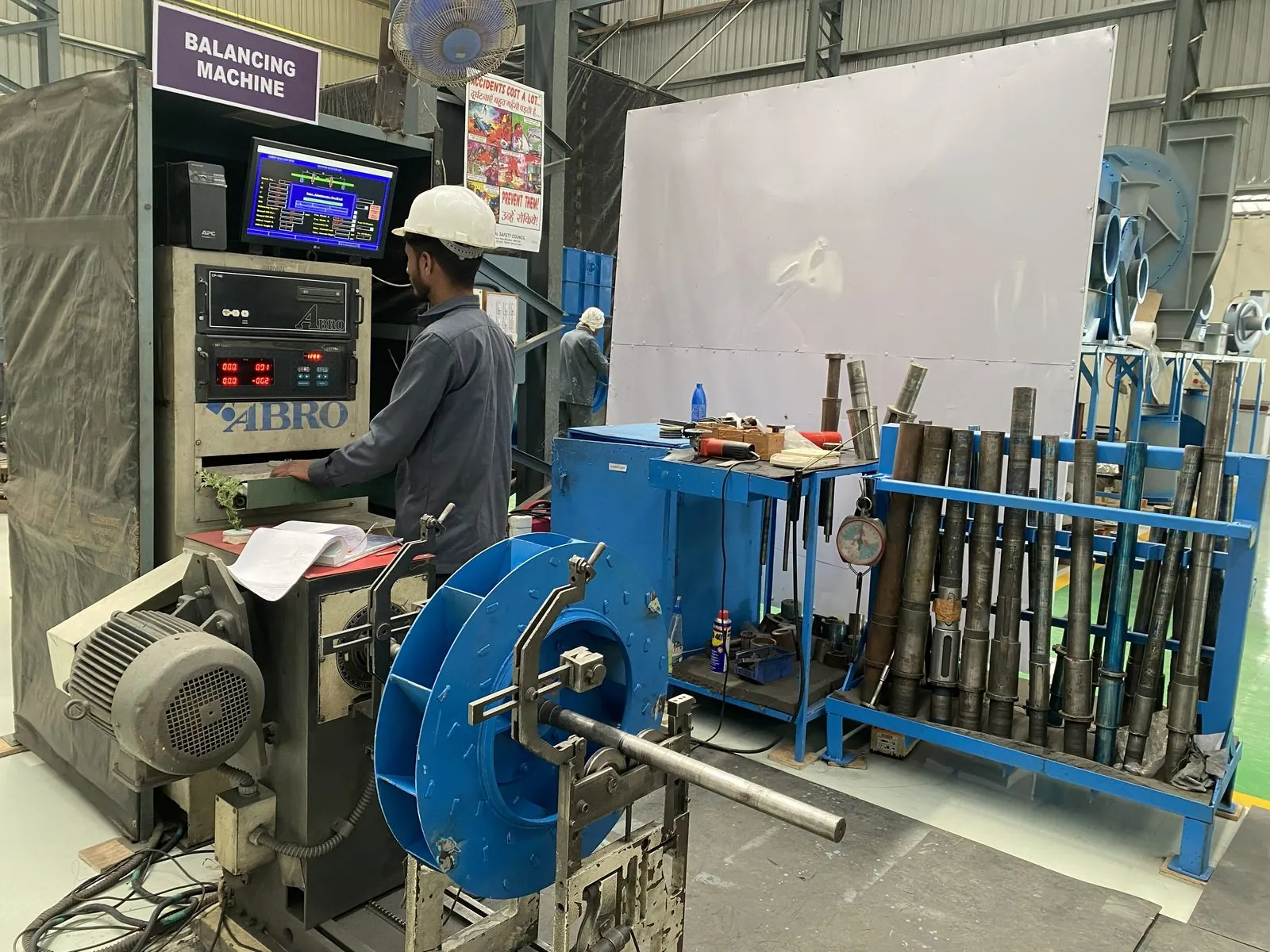
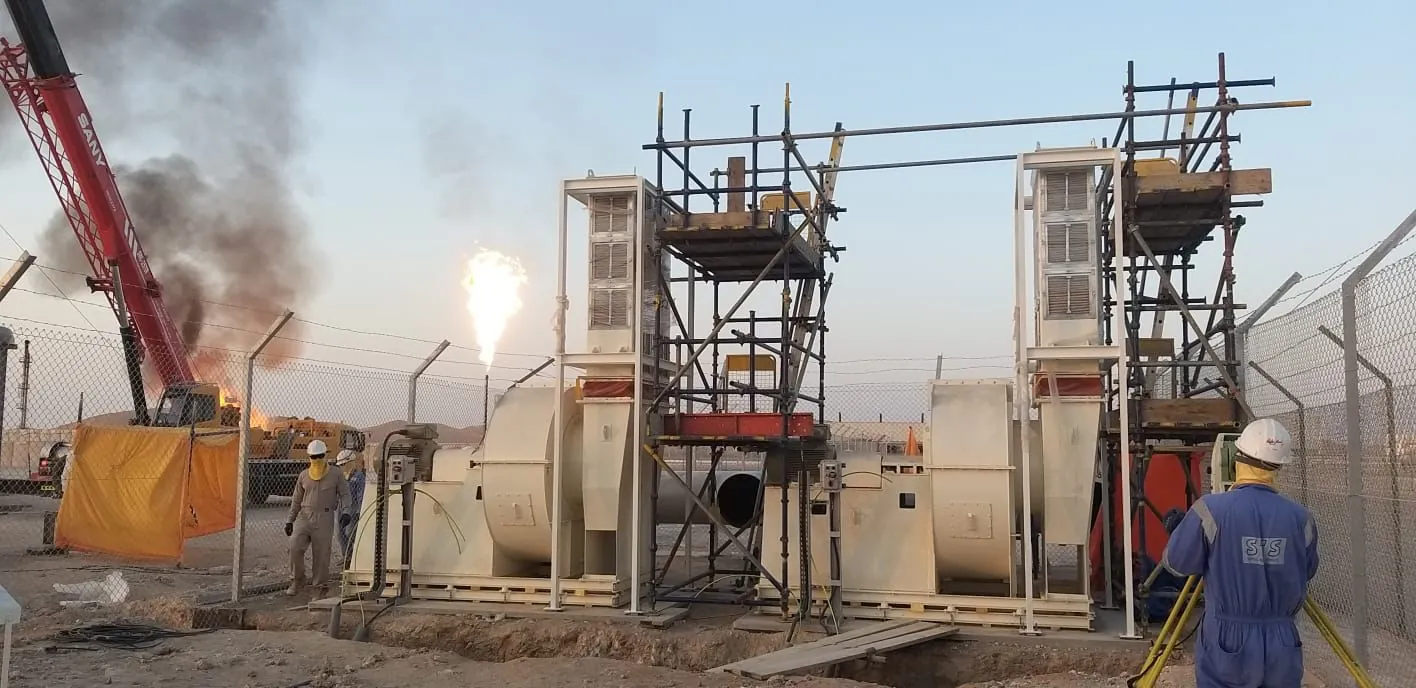
Measure actual flow, static pressure and absorbed power on the installed fan with portable instruments (Pitot traverse, suction/discharge tappings, motor power), correct to standard air for temperature, altitude and density, and plot against the design duty point using the AMCA 203 / ISO 5802 field method. We separate a genuine fan shortfall from system-effect losses in your ducting — this is field, portable-instrument testing, not an accredited-lab test — and hand over a documented field performance report on any make of fan.
Standard/method. Referenced to AMCA 203 field-test method (scope to be confirmed per attestation), expressed against the AMCA 210 / ISO 5801 rated-duty framework, with density correction to standard air per FE-1600 and system-effect assessment per AMCA 201. Note: ISO 5801 and AMCA 210 are NOT interchangeable at the margin - if the customer specifies one test standard, do not test to the other. This is field testin
Rig-test air performance, sound and balance to IS 4894 / ISO 5801 / AMCA 210 — a full flow, pressure, power and efficiency curve on a standardised Pitot-traverse or nozzle-chamber airway, rotor balance verified to ISO 21940 (G6.3, or G2.5 critical) and sound power across the 63 Hz–8 kHz octave bands, issued as a traceable certificate. This accredited-rig capability is engineered on request; today the equivalent assurance is delivered through witness testing and on-site field performance testing.
Standard/method. AMCA 210 (laboratory methods of testing fans - the basis for air-performance testing with air as the test gas); ISO 5801 (international standard for industrial fan performance testing using standardised airways - note it is not interchangeable with AMCA 210); ISO 1940 / ISO 21940 (mechanical balance quality grades G6.3, G2.5); ISO 13347 (fan sound power determination, octave bands 63 Hz to 8 kHz).
Prove rotor mechanical integrity through overspeed, strain-gauge blade-stress, modal (natural-frequency) and hot/extended run tests — the suite critical and API 673 buyers specify, with run vibration judged in mm/s RMS per ISO 14694, measured to ISO 14695 and balance to ISO 21940 (G2.5). The overspeed/strain-gauge/modal rigs are a capability being built and engineered on request; today we deliver witnessed run and balance testing on the assembled fan.
Standard/method. API 673 (3rd Ed - centrifugal fans for petroleum, chemical and gas service; invokes ISO 21940 rotor balance and vibration-transducer provisions); ISO 1940 / ISO 21940 (balance grades, G2.5 for API service); ISO 14694 (vibration acceptance limits in mm/s RMS, category BV-3). These are the target standards for the capability being built; do not claim certified delivery against them today.
Detect hidden cracks in impellers, shafts, welds and housings and verify the alloy is the specified grade — dye-penetrant (DP) crack detection in-house, with magnetic-particle (MPI), ultrasonic (UT) and PMI alloy verification routed to qualified NDT vendors and compiled into an audit-ready document package (API 673 / NACE MR0103 basis where specified). Inspection is make-independent; the full certified UT/MPI/PMI bundle is engineered on request.
Standard/method. API 673 (3rd Ed, on disk) for centrifugal fans in petroleum/chemical/gas service - it invokes ISO 21940 for rotor balance and references NACE MR0103 for sulfide stress cracking. PMI verifies materials against the specified grades (SS304/316/316L, duplex 2205, high-temp alloys). NDT methods (DP/MPI/UT) are applied to the relevant component-acceptance criteria. Documentation is compiled to support
Run the assembled fan on the test bed with your representative or a nominated third-party inspector present, measure running vibration on the bearing housings in mm/s RMS (ISO 14694 / AMCA 204 BV-3) and confirm rotor balance to ISO 21940 (G6.3, or G2.5 for critical service). The witness signs the test record against agreed acceptance limits before dispatch — a jointly accepted hand-over document, available on any make we build, repair or overhaul.
Standard/method. ISO 1940 / ISO 21940 (balance quality grades G6.3, G2.5); ISO 14694 (fan vibration acceptance limits, mm/s RMS on bearing housings, category BV-3; ISO 14695 measurement method); AMCA 204 (assembled-fan vibration grade BV-3 on the running fan). Witnessed performance testing to AMCA 210 / ISO 5801 can be added where the rig scope allows.
Compile and issue the document pack that proves a fan is correct and properly tested — GA drawings, test certificates and datasheets as standard, plus material test certificates (MTCs), balance and vibration records (ISO 21940 / ISO 14694), code-stamped repair documents and an audit-ready dossier on request. Where an EU-export contract requires it we self-issue a CE Declaration of Conformity to Machinery Directive 2006/42/EC — a manufacturer self-declaration, not a notified-body certificate — and issue our own QA-based documents on any make.
Standard/method. ISO 21940 (balance quality grades G6.3 / G2.5); AMCA 210 / ISO 5801 (air-performance test basis where a performance cert is issued); ISO 14694 (in-situ vibration acceptance limits, BV-3); Machinery Directive 2006/42/EC (self-issued EC Declaration of Conformity / CE marking available where an EU-export contract requires it - a manufacturer self-declaration, not a notified-body certificatio
Inspect the fan to a standardised checklist — bearing temperature and vibration, lubrication, belt/coupling and foundation condition, impeller cleanliness and wear — with vibration pass/fail referenced to ISO 14694 (BV-3), then affix a dated badge recording the last-checked and next-due date. This badged health-certification programme is a capability being built and engineered on request; the underlying inspection we can already perform on any make.
Standard/method. ISO 14694 (vibration acceptance limits, BV-3, that would set the badge pass/fail on vibration); ISO 21940 (balance grades referenced where rebalance is part of the check). The health-check checklist follows Jitamitra's maintenance practice; the badge itself is not a certification under any standard.
Where the answer came from measuring the fan against its curve.
These get used interchangeably in enquiries and they are not interchangeable. Each asserts something different, and only one of them is about how a fan is built.
The honest position, stated once: we test in-house on a 200 HP VFD rig to the AMCA 210 / IS 4894 method and issue the test report. We are not AMCA-certified, and we will not describe ourselves as such. Fans above the rig's 200 HP are run at derated speed and scaled to the specified duty by the fan laws — which is stated on the report, not glossed over.
If your specification names API 673, tell us at enquiry rather than at inspection: it changes the construction, the documentation set and the lead time, and it is far cheaper to build to than to retrofit into.
Witnessed testing happens at our works at MIDC Ahilyanagar. On-site measurement and in-situ balancing happen where your fan is — in the three tiers below.
Belts our service engineers are in routinely. Site attendance here is ordinary work, planned around your shutdown.
Thane · Bhiwandi · Navi Mumbai · Taloja · Pune · Chakan · Pimpri · Ranjangaon · Silvassa · Vapi · Nashik · Satara · Ahilyanagar · Surat · Hazira · Chhatrapati Sambhajinagar · Bharuch · Ankleshwar · Dahej · Kolhapur · Sangli · Bhavnagar · Jalgaon · Solapur · Vadodara · Belagavi · Rajkot · Goa · Ahmedabad · Sanand · Morbi · Hubballi · Dharwad · Jamnagar
Centres we travel to for site work. We schedule the visit with you rather than promising an engineer the same week.
Mehsana · Indore · Pithampur · Ratlam · Gandhidham · Mundra · Dewas · Udaipur · Hyderabad · Bhopal · Nagpur · Mangaluru · Bhilwara · Kota · Ajmer · Bengaluru · Jabalpur · Hosur · Jaipur · Raipur · Bhilai · Gwalior · Malanpur · Coimbatore
We attend on request. Tell us the machine and the window, and we come back with a dated plan before anyone travels.
Chennai · Sriperumbudur · Agra · Neemrana · Bhiwadi · Visakhapatnam · Kanpur · Gurugram · Manesar · Faridabad · Delhi · Noida · Madurai · Rourkela · Ludhiana · Jamshedpur
Breakdown response and what to have ready · Aftermarket & repair — any make · Talk to the desk
Flow, static, gas temperature, application — or attach a spec, GA drawing or a multi-fan schedule. Engineer to engineer.
ISO 9001:2015 quality system · performance-tested to IS 4894 / ISO 5801 / AMCA 210 method · witnessed FAT on request.
*For our standard range. ATEX and special projects need 5 to 7 working days.
Free field guides from our service engineers — for fans of any make.
This site sets no cookies of its own. Google Analytics loads only if you accept. It sets two cookies, so we can see which fan topics people actually read. Decline and no analytics loads — the site works exactly the same. What we collect →