
Redundancy
When one unit stops, the rest keep running. In a paint line or a pharma AHU the expensive event is rarely the failed fan; it is the stopped process.
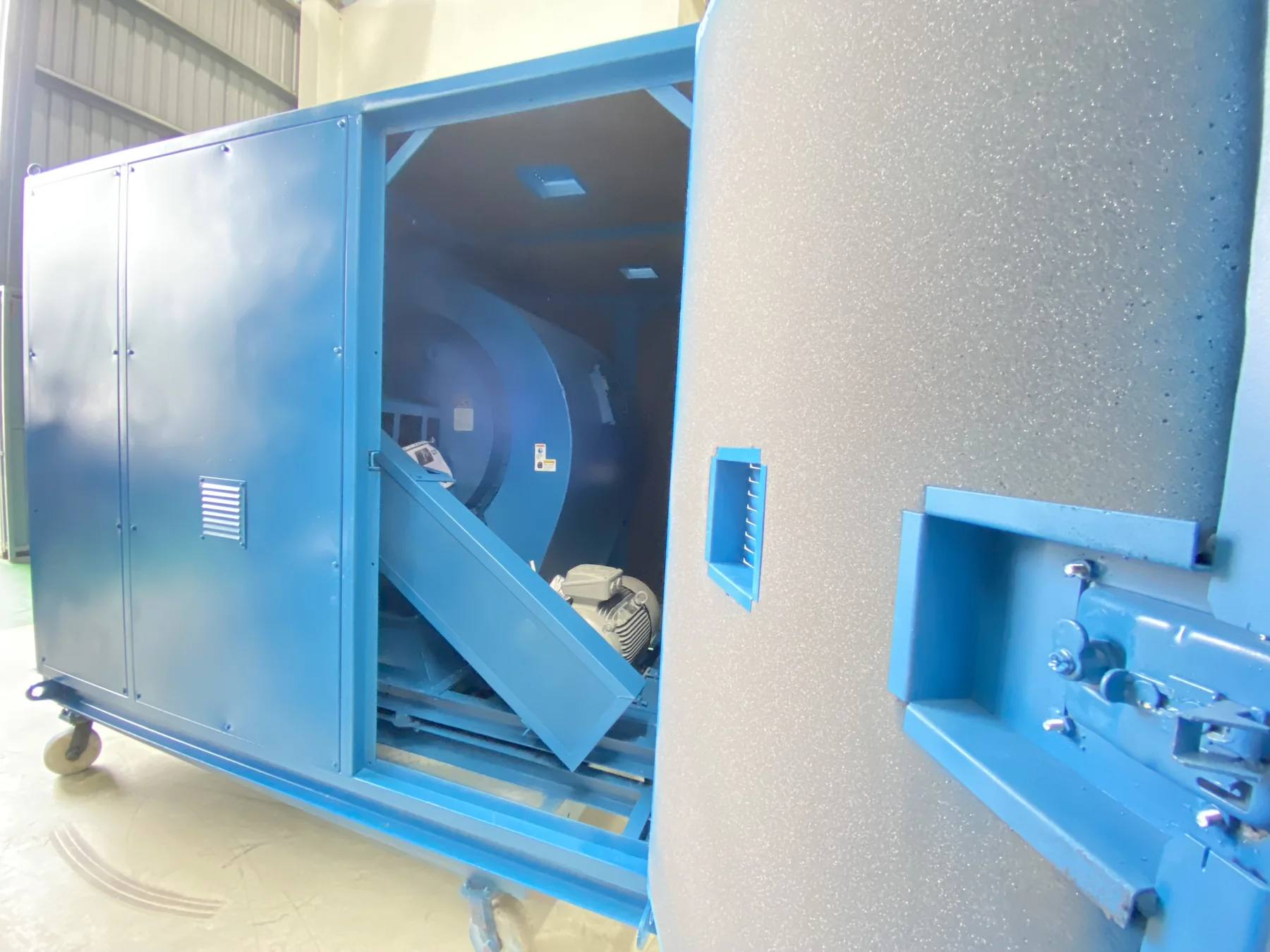
Selecting an EC backward-curved fan is the same exercise as selecting any centrifugal fan. Two numbers put you on the curve; everything after that is the installation, the control interface and the air itself. What changes is that the drive is inside the machine — and a few duties that a steel-bladed fan would take, this one will not.
Selecting an EC backward-curved fan is the same exercise as selecting any centrifugal fan. Two numbers put you on the curve; everything after that is the installation, the control interface and the air itself.
What changes is that the drive is inside the machine, so a few of the questions we ask you are questions a belt-driven fan never raised — and a few duties that a steel-bladed fan would take, this one will not.
We select, supply, install and service them from Ahilyanagar. This page is about how we do the selection, and about the duties where we will tell you to buy something else — often one of our own fans.
Send them as you have them — m³/h, CMH, CFM, Pa, mmWC — and say whether the pressure is static or total, and where in the system it was taken. If you are working from an existing fan’s curve, tell us the speed it was running at, because that is what we scale from.
Both change air density, and density changes flow, pressure and power together. The manufacturer’s specification for the Ø450 frame we hold carries the density-correction formulas explicitly, and it also states an applicable altitude range of under 1,000 m. Ahilyanagar and Pune sit comfortably inside that; a plant in the ghats or further north may not, and we would rather establish that at the enquiry stage than after commissioning.
The operating-temperature band is stated per model, because each model has its own. The model we can evidence in full, the Ø450 high-static frame, is rated −25 to +50 °C. Other frames in the same family are rated differently, and some stop lower at the top of the band. Tell us your inlet temperature and we will confirm the rating against the specific model we are offering, in writing, with the model number on it. If anyone quotes you one temperature band for the whole range, ask them which model it belongs to.
Frame-mounted, venturi-mounted or lifted — the mount is part of the model code, not an accessory chosen later. Give us the plenum opening, the depth available and the route the fan has to travel to get there. For scale, the Ø450 model above sits on a 630 × 630 mm plate with eight Ø11 fixing holes, is about 463.5 mm deep overall and weighs 60 kg. On retrofits the doorway is often the binding constraint.
Ask us; do not assume. Supply is not uniform across the range: every one of the thirteen models in the manufacturer’s cleanroom catalogue is rated 220 VAC, and every one of the ten in the high-static catalogue is rated 380 VAC. For the Ø450 model above, the specification gives 380 VAC rated with an operating range of 380–480 VAC, so India’s 415 V nominal is inside range. We confirm the supply against the model we are quoting.
A panel potentiometer, a controller output, or a BMS. On the Ø450 model the manufacturer’s specification gives a linear 0–10 V DC control input with a usable window of 1.0 ±0.1 V to 9.8 ±0.2 V for a speed range of 600 to 2,550 r/min, and the fan stops when the signal falls below 0.8 V. It also lists speed feedback over RS-485 and fault feedback as a dry contact or over RS-485. It does not name an application protocol — RS-485 is a physical layer — so if your design depends on the fan appearing as a BMS object rather than as an analogue endpoint with a fault contact, raise it in the enquiry and we will confirm it per model before anything is committed. Full detail on EC fan control.
Not to sell you a saving — to size the machine at the duty it will actually spend its life at rather than the one on the nameplate. The payback for this range is worked out on your duty and tariff. Give us your rate and your hours and we will work the arithmetic with you, on your numbers. And tell us your noise limit, and where it is measured — see below, because it matters more than the catalogue number suggests.
Clean, filtered, ambient supply air is the duty this range is built for. Solvent, overspray, abrasive dust, hot gas or a classified area is a different conversation — see the last section.
Fan laws do not change because the motor changed: flow follows speed, pressure the square, power the cube.
What changes is that an EC fan does this natively, from a signal, with no drive panel between the supply and the motor — and it does not have an induction motor’s slip and rotor losses to carry while it does it.
It is worth being precise about what the published data does and does not prove. The manufacturer tabulates the Ø450 fan at two points on its control range — 10 V and 6 V. At free air the 10 V table reads 15,202 m³/h for 4,186 W; the 6 V table reads 10,103 m³/h for 1,229 W. A third less air for a bit over seventy per cent less power.
That is the fan law working exactly as it should, and we will not dress it up as anything more. The 6 V table is an exact similarity scaling of the 10 V table — we checked, and the static-efficiency column is identical row for row, which is what happens when one curve is scaled from another rather than measured separately. So those two rows tell you what speed control does to a fan, on the manufacturer’s own numbers. They do not tell you how this fan compares with an AC machine, and nothing we hold does. What is genuinely different about an EC fan is that this saving is available from a signal, with no drive panel, and with a motor that does not lose efficiency as you slow it — not that the cube law works harder for it.
Two further qualifications. These are the manufacturer’s published figures; we have not independently verified them, and we do not present the derived points as separately measured. And bearing life on this range is quoted as 40,000 hours — but the qualifier is part of the figure: at nominal supply voltage, at full speed, in a 40 °C ambient. The same model is permitted to 50 °C and no life figure is published at 50 °C. We quote it that way or not at all.
When one unit stops, the rest keep running. In a paint line or a pharma AHU the expensive event is rarely the failed fan; it is the stopped process.
You can take fans out of service and slow the remainder, which keeps the running units nearer their better region of the curve instead of dragging one large fan down to a poor one.
Small units go through a standard doorway and into an existing plenum. On more retrofits than we would like to admit, that is the only reason the job is possible at all.
What an array does not do is scale linearly. Lose one fan of six and you do not lose one-sixth of the air, because the system curve moves and the survivors ride up it. If continuity of a specific airflow is the requirement, tell us the flow you must hold with one unit down and we will size for that case, not for the all-running case. Nor does an array bring its own staging logic — that sits in your BMS or your panel.
A single dB(A) figure against a model number is the loudest point on that fan’s curve, and it will not be your point.
The Ø450 fan above, on the same 10 V speed reference, reads 95.2 dB(A) at free air and 85.4 dB(A) at 1,422 Pa — 9.8 dB apart on one machine, at one signal setting, purely from where it sits on the curve. It rises again as the fan is pushed towards shut-off. Slow the fan down and the whole picture shifts again.
Three things follow. Sound pressure is not sound power; the manufacturer’s figures are measured at 1 m from the fan outlet, to GB/T 2888, and a level at 1 m in a wind tunnel is not a level at your operator’s ear in your plant room. We do not hold sound-power or octave-band data for this range, so if you have a contractual noise limit we design to it with attenuation and a site measurement, not with a catalogue number. And an array changes the character of the noise as well as its level — more sources, different blade-pass content — which is a reason to declare the limit early rather than to assume the small fans will be quieter.
We will say so. These are the duties where this range does not belong, read off the manufacturer’s own specification for the frame we hold.
IP54, class F insulation, aluminium-alloy impeller, galvanised-sheet air duct, no spark-protected or explosion-protected construction offered:
For every one of those, the answer is usually a Jitamitra fan: backward-curved and aerofoil for clean high-efficiency duty, radial and radial-tip for loaded and abrasive air, and our own construction for hot gas and hazardous areas. We build both sides of the plant, which is precisely why we can afford to tell you when the imported fan is the wrong one.
Performance and rating figures on this page are the manufacturer’s published data for the model named against them, measured by the manufacturer. They have not been independently verified by Jitamitra and are subject to the manufacturer’s tolerances. Nothing on this page constitutes a warranty given on the manufacturer’s behalf. The binding specification is the one on our quotation for your duty.
Related: EC fans — the range and how they work · EC fan control · Retrofitting an AHU to EC · AHU supply and return · Cleanroom and pharma AHU · Our own centrifugal fan families
Not sure an EC fan is the right machine at all? EC vs AC with a VFD →
Airflow, static pressure, inlet temperature, altitude, supply at the fan, and the noise limit if you have one. That is enough for a real selection rather than a catalogue page — normally within three to five working days.*
Jitamitra Help Desk +91 8329172325 · sales@jitamitrablowers.com
*For our standard range. ATEX and special projects need 5 to 7 working days.
This site sets no cookies of its own. Google Analytics loads only if you accept. It sets two cookies, so we can see which fan topics people actually read. Decline and no analytics loads — the site works exactly the same. What we collect →