Balancing, vibration diagnostics, alignment, installation, commissioning and breakdown response — delivered at your plant, on any make of centrifugal fan. Our engineers work the running machine in place, so downtime stays minimal.
Yes - on-site dynamic balancing, vibration diagnosis, alignment, bearing and shaft work, installation supervision and breakdown attendance, on any make of centrifugal fan. Engineers work the running machine in place, so the fan need not come off its base. Coverage runs from the works at MIDC Ahilyanagar and the office in Pune across three published tiers of industrial belts; the full city list is on this page. Remote and technical response is within 24 to 48 working hours of a documented request.
839 service events over 12 years.
When a fan is bolted to your foundation and tied into your ductwork, the last thing you want is to ship it back to a workshop. Jitamitra brings the workshop to the plant: in-situ balancing to ISO 21940 grades, FFT vibration diagnostics, laser shaft alignment, turnkey installation and controlled commissioning — all on any make of centrifugal fan, not only the ones we build.
Every visit is run by fan engineers who design and manufacture these machines for a living, so a field call reads the whole picture — the fan, the drive, the duct system and the operating point — and hands back a documented before/after record. Whether it is a routine balance, a stubborn vibration no one can pin down, or a breakdown that has stopped the line, the same team finds the real cause and fixes it in place.
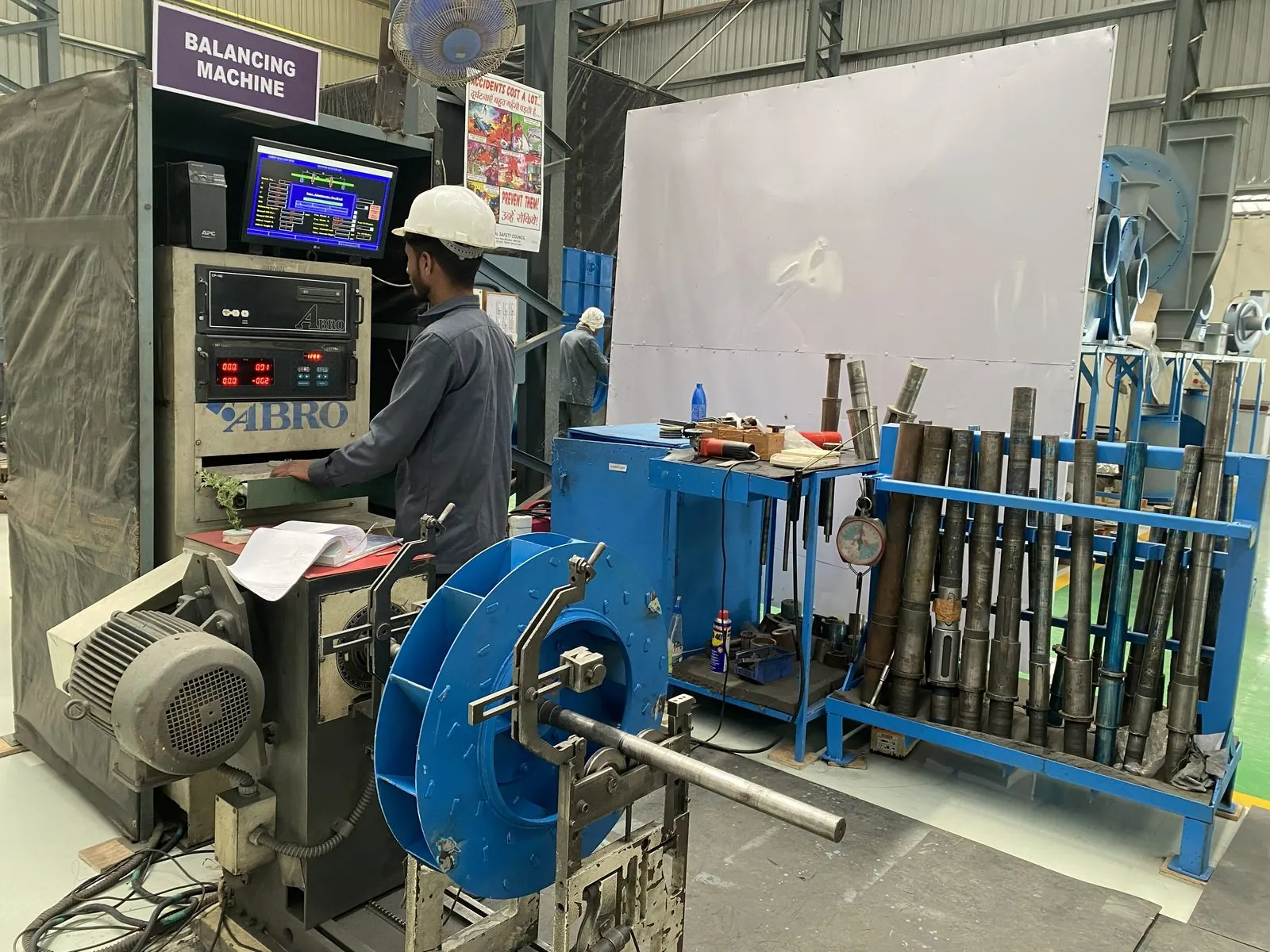
Balance your installed impeller in place — single- or two-plane — using portable tri-axial sensors and an FFT field analyser, trimming correction weights until vibration falls within an accepted grade, with no dismantling or transport. We work to ISO 21940 grades (G6.3 general, G2.5 for API 673 / critical service) and hand back a documented before/after balance report. Any manufacturer's centrifugal fan.
Standard/method. ISO 21940 balance quality grades (G6.3 general, G2.5 critical/API). ISO 14694 in-situ vibration acceptance limits, category BV-3 (velocity mm/s RMS by mounting), measured to ISO 14695. API 673 invokes ISO 21940 for petroleum/chemical/gas-service fans.
Tri-axial vibration capture and FFT spectrum diagnosis to pinpoint imbalance, bearing and looseness faults.
Standard/method. ISO 14695 vibration measurement method; ISO 14694 acceptance limits (velocity mm/s RMS by category and mounting). ISO 14694 fan vibration categories and causes-of-vibration framework. Cross-references ISO 21940 balance grades where imbalance is the diagnosed cause.
Align the fan-to-motor coupling with laser/detector heads, correcting soft-foot first, then shimming and shifting the motor until both parallel offset and angular misalignment sit within tolerance. We verify the result against ISO 14694 in-situ acceptance (BV-3) and hand over an alignment report with the final offset and angle figures. Any make of direct-coupled or belt-driven fan set.
Standard/method. ISO 14694 in-situ vibration acceptance, category BV-3 (velocity mm/s RMS), used to verify alignment quality. Aligns with the same vibration/balance framework (ISO 21940 grades) that governs smooth fan running; misalignment is a named cause in the ISO 14694 / Fan Manual vibration framework.
A capability under development: high-speed camera capture with motion-amplification processing that makes a running fan's sub-visible movement visible, exposing looseness and structural resonance across the whole structure that single-point sensors miss — a visual layer over conventional vibration diagnostics. Offered on enquiry as a roadmap item; today the same looseness and resonance faults are pinpointed by our delivered vibration-analysis and troubleshooting services.
Standard/method. Would complement ISO 14694 / ISO 14695 vibration-assessment practice and ISO 21940/1940-1 balance grades used in the conventional diagnostics it supports. No standard is claimed for the MAVD method itself as delivered, because it is not currently delivered.
Diagnostic service finding root cause of airflow shortfall, noise, vibration or repeat failures.
Standard/method. ISO 14694 for vibration causes and acceptance limits (BV-3), measured to ISO 14695; ISO 21940 balance grades (G6.3 general, G2.5 API/critical) where re-balance is the fix; AMCA 201 system-effect concepts and AMCA 210 / ISO 5801 performance basis for diagnosing duty shortfall; AMCA Environmental Noise / ISO 13347 octave-band framework for noise diagnosis.
Diagnose your fan remotely — over a video call where your technician measures on camera, an app-based ticket or a phone line — working the same structured checks as an on-site visit: rotation, damper position, deposit imbalance, bearing temperature, vibration and surge signatures. We resolve what can be resolved live (wrong rotation, damper, belt slip) and pre-scope the parts and visit for anything that can't, closing out a logged ticket with the diagnosis and recommended action. Any make of centrifugal fan.
Standard/method. No formal external certification applies to remote support itself. The diagnostic basis references ISO 14694 / ISO 14695 vibration practice and Jitamitra's troubleshooting manual; any follow-on physical work carries the standards of that service (balancing, testing, repair).
Mount wireless vibration and temperature sensors on the bearing housings and casing to stream continuous data to a cloud dashboard, with alert thresholds set from real fan engineering — bearing-temperature limits and ISO 14694 BV-3 vibration bands — so a drifting reading flags a developing fault weeks early. Offered as a subscription and delivered with a specialist sensor/cloud partner, it turns an emergency breakdown into a planned, cheaper repair. Any make of centrifugal fan.
Standard/method. ISO 14694 vibration acceptance limits, category BV-3 (mm/s RMS on bearing-support housings) and ISO 21940 / 1940-1 balance context underpin the vibration thresholds; bearing temperature limits per Jitamitra's maintenance manual / FE-3200 high-temperature practice.
Respond to a breakdown by mobilising a crew to site, root-causing the failure with the same structured field-diagnostic method as our troubleshooting service, then removing, repairing and reinstalling the fan — shafts, bearings, impeller — and re-balancing to ISO 21940 (G6.3 general, G2.5 critical) before restart. We respect critical-stop indicators such as a cracked impeller or a bearing over 110 °C, and commit only to a response time we can actually meet. Any make of centrifugal fan.
Standard/method. Repair and re-balance follow ISO 21940 (G6.3 general, G2.5 critical); vibration acceptance to ISO 14694 (BV-3) where applicable; diagnostic method per Jitamitra Manual Section 8. No certification of a response-time SLA is claimed.
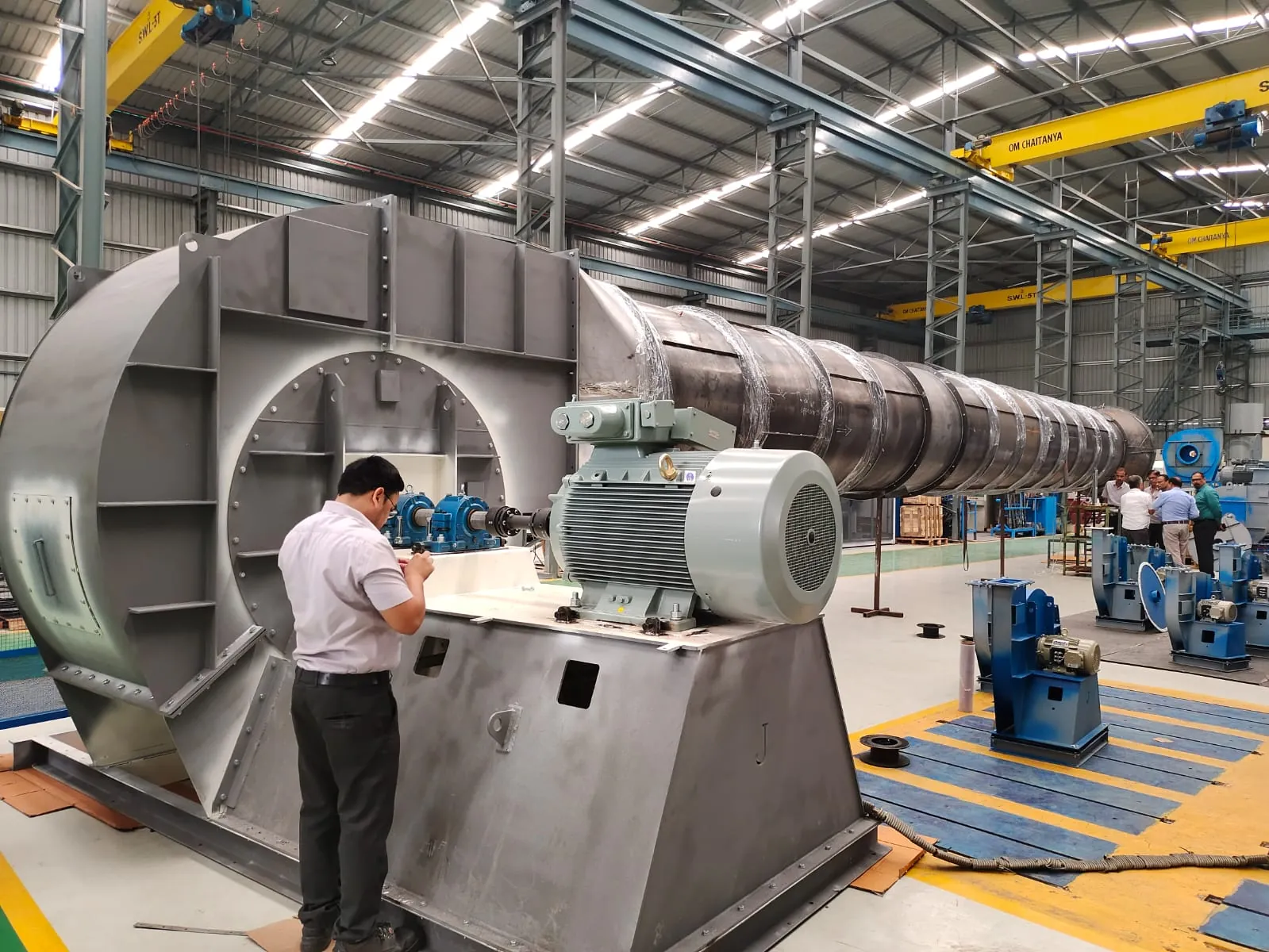
We rig, level, anchor and grout the fan to its foundation, fit the drive and anti-vibration mounts, and tie it into your inlet and discharge ducting — preserving the straight inlet run that protects rated performance. First-run coupling alignment and vibration are verified to ISO 14694 acceptance (BV-3). You receive a documented installation and handover record, on any make of centrifugal fan.
Standard/method. Installation follows AMCA 201 system-effect guidance (straight inlet duct / turning vanes to protect rated performance) and ISO 14694 vibration acceptance (BV-3) on first run. Coupling alignment supports both the ISO 21940 balance grade and the ISO 14694 vibration limit. SAC 995463 for the installation service classification.
We station our engineer at your crew's critical hold points — foundation and levelling, rotor and impeller-to-cone clearances, coupling alignment, soft-foot and duct tie-in — and witness and sign off every bolt torque. Checks apply AMCA 201 system-effect practice and ISO 14694 first-run acceptance (BV-3). You keep the cost advantage of your own labour and get a signed hold-point checklist, on any make of fan.
Standard/method. Hold-point checks apply AMCA 201 system-effect practice (inlet straight-run / turning vanes) and ISO 14694 first-run vibration acceptance (BV-3); coupling alignment supports both the ISO 21940 balance grade and the ISO 14694 vibration limit. SAC 995463 for the installation-service classification.
We run the pre-start checklist — rotation, clearances, torques, lubrication, damper position — then start the fan correctly for its type, holding high-inertia and hot-gas wheels against a closed or 10–20% open damper to avoid surge and cold-start trip. First-run vibration and bearing temperatures are taken, the fan is tuned to its duty point, and acceptance is confirmed to ISO 14694 (BV-3). You receive a documented commissioning checklist and first-run report, on any make of fan.
Standard/method. First-run vibration acceptance per ISO 14694, category BV-3 (velocity mm/s RMS by mounting); balance/smooth-running framework per ISO 21940; start and damper practice per the Fan Manual; relates to AMCA 210 / ISO 5801 rated-duty basis when confirming the fan reaches its duty point. SAC 995463 for the service classification.
Measure and re-engineer the whole airside path, ducting, dust collector, stack and draft, not just the fan. · engineered on request
Standard/method. AMCA 201 (Fans and Systems - System Effect Factors, the basis for duct-loss diagnosis); AMCA 210 / ISO 5801 air-performance measurement principles applied with portable field instruments; AMCA 203 field-test method as the reference for on-site airside measurement. Note that AMCA 201 full System Effect Factor tables are a documented purchase gap, so quantified factors are engineered case by case.
We can own the full fan scope of a plant shutdown end to end — inspection against wear criteria, impeller replacement, hardfacing, bearing and shaft renewal, balancing to ISO 21940 (G6.3 / G2.5), laser alignment and re-commissioning — sequenced to fit the outage window. A staged plan-execute-verify-report method with pre-staged spares gives you one accountable party and a post-outage record. The constituent repairs are delivered services today; the turnkey wrapper is engineered to your shutdown on request, across any make in the fleet.
Standard/method. Work elements carry their own standards: ISO 21940 / 1940-1 balance grades (G6.3 / G2.5), ISO 14694 vibration acceptance (BV-3) on re-commissioning, AMCA 210 / ISO 5801 performance basis, and Jitamitra's maintenance-manual repair and wear criteria. No outage-specific certification is implied; the offering is a project wrapper over these.
Field calls where we found the real cause in place.
~23,000 CMH · 150 mmWC · 25 HP class
On-site balancing — any make
FD & ID fans · ~18–25 HP class
Vibration root-cause — any make
~15,000 CMH · 350 mmWC · 30 HP
Field diagnosis — proved on-spec
~7,500 CMH · 280 mmWC
No-fault-found diagnosis
~15,000 CMH · 750 mmWC · 75 HP
Commissioning support
Centrifugal blower
Field vibration diagnosis
A stopped fan is a stopped line, so the clock that matters is the one before anyone travels. We answer first and travel second — and a good number of faults never need the visit at all.
We acknowledge your complaint by email and come back to you on a voice or video call within 3 hours, inside service hours. Our service engineers are trained to take the information and, wherever the fault allows it, solve it on that call — which saves you a site visit and a day of production. That is the point of the call, not a formality before one.
These four things decide whether we can settle it on the phone or have to send someone:
Both figures assume two things outside our control, and we would rather state them than miss them: the machine is available for shutdown for inspection and repair, and travel and accommodation can be arranged without delay. Tell us early if either is a problem and we will plan around it.
09:00–18:00 on working days. Urgent calls outside those hours are answered — a fan that stops at midnight does not wait for Monday — and are charged at a premium rate.
Charged per engineer-day, plus travel and accommodation at actuals. You get the figure before anyone travels, not after.
Standard servicing charges apply if the complaint is found not to be a manufacturing or design related matter — judged on the complaint information received and the inspection carried out by our service engineer. Where it is ours, it is ours, and we do not invoice you for it.
Most field failures are not manufacturing defects. In our own service record the largest recurring causes are transport and handling damage, installation and commissioning error, and normal wear — which is exactly why the inspection decides it rather than an argument.
The response commitments are above; this is the geography behind them. Three tiers, and no city is on the list because we would like to be there.
Belts our service engineers are in routinely. Site attendance here is ordinary work, planned around your shutdown.
Thane · Bhiwandi · Navi Mumbai · Taloja · Pune · Chakan · Pimpri · Ranjangaon · Silvassa · Vapi · Nashik · Satara · Ahilyanagar · Surat · Hazira · Chhatrapati Sambhajinagar · Bharuch · Ankleshwar · Dahej · Kolhapur · Sangli · Bhavnagar · Jalgaon · Solapur · Vadodara · Belagavi · Rajkot · Goa · Ahmedabad · Sanand · Morbi · Hubballi · Dharwad · Jamnagar
Centres we travel to for site work. We schedule the visit with you rather than promising an engineer the same week.
Mehsana · Indore · Pithampur · Ratlam · Gandhidham · Mundra · Dewas · Udaipur · Hyderabad · Bhopal · Nagpur · Mangaluru · Bhilwara · Kota · Ajmer · Bengaluru · Jabalpur · Hosur · Jaipur · Raipur · Bhilai · Gwalior · Malanpur · Coimbatore
We attend on request. Tell us the machine and the window, and we come back with a dated plan before anyone travels.
Chennai · Sriperumbudur · Agra · Neemrana · Bhiwadi · Visakhapatnam · Kanpur · Gurugram · Manesar · Faridabad · Delhi · Noida · Madurai · Rourkela · Ludhiana · Jamshedpur
Breakdown response and what to have ready · Aftermarket & repair — any make · Talk to the desk
Flow, static, gas temperature, application — or attach a spec, GA drawing or a multi-fan schedule. Engineer to engineer.
ISO 9001:2015 quality system · performance-tested to IS 4894 / ISO 5801 / AMCA 210 method · witnessed FAT on request.
*For our standard range. ATEX and special projects need 5 to 7 working days.
Free field guides from our service engineers — for fans of any make.
This site sets no cookies of its own. Google Analytics loads only if you accept. It sets two cookies, so we can see which fan topics people actually read. Decline and no analytics loads — the site works exactly the same. What we collect →