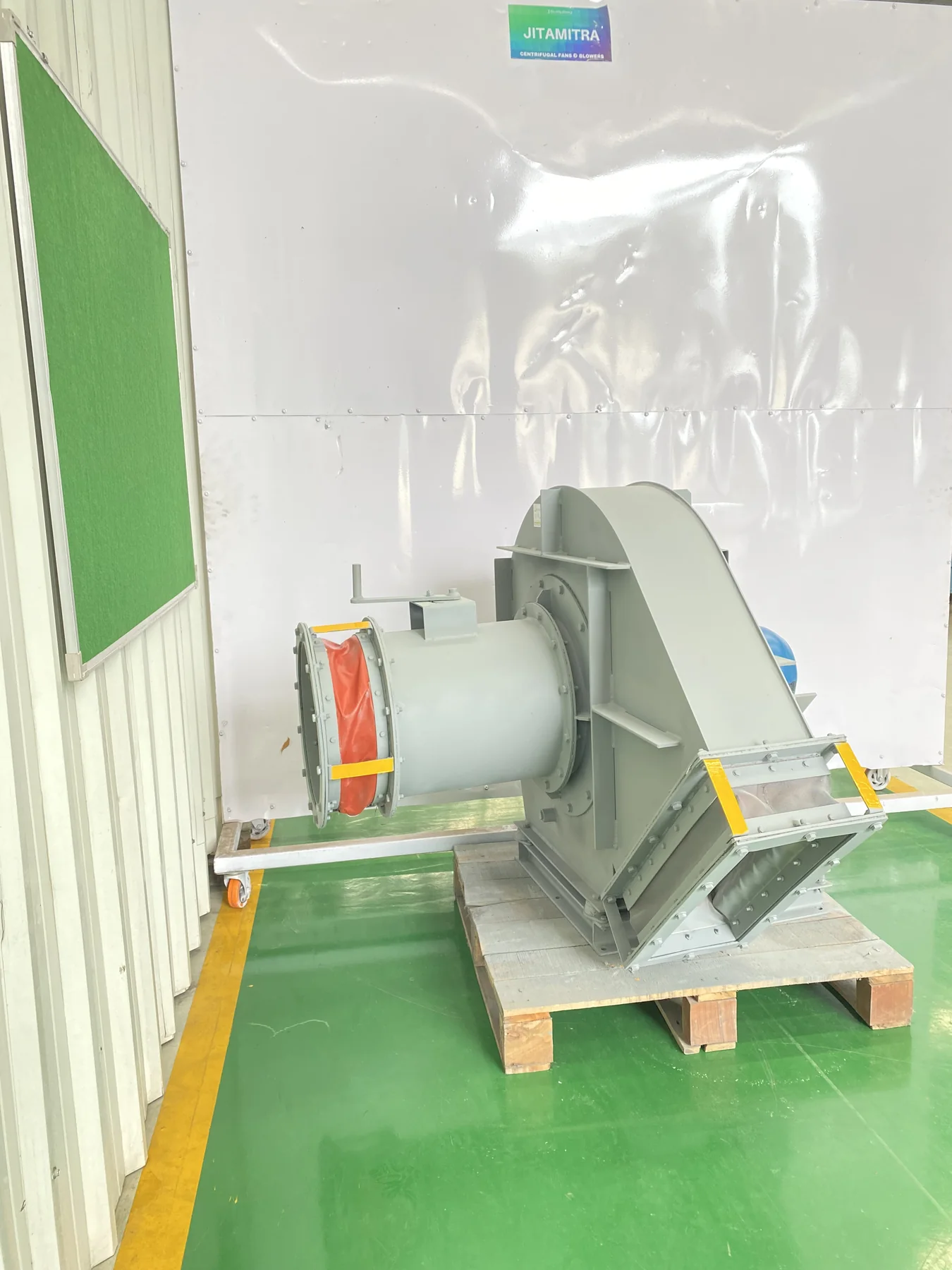
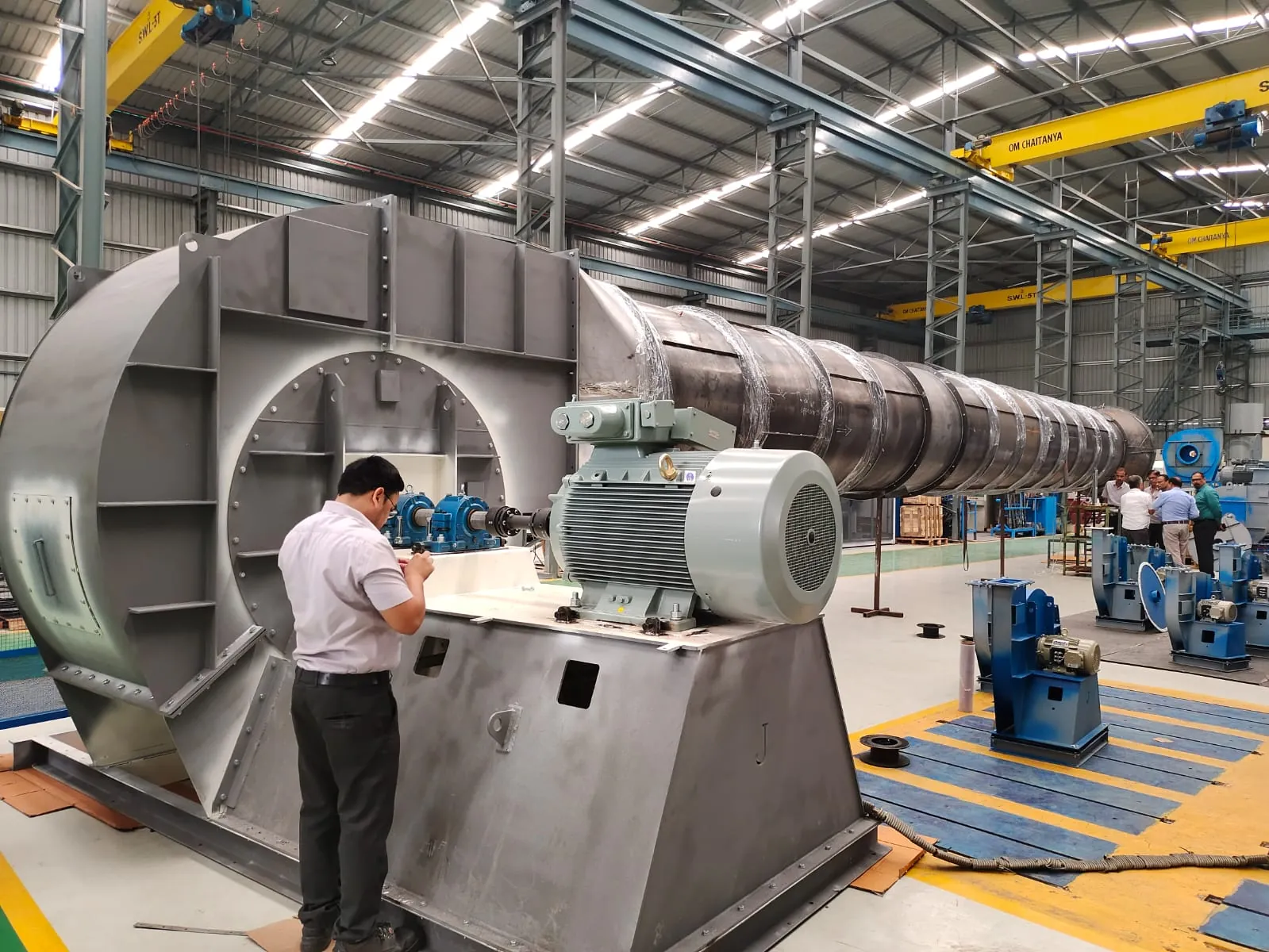
Clean-air centrifugal process blower for a fuel-cell / hydrogen system on the Jitamitra shop floor
Home  /  Applications  /  Fuel-cell / hydrogen process air
Applications

Fuel-cell / hydrogen process-air blowers — clean air, tight control, hydrogen-safe.

A fuel-cell / hydrogen process-air blower feeds cathode and process air, or ventilates a hydrogen enclosure, in a fuel-cell or electrolyser system. The air must be clean and oil-free so it does not poison the catalyst or foul the membrane; the flow must track cell load closely; and where hydrogen can be present the whole build has to be ignition-safe. We engineer these blowers to your stack, balance-of-plant and area classification — clean controlled air, high static at modest flow, ATEX self-declared where the zone calls for it — across the envelope below, up to 2,00,000 CMH, 2,000 mmWC and 400 HP.

2,00,000CMH max flow
2,000mmWC max static
Zone 2ATEX self-declared
400 HPdrive power
15,000+
fans built since 2011
200 HP
VFD test rig · IS 4894 / AMCA 210
99%
on-time delivery
3
working days to quote — always
OIL-FREE CLEAN AIR · TIGHT FLOW CONTROL · HIGH STATIC AT MODEST FLOW · HYDROGEN-SAFE
What it does

Two duties around the stack — feed clean cathode air, and keep the hydrogen space safe.

A fuel-cell / hydrogen process-air blower does one of two jobs. On the cathode side it delivers clean, oil-free process air to the stack at the flow the cell needs for the current it is drawing. On the balance-of-plant side it ventilates the hydrogen-bearing enclosure so any leak is diluted below its lower flammable limit. Both jobs are clean-air, control-critical and safety-critical — the engineering is in the precision, not in surviving abrasion.

  • 01
    Feed

    Clean, oil-free process air to the cathode, tracking cell load. Cathode stoichiometry typically runs 1.5–2.5× the reacting-air demand, so the blower delivers a controlled flow that rises and falls with the current the stack draws.

  • 02
    Control

    Flow and pressure held to a tight band across load transients — typically ±3–5% on flow — because a starved or flooded cathode costs efficiency and stack life. Speed control (VFD or EC) is the default, not a throttling damper.

  • 03
    Ventilate safely

    Where hydrogen can be present, dilute any leak below 25% of its lower flammable limit (LFL 4% vol H₂ in air) with a defined air-change rate, in an ignition-safe build sized to the enclosure and the area classification.

INDUCED-DRAFT CENTRIFUGAL FAN Single-width single-inlet — scroll cut away to reveal the impeller inlet expansion joint MOTOR IE3 / VFD GAS IN GAS OUT n 1 2 3 4 5 6 7 8 9 10 1 Inlet cone (bell-mouth) 2 Backward-curved / radial-tipped impeller 3 Spiral volute casing 4 Replaceable AR wear plates (volute throat) 5 Shaft 6 Plummer-block bearings (L10 ≥ 40,000 h) 7 Shaft cooling disc (>400 °C duty) 8 Pedestal / base frame 9 Drive — motor + coupling 10 Outlet flange + duct take-off
Fig. 1Fuel-cell process-air blower — single-width single-inlet, scroll cut away to reveal the backward-curved impeller and the shaft-seal detail. Numbered components keyed below the drawing.
Why it is hard

Clean air is the easy part — control precision, hydrogen safety and air integrity are not.

The airstream is clean, so nothing erodes or corrodes the wheel. The difficulty is elsewhere: the flow has to track cell load within a few percent or the stack suffers, the build has to stay ignition-safe wherever hydrogen can reach, and the air must arrive oil-free so it never poisons the catalyst. Miss any one and the fan is quietly wrong — the stack loses efficiency and life long before the fan itself shows a symptom.

01 — CONTROL

Flow control across load transients

Cathode air demand swings with stack current, and a fan sized onto the flat or rising part of its curve wanders under back-pressure change — over-feeding dries the membrane, under-feeding starves the cathode. Both cost stack efficiency and life.

How we engineer it out

Duty point engineered onto the falling, stable portion of the curve, with a backward-curved / backward-inclined wheel for a steep, predictable pressure–flow line; VFD or EC speed control as default so flow tracks load to within ±3–5% instead of throttling against a damper.

02 — HYDROGEN

Ignition safety where hydrogen can be present

Hydrogen has a wide flammable range (4–75% vol in air) and a very low ignition energy, so on the ventilation duty and any leak-exposed path a spark from ferrous rub or a hot bearing is a real ignition source.

How we engineer it out

ATEX Zone 2 self-declared per 2014/34/EU (Category 3G) with spark-resistant construction per AMCA 99 — non-sparking impeller, non-ferrous rub ring, bonded earthing throughout, anti-static coatings and bearing-temperature control — matched to the gas-group and area classification you declare.

03 — AIR INTEGRITY

Oil-free, contaminant-free process air

The cathode catalyst and the membrane are poisoned by oil mist, and degraded by carried-over particulate. A fan that leaks bearing oil into the airstream, or a build that sheds contaminant, damages the stack irreversibly.

How we engineer it out

Oil-free flow path with a shaft seal chosen to keep lubricant out of the air, non-shedding internal finish, stainless or coated wetted surfaces on demanding builds, and a clean-assembly regime so the air reaching the stack is as clean as it left the filter.

How we design for it

Every choice is documented on the GA drawing you sign off — before we cut metal.

We don't sell a catalogue near-fit. The blower is engineered to your stack duty, control band, area classification and cleanliness requirement — made to order, not off a shelf.

  • Impeller geometry & control — Backward-curved or backward-inclined wheel for a steep, stable curve and high static efficiency (higher on airfoil high-efficiency builds); VFD or EC speed control as default so cathode-air flow tracks stack load to within ±3–5% instead of throttling.
  • Hydrogen-safe construction — Spark-resistant construction per AMCA 99 (Type A / B / C to the risk) with ATEX Zone 2 self-declared per 2014/34/EU (Cat 3G) where the zone calls for it — non-sparking impeller, non-ferrous rub ring, bonded earthing and bearing-temperature control, sized to the gas-group you declare.
  • Clean-air integrity — Oil-free flow path; shaft seal selected to keep lubricant out of the airstream; non-shedding internal finish; stainless or coated wetted surfaces where the process demands, so the air reaching the cathode does not poison the catalyst or foul the membrane.
  • Ventilation sizing — For enclosure ventilation the air-change rate is set to dilute a credible hydrogen leak below 25% of the LFL (4% vol), with the fan sized for the enclosure volume, the leak case and the duct resistance — not a nominal air-changes-per-hour figure.
Engineered to your duty point

We size the blower onto the stable side of its curve — then prove it on the rig.

No catalogue fan forced onto your spec. Your operating point is engineered onto the falling, stable portion of the selected wheel — where flow tracks predictably with speed — and verified on the 200 HP VFD test rig before dispatch, so the control band you specified is the control band you get.

avoid: unstable 0 40,000 80,000 1,20,000 1,60,000 2,00,000 VOLUME FLOW RATE  [ CMH ] 0 500 1000 1500 2000 STATIC PRESSURE  [ mmWC ] 0 25 50 75 100 STATIC EFFICIENCY  [ % ] Fan static pressure System resistance Static efficiency BEP 82% DUTY POINT 1,20,000 CMH · 450 mmWC Fan static pressure System resistance Static efficiency
Fig. 2Representative process-air-blower characteristic — fan static pressure, system resistance and static efficiency vs. flow, with the duty point engineered onto the falling, stable region and the control band marked. Illustrative; every blower is sized to its own duty.
Capability envelope — fuel-cell / hydrogen process-air service

What we can supply, and where it stretches on application.

ParameterStandardOn application
Volume flowup to 2,00,000 CMHtypically modest flow at high static; higher on enquiry
Static pressureup to 2,000 mmWChigh static at modest flow is the typical duty
Air cleanlinessoil-free flow path, non-shedding finishstainless / coated wetted surfaces on demanding builds
Flow-control band±3–5% on VFD / EC speed controltighter with closed-loop control on application
Construction (ignition)AMCA 99 spark-resistant + ATEX Zone 2 (Cat 3G) self-declaredZone 1 (Cat 2G) on application via Notified-Body partner
Drive powerup to 400 HPhigher with custom motor sourcing
Static efficiencyhigh static efficiencyhigher on high-efficiency airfoil builds
Balance qualityISO 21940 G6.3G2.5 / G1.0 on application

The envelope above covers the great majority of fuel-cell and hydrogen process-air duty, which typically sits at modest flow and high static rather than near the flow ceiling. The airstream is clean, so wear protection is not required; the design effort goes into flow-control precision, oil-free air integrity and ignition safety. Where hydrogen can be present the build is spark-resistant per AMCA 99 with ATEX Zone 2 (Cat 3G) self-declared per 2014/34/EU; Zone 1 (Cat 2G) is available on application via a Notified-Body partner. Bearing life is a design target of L10h ≥ 40,000 h continuous, longer on application. For duty beyond the envelope we engineer to spec and quote on enquiry.

How a Jitamitra FCHP fan is specified

Specified, not picked from a shelf.

The same engineering language carries from your enquiry to the GA drawing to the nameplate — expressed in the standard AMCA conventions, with the spark-resistant and ATEX marking alongside.

Specification fieldOptions
Arrangement (AMCA 99)Arr. 1 (overhung, fan bearings) / Arr. 4 (direct, motor on base) / Arr. 8 (overhung on common base) / Arr. 9 (overhung, motor side) / Arr. 10 (overhung, motor inside base) — selected by drive, access and enclosure footprint.
Width / inletSWSI (single width, single inlet) default for process-air duty; DWDI (double width, double inlet) for higher flow at moderate pressure on larger balance-of-plant ventilation.
Wheel typeBackward-curved or backward-inclined (default — steep stable curve, best efficiency on clean air) / airfoil-bladed (highest efficiency on large continuous-duty builds).
Spark-resistant construction (AMCA 99)Type A (all non-ferrous parts in the airstream) / Type B (non-ferrous rub ring and non-ferrous parts across the shaft opening) / Type C (aligned construction preventing ferrous rotating-to-stationary contact) — selected to the hydrogen ignition risk.
ATEX scopeZone 2 self-declared (Cat 3G) per 2014/34/EU for hydrogen-exposed duty — non-sparking impeller, non-ferrous rub ring, bonded earthing throughout, anti-static coatings and bearing-temperature control, matched to gas group IIC. Zone 1 (Cat 2G) on application via a Notified-Body partner.
Materials of constructionMild steel + epoxy coating (standard clean-air build) / 304 or 316L stainless where the process or ambient demands / non-ferrous parts in the flow path for spark resistance / non-shedding internal finish for cathode-air cleanliness.
DriveDirect-coupled / V-belt / VFD or EC (default for flow tracking across stack load). Drive up to 400 HP across the envelope; speed typically 600–1,800 RPM.
Accessories & acoustic scopeOil-free shaft seal; inlet filtration interface for cathode-air cleanliness; VFD / EC control and instrumentation interface; inlet and outlet silencers with acoustic-lagged casing (down to <75 dB(A)) for occupied plant-room duty; flexible connections; drain and inspection doors.
The proof, not the promise

We test before we ship — and you're welcome to witness it.

Every job's performance is verified at our works on the 200 HP VFD test rig, to the AMCA 210 / ISO 5801 method, before dispatch.

  • Customer-witnessed FAT on request — at no extra cost
  • Rotors balanced to ISO 21940 G6.3 as standard (G2.5 / G1.0 on application) before they leave the floor
  • Full NDT in-house — DP, MPI, UT, RT — to what the duty demands
30+ INDUSTRIES · 45 APPLICATION / DUTY TYPES
Where these blowers run

Engineered for clean, controlled, hydrogen-safe air.

Renewable Hydrogen

Electrolyser balance-of-plant ventilation, fuel-cell cathode / process-air supply, hydrogen-enclosure dilution ventilation.

Battery & EV Manufacturing

Fuel-cell test-cell process air, dry-room and enclosure ventilation on hydrogen-adjacent lines.

Chemicals & Petrochem

Hydrogen-handling area ventilation, process-air supply to fuel-cell CHP and pilot units.

Semiconductor & Electronics

Clean, oil-free process-air and enclosure-ventilation duty around hydrogen-using process tools.

Power Generation

Stationary fuel-cell and CHP cathode-air blowers, ancillary ventilation for hydrogen skids.

Oil & Gas

Hydrogen-blending and refuelling-skid ventilation, process-air supply on fuel-cell backup power.

Research & Pilot Plant

Fuel-cell and electrolyser R&D rigs needing tight flow control and a documented hydrogen-safe build.

Your process

45 application/duty types engineered. Tell us yours.

Standards & conformity

Stated precisely — because procurement checks.

What our marks mean, in the words that survive an audit.

Performance

Tested to the AMCA 210 / ISO 5801 method, in-house on our 200 HP VFD rig. Tested-to-method — not AMCA-certified.

Quality system

ISO 9001:2015 — third-party certified. Our only third-party certification.

CE conformity

Self-declared per 2006/42/EC + 2014/35/EU (Module A). A self-declaration, not a notified-body certificate.

ATEX conformity

Self-declared, Zone 2/22, Category 3, per 2014/34/EU, where the area classification calls for it.

Oil & gas duty

Designed and built to API 673 as project-specific scope.

Welding

ASME Sec IX qualified welders + WPS for every joint.

Balance

ISO 21940 — G6.3 minimum, G2.5 / G1.0 on application.

Vibration

ISO 20816 evaluation; ISO 14694 for fan-specific limits.

Lead time & process

From enquiry to a tested fan on your dock.

StageStandard dutyAPI-673 / engineered
Offer / quotation3 working days — always7–10 working days
GA drawing for approval2–3 weeks from PO3–4 weeks from PO
Manufacture + balance + paint6–10 weeks10–14 weeks
Performance test + witnessed FAT~1 week1–2 weeks
Order-to-dispatch (total)9–14 weeks14–20 weeks

Shutdown-driven replacements: we have shipped fans within 6 weeks of a clean PO. Tell us your shutdown window and we commit to a dated plan.

Questions engineers ask

The eight we hear most before a PO.

Do you have a track record on fuel-cell and hydrogen process-air duty?
We engineer to this duty rather than claiming a long reference list on it. This is a capability page: the blower is designed to your stack, balance-of-plant and area classification using the same custom-engineering method and the same 200 HP VFD test rig we use across every other application. Send us the duty point, the control band, the cleanliness requirement and the area classification, and we engineer and quote to it. We would rather name that boundary honestly than imply installs we have not done.
How tightly can you hold cathode-air flow as the stack load changes?
We engineer the duty point onto the falling, stable portion of the pressure-flow curve and use a backward-curved or backward-inclined wheel for a steep, predictable line, so flow tracks speed cleanly. With VFD or EC speed control as the default we hold flow to within roughly plus or minus 3 to 5 percent across load transients, and tighter with closed-loop control on the balance-of-plant side. We size onto the stable side deliberately so the cathode is neither starved nor over-fed as the current swings, and we verify the curve on the 200 HP VFD test rig before dispatch.
How do you make the blower hydrogen-safe?
Where hydrogen can be present we build spark-resistant construction to AMCA 99 and self-declare ATEX Zone 2 per 2014/34/EU, Category 3G, matched to the gas group and area classification you declare. The configuration uses a non-sparking impeller, a non-ferrous rub ring, bonded earthing throughout, anti-static coatings and bearing-temperature control. Hydrogen has a wide flammable range (4 to 75 percent by volume in air) and a low ignition energy, so we treat every leak-exposed path as an ignition risk and design it out. Zone 1 (Category 2G) is available on application via a Notified-Body partner.
Why does oil-free, clean process air matter, and how do you guarantee it?
The cathode catalyst is poisoned by oil mist and the membrane is degraded by carried-over particulate, and that damage is irreversible. We build an oil-free flow path with a shaft seal chosen to keep lubricant out of the airstream, a non-shedding internal finish, and stainless or coated wetted surfaces where the process demands it, assembled under a clean regime. The blower moves the air; keeping it clean is a system job, so we also document the inlet-filtration interface so the air reaching the stack is as clean as it left the filter.
How do you size the ventilation fan for a hydrogen enclosure?
We size the air-change rate to dilute a credible hydrogen leak below 25 percent of its lower flammable limit, which for hydrogen is 4 percent by volume in air, using the enclosure volume, the leak case you provide and the actual duct resistance rather than a nominal air-changes-per-hour figure. The fan is a spark-resistant, ATEX Zone 2 self-declared build so it is safe in the space it is protecting. Give us the enclosure geometry, the worst-case leak rate and the classification, and we size the flow and the build to it.
What flow and pressure range do these blowers cover?
Across the standard envelope up to 2,00,000 CMH, 2,000 mmWC and 400 HP, but fuel-cell and hydrogen process-air duty typically sits at modest flow and high static rather than near the flow ceiling. High static at a controlled, modest flow is the usual shape of this duty, so we select a wheel with a steep stable curve for it. Tell us your flow, static and control band and we engineer the selection to sit on the stable side of the curve at your operating point.
Can you meet a sound limit for a plant room or test cell?
Yes. As standard we design to below 85 dB(A) at 1 m; below 80 dB(A) is achievable with inlet and outlet silencers plus an acoustic-treated casing, and below 75 dB(A) with a custom acoustic enclosure. Fuel-cell and electrolyser systems often sit in occupied plant rooms or test cells, so we predict the sound level for the selection and engineer the acoustic scope to your stated limit and the space the blower sits in.
Do you build these to CE and ATEX, and what standards actually apply?
Yes. CE is self-declared per 2006/42/EC and 2014/35/EU, and ATEX Zone 2/22 is self-declared per 2014/34/EU (Category 3) where the area classification calls for it, with Zone 1 available on application via a Notified-Body partner. To be precise: those are self-declarations of conformity, not third-party certifications. Performance is tested in-house to the AMCA 210 / ISO 5801 method on our 200 HP VFD test rig, not AMCA-certified, and we are not an AMCA member. Balance is to ISO 21940 G6.3 as standard, G2.5 or G1.0 on application. Our only third-party certification is ISO 9001:2015.

Across the range

Where fuel-cell / hydrogen process air fans fit — the fans that run them, related duties, and the industries served.

The same engineering, viewed three ways — by fan family, by duty, and by industry. Follow the cross-references.

Take it further

Specs an engineer can use — not a brochure.

Engineer to engineer

Send us the duty point.
We'll quote in 3 working days — always.

No model numbers needed. Give us the operating conditions — flow, static, gas temperature, composition, particulate, and any tender standard — and our application engineers size the fan and quote it. Attach a spec or GA if you have one.

+91 90110 09155  ·  mihir.jitamitra@gmail.com