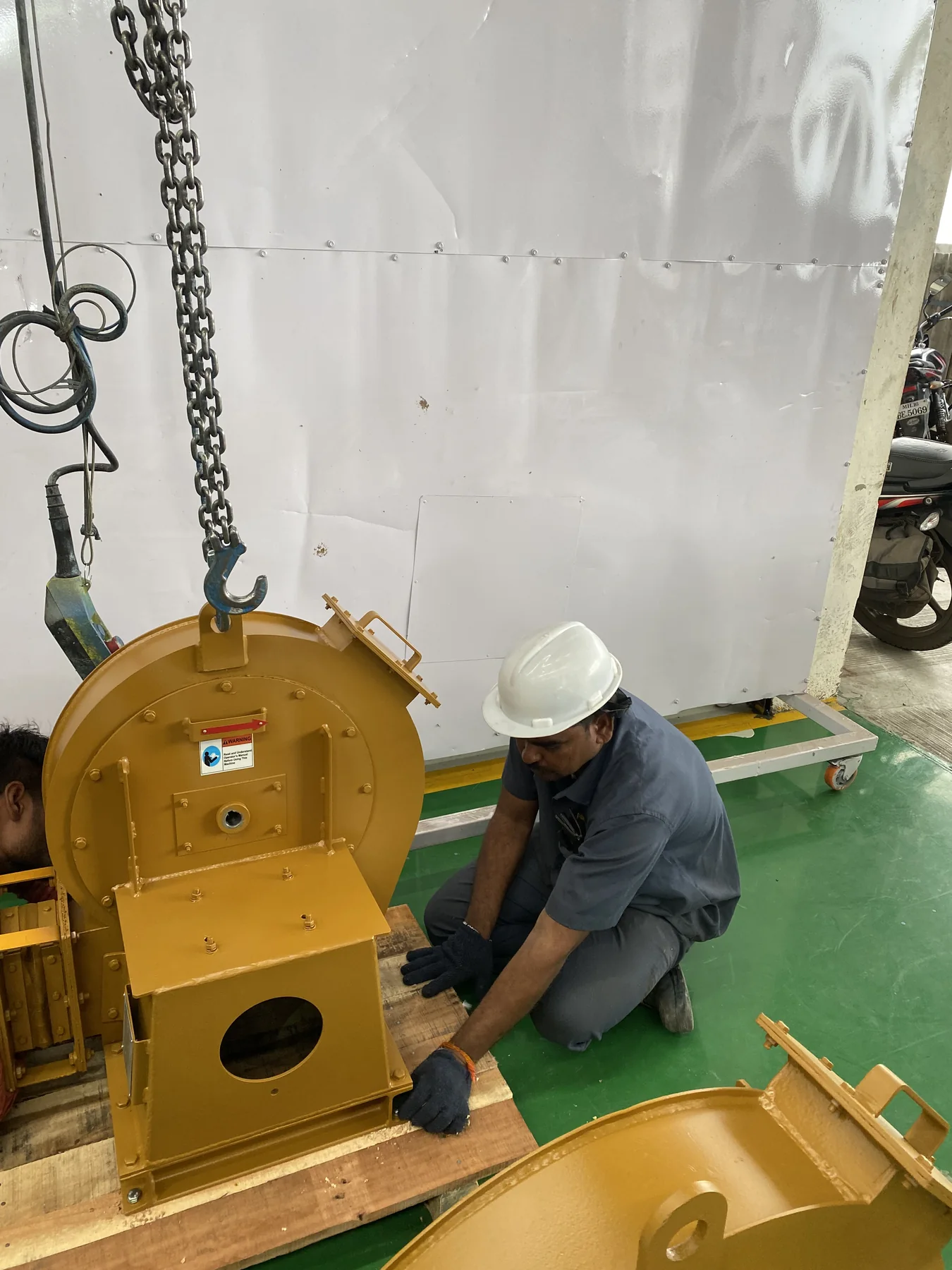
The manufacturer’s own record of the job shows the sequence — fan out, motor out, then the diffuser plate and the sheet metal — which is what a real retrofit looks like from the inside.
The manufacturer headlines this as an energy saving of up to 41.5%. That figure is simply the drop in input power, 18.8 kW to 11 kW. Airflow rose 49% at the same time, so it is not a like-for-like comparison and we will not present it as one. The honest figure is the better one anyway: expressed as energy per cubic metre of air actually moved, the retrofit cut consumption by about 61%, from 0.707 to 0.278 kW per 1,000 m³/h.
Two other things came with it, and they matter more than the kilowatts on some sites. The belt drive is gone. And a wall of five fans keeps running when one stops — in a paint line the expensive event is not the failed fan, it is the stopped booth.
The manufacturer also reports an annual electricity saving, computed on 8,760 running hours and CNY 1 per kWh. We are not going to convert that into rupees for you, because a saving calculated on someone else’s tariff and someone else’s running hours tells you nothing about your plant. The payback period is worked out on your numbers. Give us your rate, your hours and your throttling pattern and we will do that arithmetic with you, on your numbers.