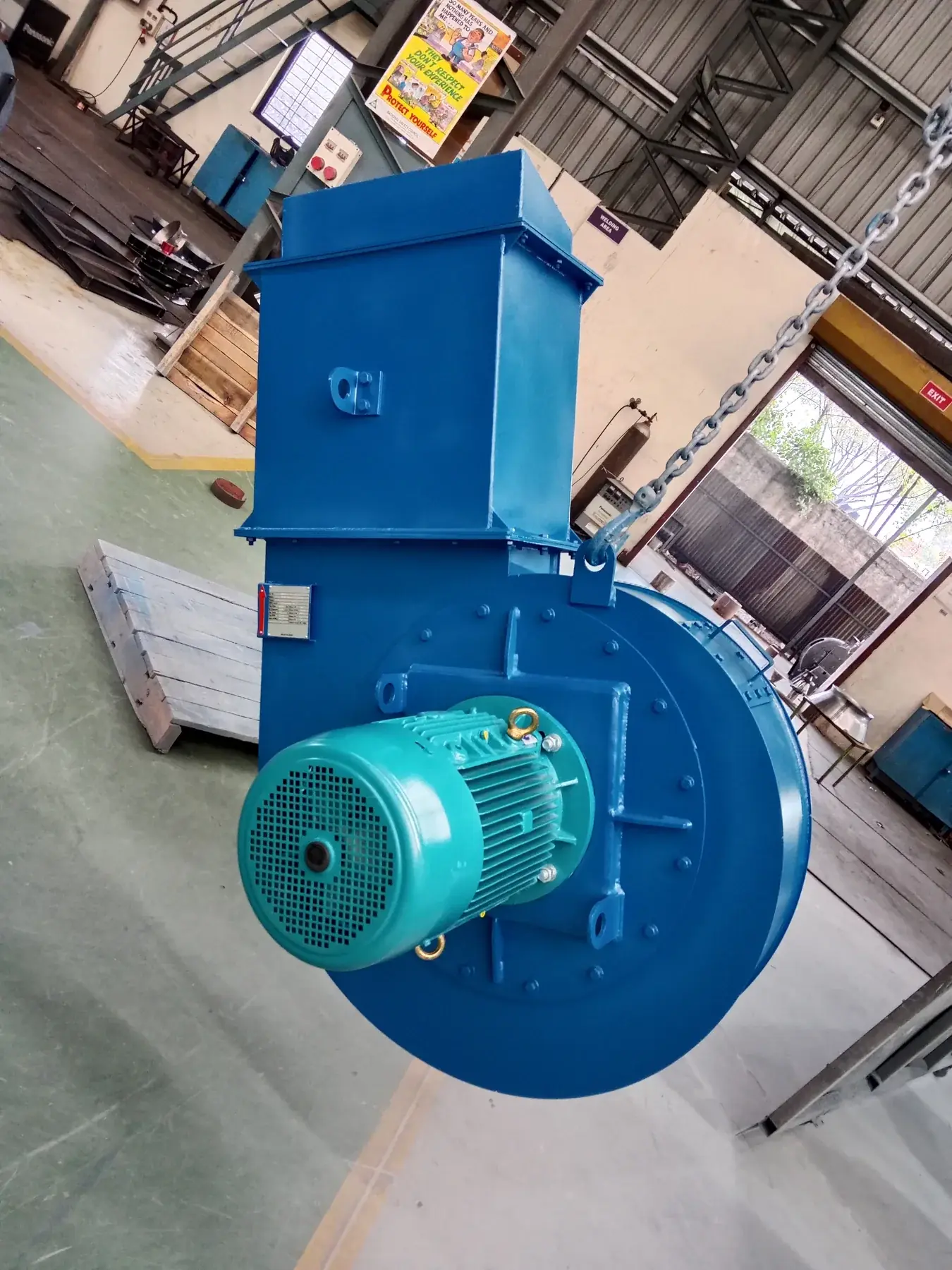
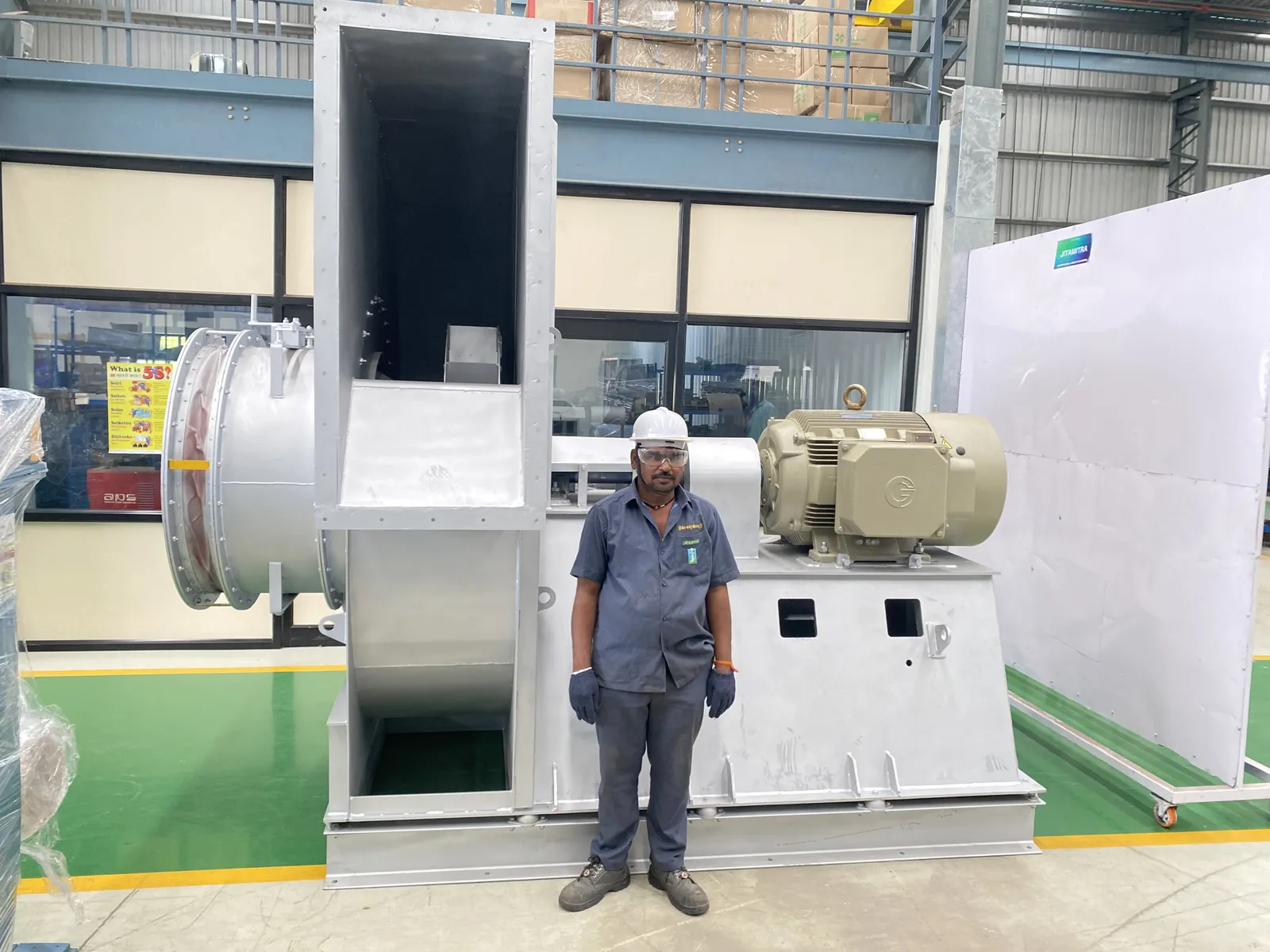
Can you supply the fans for both the biogas side and the biomass boiler, or only one?
Both. We engineer the flammable-gas side — the digester and biogas boosters that lift methane-rich gas to the CHP engine or flare, plus the H₂S-laden corrosive vents — and the biomass boiler island — the complete draught set of induced, forced, primary and secondary air, plus dirty-side dust extraction. A handful of biogas and biomass duties are already executed, and the underlying fan engineering is proven across our whole range. Each fan is engineered to its own gas, temperature, corrosion and dust load — the spark-safe biogas booster and the hot biomass ID are different machines — but they come from one partner, on one engineering convention across the plant.
Biogas is flammable. How do you make the booster safe against ignition?
Raw biogas is roughly 50 to 65 percent methane, well inside the flammable range, so where the area classification calls for it we build the fan to an ATEX Zone 2/22 self-declaration per 2014/34/EU, Category 3. That means a non-sparking impeller and inlet-cone material pairing, controlled running clearances so nothing can rub, spark-resistant construction, bonded and earthed rotating parts to bleed off static, and gas-tight casing and shaft sealing. To be precise, that is a self-declaration of conformity, not a third-party certification. We build to your stated area classification and gas analysis, not a generic rating.
Raw biogas carries H₂S. What materials do you use against acid corrosion?
Hydrogen sulphide in raw biogas runs from hundreds to thousands of ppm, and where it cools below the dew point on the casing wall it condenses to a sulphurous acid that eats mild steel and pits the wheel. We size the metallurgy and the dew-point margin to your gas analysis: 316L stainless or a higher alloy on the wetted surfaces, with the casing wall held above dew point by insulation and heat tracing so the acid never forms, and drains at the low points for any condensate. The right answer depends on your H₂S content, moisture and whether the gas is raw or upgraded, so we engineer it to your gas, not a default.
Biomass ash is sticky, not hard like mineral dust. How do you keep the boiler ID in balance?
Biomass ash is high in alkali and low-melting, so unlike hard mineral dust it stays sticky and cakes onto the wheel and casing, building an unbalanced deposit that grows until the fan trips on vibration. We handle it with a rugged radial wheel and blade geometry that shed ash rather than let it key on, bolted-in replaceable anti-build-up liners at the scroll and inlet, and inspection and cleanout doors so the wheel is cleaned or washed in place without dismantling the fan. On some fuels we also fit an on-line cleaning provision. We size all of it to your fuel and ash chemistry.
What is the maximum gas temperature you handle on the biomass boiler fans?
Continuous duty up to 500 °C across the envelope, with most biomass boiler ID running 150 to 400 °C. Above about 350 °C we fit a shaft cooling disc to keep heat off the bearings, keep the bearings outside the airstream, and add expansion joints for the thermal growth (a 1 m shaft grows about 5.8 mm from cold to 500 °C). Refractory lining is specified where the gas temperature calls for it. The biogas booster, by contrast, is a near-ambient gas duty where corrosion and spark-safety dominate, not temperature. Each fan is built for its own stated gas temperature, not a generic rating.
Do you performance-test the fans, and what about AMCA, CE, ATEX and quality certification?
Every fan is performance-tested in-house to the IS 4894 / ISO 5801 / AMCA 210 method on our 200 HP VFD test rig, and dynamically balanced to ISO 21940 G6.3 as standard (G2.5 / G1.0 on application). Fans above the rig's 200 HP are run at derated speed and scaled to the specified duty by the fan laws. Because the rig runs cold air, hot biomass boiler operation is extrapolated by fan-law correction for density. To be precise: that in-house testing is to the IS 4894 / ISO 5801 / AMCA 210 method, not AMCA-certified; CE is self-declared per 2006/42/EC and 2014/35/EU, and ATEX Zone 2/22 is self-declared per 2014/34/EU (Category 3) for the flammable biogas duty where the area classification calls for it — those are self-declarations of conformity, not third-party certifications. Our only third-party certification is ISO 9001:2015.