Can you supply the fans across the whole sugar plant and distillery, or only one duty?
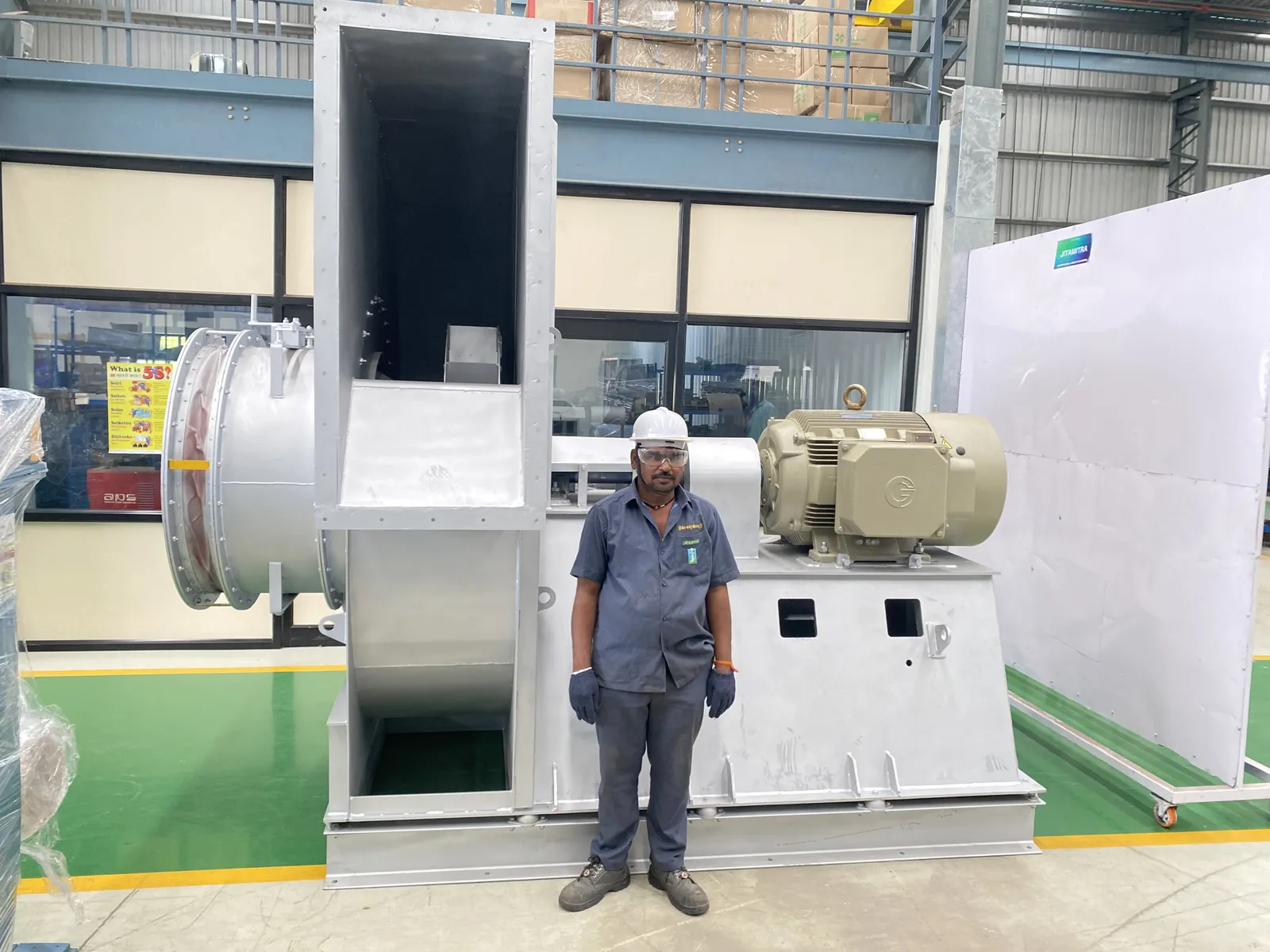
Across the whole plant. We have delivered 43 sugar & distillery fans spanning the complete bagasse-boiler draught set (induced, forced, primary and secondary air), dilute-phase bagasse and ash conveying, dirty-side dust extraction, process and dilution ventilation, combustion and process air blowers, and the distillery scrubber and vent fans. Each fan is engineered to its own gas, temperature, moisture and ash load — the wet dirty-side boiler ID and the clean forced-draught fan are different machines — but they come from one partner, on one engineering convention across the mill and distillery.
Bagasse ash is wet and sticky. How do you keep the boiler ID fan from fouling and wearing?
Bagasse ash is light but sharp and it burns wet, so it both scours and cakes. We handle both. A rugged radial wheel that sheds ash and resists erosion; chrome-carbide hard-facing on the blade leading edges and high-wear zones; blade geometry chosen so wet ash does not key onto the wheel; and wash-in and drain connections plus bolted-in, replaceable wear plates and inspection doors so build-up is cleared and worn parts change out in place. The wear scope is replaceable, not welded in — which is what keeps the fan running the full crushing season.
Our boiler runs flat-out through the crushing season and then shuts down. Does that seasonal cycling matter for the fan?
It does, and we design for it. Running the bagasse boiler hard for a 180 to 210 day season and then shutting it down cold cycles the wheel and casing from up to 500 °C service to ambient every year. We size the wheel for stress at temperature and for repeated cycling, fit a shaft cooling disc above about 350 °C with the bearings outside the airstream, and add expansion joints sized so the thermal growth (a 1 m shaft grows about 6 mm hot) returns true campaign after campaign. The off-season is also when we design the wear parts to be changed out in place.
The distillery vent and the ventilation air are humid and can turn corrosive. What do you do?
We size the metallurgy and the dew-point margin to your gas. On the humid ventilation and distillery scrubber-vent circuits the gas drops below dew point (typically around 50 to 60 °C) and condenses on a cold casing wall, feeding corrosion. We keep the casing wall above dew point with insulation and heat tracing, and select Corten or 316L on the wetted surfaces, stepping to higher alloys on request where the vent is acidic. The right answer depends on your vapour, moisture and any acidity, so we engineer it to your gas analysis, not a default.
Can you build a replacement to match our existing bagasse-boiler fan's duty and footprint?
Yes. We reverse-engineer to the existing duty point (flow, static pressure, gas temperature, density, moisture and ash load), bearing centres, inlet/outlet orientation and foundation bolt pattern so the unit drops onto the existing base and ducting — whether it is a boiler ID, an FD or primary-air fan, an ash-conveying fan or a distillery vent fan. Made to your installation, not a nearest-catalogue substitute. Send the old GA, the nameplate and a curve if you have one, and we match it in time for the off-season change-out.
Do you performance-test the fans, and what about AMCA, CE, ATEX and quality certification?
Every fan is performance-tested in-house to the IS 4894 / ISO 5801 / AMCA 210 method on our 200 HP VFD test rig, and dynamically balanced to ISO 21940 G6.3 as standard (G2.5 / G1.0 on application). Fans above the rig's 200 HP are run at derated speed and scaled to the specified duty by the fan laws. Because the rig runs cold air, hot wet boiler-gas operation is extrapolated by fan-law correction for density. To be precise: that in-house testing is to the IS 4894 / ISO 5801 / AMCA 210 method, not AMCA-certified; CE is self-declared per 2006/42/EC and 2014/35/EU, and ATEX Zone 2/22 is self-declared per 2014/34/EU (Category 3) where the distillery area classification calls for it — those are self-declarations of conformity, not third-party certifications. Our only third-party certification is ISO 9001:2015.