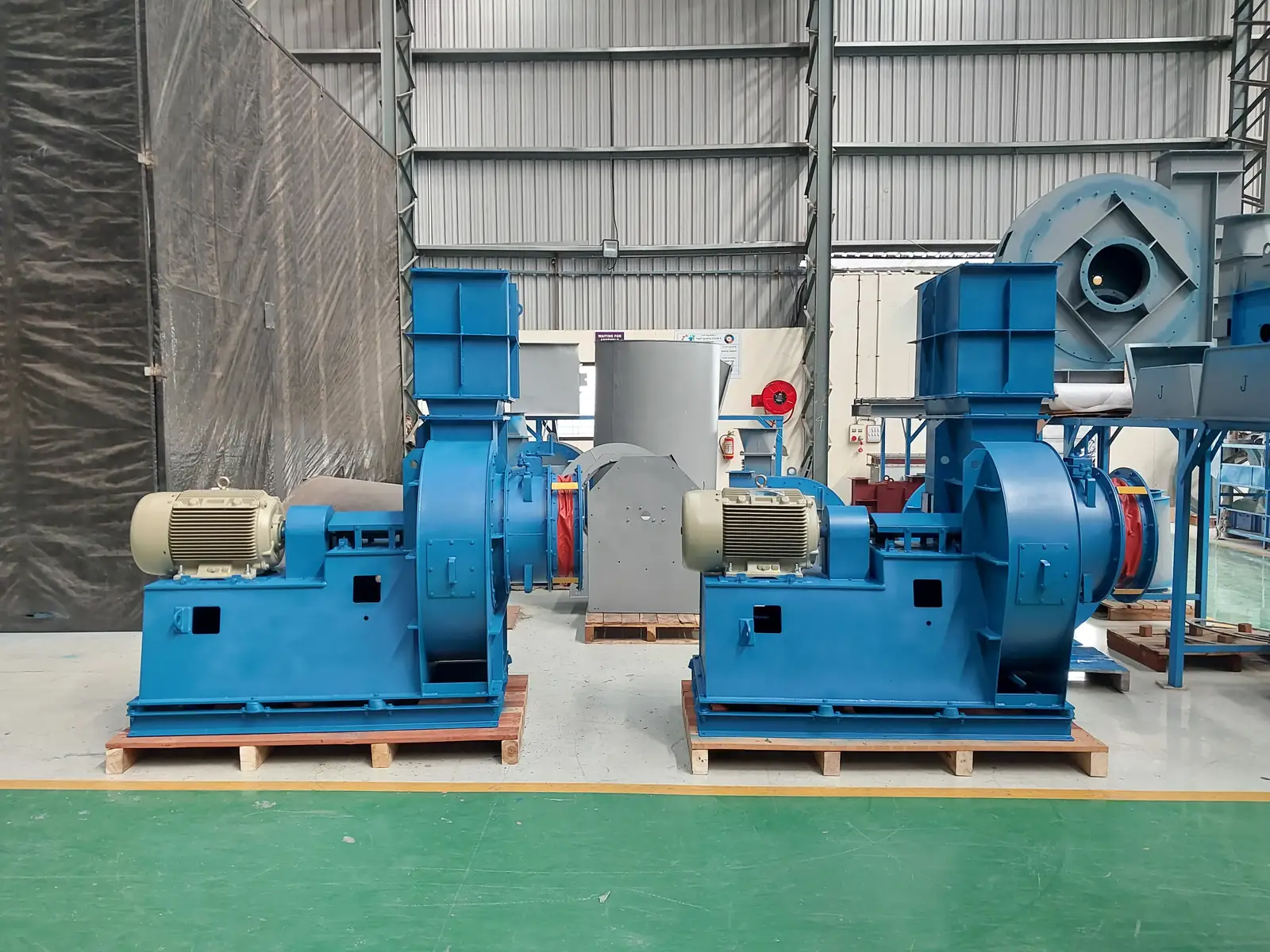
Corrosion-protected centrifugal ventilation fan for marine and offshore duty on the Jitamitra shop floor
Home  /  Industries  /  Marine & Offshore
Industries

Fans for marine & offshore — engine room, machinery space and deck.

A ship or an offshore platform runs its ventilation on fans that never see calm conditions: engine-room and cargo-hold supply and exhaust, machinery-space air, seal and cooling air, and the corrosive and emergency-exhaust duties in between. The air is salt-laden, the deck rolls and pitches, and on a platform the hazardous-area classification governs everything. We do not hold a track record we can cite for this sector yet — so this is an engineered-capability page: the corrosion, motion and gas-safe engineering below is proven across our fan range, and we build it to your class-society scope. The full envelope: up to 2,00,000 CMH, 2,000 mmWC, 400 HP and 600 °C.

Class-societyscope, to your rules
316L / FRPsalt-corrosion metallurgy
Spark-safegas-safe construction, hazardous zones
2,00,000 CMHmax flow, full envelope
15,000+
fans built since 2011
200 HP
VFD test rig · IS 4894 / AMCA 210
99%
on-time delivery
3
working days to quote — always
ENGINE-ROOM VENT · MACHINERY-SPACE SUPPLY · CARGO-HOLD · SEAL & COOLING AIR · EMERGENCY EXHAUST
Where the fans sit

One vessel, three jobs the fans have to do — and every one of them is at sea.

Across a ship or an offshore platform the fans do three distinct jobs: they ventilate the engine room and machinery spaces so the plant can breathe, they supply and exhaust the cargo holds and process areas, and they hold the gas-safe and emergency duties that keep the vessel survivable. Every one of them handles salt-laden air, works while the deck moves, and answers to a class society — so the fan is engineered to your rules, not adapted from a landside catalogue.

The duties we run on a vessel

The fan duties across a ship or platform — and the role each one plays.

A single vessel needs a family of fan duties, from continuous engine-room ventilation to the emergency exhaust that only runs when it must. The underlying fan engineering is proven across our range — each duty engineered to its own air, corrosion class and motion case, and built to your class-society scope, not adapted from a catalogue near-fit.

The fans we deploy here

Three fan types cover the vessel — matched to the pressure and the corrosion class.

The wheel is chosen by the pressure it has to make and how clean the air is: a backward-curved plate wheel for the efficient engine-room and machinery-space ventilation, a backward-flat plate wheel for the large-flow low-pressure supply and exhaust, and an aerofoil wheel for the quietest, highest-efficiency accommodation and clean-air duty. All three build across the same envelope — to 2,00,000 CMH, 2,000 mmWC, 400 HP and 600 °C — and all three carry the salt-corrosion and gas-safe scope the sector needs.

Why marine fan duty is hard

Three things at sea decide whether a marine fan survives the vessel's life or corrodes out early.

Marine and offshore air attacks a fan in three ways landside duty never does — a constant salt-laden atmosphere that corrodes ordinary steel, a deck that rolls, pitches and shocks the machine while it runs, and on a platform an area classification that makes ignition unacceptable. Engineer for all three and the fan runs the vessel's full service life. Engineer for the duty point alone and it corrodes, cracks or fails the survey within a few years at sea.

01 — CORROSION

Salt-laden marine atmosphere

Sea salt and humidity attack every surface continuously — plain mild steel can lose coating and pit within 12–24 months in a marine atmosphere, throwing the wheel out of balance and failing the class survey.

How we engineer it out

Corrosion-resistant metallurgy sized to the exposure — 316L stainless or FRP on the wetted and exposed surfaces, hot-dip galvanising or a marine-grade multi-coat paint system on structural steel, and sealed bearings kept out of the salt air.

02 — MOTION

Roll, pitch, vibration & shock

A vessel rolls, pitches and slams while the fan runs, and a platform can see shock loads — the fan and its foundation carry dynamic loads a static landside base never sees, cracking rigid mounts and loosening fasteners over time.

How we engineer it out

A rigid, ribbed baseframe and pedestal designed for the class-defined roll, pitch and shock case; anti-vibration mounts where the rules require; locked and marine-rated fasteners; and balance to ISO 21940 G2.5 so the machine runs smooth under motion.

03 — IGNITION

Gas-safe & fire-integrity duty

On an offshore platform or in a fuel or paint space the atmosphere can be flammable, and engine-room fire integrity is a class rule — an ordinary fan is an ignition source, and a standard smoke fan will not hold flow when the space is on fire.

How we engineer it out

Spark-resistant construction to the hazardous-area classification — non-sparking wheel and inlet-cone material pairings, ATEX Zone 2/22 self-declared per 2014/34/EU (Category 3) where called for; and emergency-rated construction to hold flow at 300 °C for 2 h or your class duration.

How we design for the vessel

Every metallurgy, motion and gas-safe choice is documented on the GA drawing you sign off — before we cut metal.

We don't sell a catalogue near-fit onto a ship or a platform. Each fan is engineered to its own duty — the engine-room vent to its air, the seal-air fan to its pressure, the emergency fan to its temperature rating — at your operating point and to your class-society scope.

  • Marine corrosion protection — Corrosion-resistant metallurgy sized to the exposure — 316L stainless or FRP on the wetted and salt-exposed surfaces, hot-dip galvanising or a marine-grade multi-coat paint system on structural steel, and sealed, greased-for-life bearings kept out of the salt air so the machine holds balance and passes survey.
  • Motion & shock construction — A rigid, ribbed baseframe and pedestal engineered for the class-defined roll, pitch and shock case; anti-vibration mounts and flexible connections where the rules require; locked, marine-rated fasteners; and dynamic balance to ISO 21940 G2.5 (G1.0 on application) so the fan runs smooth while the deck moves.
  • Gas-safe & emergency scope — Spark-resistant construction to the hazardous-area classification — non-sparking wheel and inlet-cone pairings, ATEX Zone 2/22 self-declared per 2014/34/EU (Category 3) where the area calls for it; and emergency smoke-and-fire construction rated to hold flow at 300 °C for 2 h or your class duration.
  • Built to your class scope — The fan is engineered to your class-society and project specification — the metallurgy, the motion case, the documentation and the witnessed testing on our 200 HP VFD rig — so the machine, its drive and its papers arrive matched to the survey, not a landside default carried to sea.
Standards & conformity

Stated precisely — because procurement checks.

What our marks mean, in the words that survive an audit.

Performance

Tested to the AMCA 210 / ISO 5801 method, in-house on our 200 HP VFD rig. Tested-to-method — not AMCA-certified.

Quality system

ISO 9001:2015 — third-party certified. Our only third-party certification.

CE conformity

Self-declared per 2006/42/EC + 2014/35/EU (Module A). A self-declaration, not a notified-body certificate.

ATEX conformity

Self-declared, Zone 2/22, Category 3, per 2014/34/EU, where the area classification calls for it.

Oil & gas duty

Designed and built to API 673 as project-specific scope.

Welding

ASME Sec IX qualified welders + WPS for every joint.

Balance

ISO 21940 — G6.3 minimum, G2.5 / G1.0 on application.

Vibration

ISO 20816 evaluation; ISO 14694 for fan-specific limits.

Questions engineers ask

Marine & offshore fan questions, answered straight.

You show no track record for marine — can you actually build to this sector?
Straight answer: we do not yet hold a marine and offshore reference we can cite, so we will not claim one. What we do hold is the engineering the sector needs, proven across our fan range in other industries — salt-grade corrosion metallurgy, rigid baseframes for dynamic loads, spark-resistant and ATEX self-declared construction, and emergency high-temperature duty. This is an engineered-capability page: tell us your duty and your class-society scope, and we engineer the fan to it and prove it on the rig. A credible single source names its own boundaries before you discover them.
How do you protect a marine fan against salt corrosion?
We size the metallurgy and the coating to the exposure. On the wetted and salt-exposed surfaces we select 316L stainless or FRP; on structural steel we specify hot-dip galvanising or a marine-grade multi-coat paint system; and we keep sealed, greased-for-life bearings out of the salt air. Plain mild steel can pit and lose coating within 12 to 24 months in a marine atmosphere, which is why the corrosion answer is engineered to your salinity and exposure, not a default. Send us the environment and the class rule and we specify it on the GA drawing you sign off.
The deck rolls, pitches and can shock the machine. How is the fan built for motion?
The baseframe and pedestal are engineered for the class-defined roll, pitch and shock case, not a static landside base. That means a rigid, ribbed structure, anti-vibration mounts and flexible connections where the rules require, locked and marine-rated fasteners, and dynamic balance to ISO 21940 G2.5 (G1.0 on application) so the fan runs smooth while the vessel moves. Give us your class society's motion and shock criteria and we design the mounting and the structure to them.
Our platform has hazardous areas. Can you supply a gas-safe, spark-resistant fan?
Yes, to the area classification you give us. We build spark-resistant construction with non-sparking wheel and inlet-cone material pairings, and ATEX Zone 2/22 is self-declared per 2014/34/EU (Category 3) where the classification calls for it. To be precise, that ATEX declaration is a self-declaration of conformity, not a third-party certification. Tell us the zone, the gas group and the temperature class, and we engineer the construction and the declaration to match.
Do you build emergency smoke and fire fans to a marine fire duration?
Yes. We build emergency smoke-and-fire extraction construction rated to hold flow at high temperature for a class-required duration — commonly 300 °C for 2 hours, or the exact rating and duration your class society specifies. The motor, wheel and construction are selected so the fan keeps moving air when the space it serves is on fire. Give us the class rule and the required temperature-time rating and we engineer to it.
Do you performance-test the fans, and what about AMCA, CE, ATEX and quality certification?
Every fan is performance-tested in-house to the AMCA 210 / ISO 5801 method on our 200 HP VFD test rig, and dynamically balanced to ISO 21940 G6.3 as standard (G2.5 / G1.0 on application), with the test witnessed on request. To be precise: that in-house testing is to the AMCA 210 / ISO 5801 method, not AMCA-certified, and we are not an AMCA member; CE is self-declared per 2006/42/EC and 2014/35/EU, and ATEX Zone 2/22 is self-declared per 2014/34/EU (Category 3) where the area classification calls for it — those are self-declarations of conformity, not third-party certifications. Our only third-party certification is ISO 9001:2015. Class-society approval and witnessing is handled as project-specific scope to your named society.

Across the range

Where Marine & Offshore fits — the fans we deploy, the duties we run, and adjacent industries.

The same engineering, viewed three ways — by fan family, by duty, and by industry. Follow the cross-references.

Take it further

Specs an engineer can use — not a brochure.

Engineer to engineer

Send us the duty point.
We'll quote in 3 working days — always.

No model numbers needed. Give us the operating conditions — flow, static, gas temperature, composition, particulate, and any tender standard — and our application engineers size the fan and quote it. Attach a spec or GA if you have one.

+91 90110 09155  ·  mihir.jitamitra@gmail.com