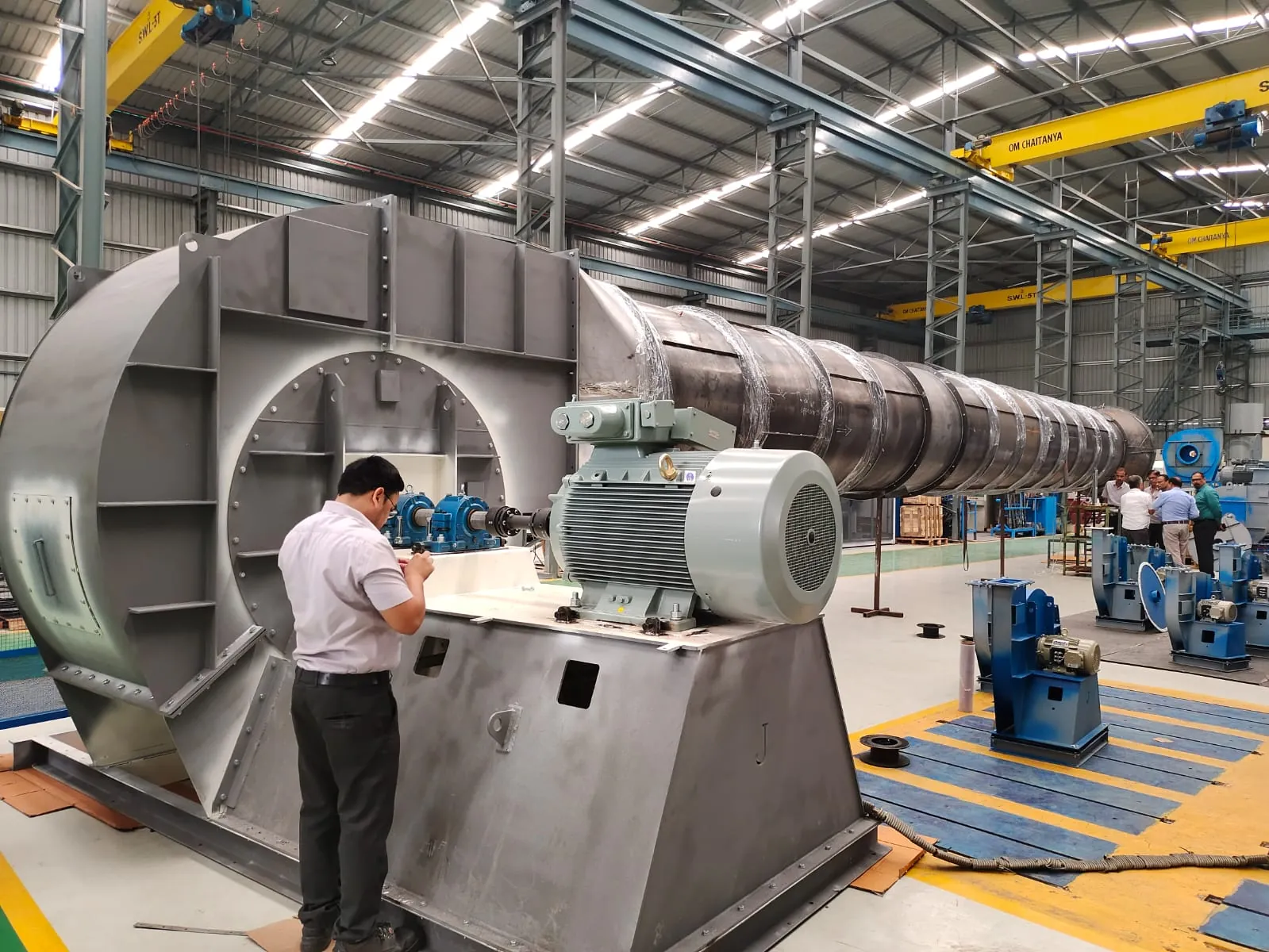
How do you protect a marine fan against salt-air corrosion?
We match the corrosion protection to the exposure, not to a single default. Protected supply air gets hot-dip galvanising or a heavy-duty epoxy system; exhaust and salt-spray-exposed duty gets 304 or 316L stainless steel; corrosive cargo-vapour exhaust gets an FRP coating or lining. Across all builds we use sealed fasteners and drained casings so seawater and condensate can never stand inside the fan and pit it from within. Tell us where the fan sits and what it handles, and we specify the material and coating to that exposure rather than over- or under-building it.
My cargo hold or pump room can hold a flammable atmosphere. Is the fan safe to run there?
Yes, that is exactly the case we build spark-resistant and gas-safe construction for. We build to AMCA 99, which defines three spark-resistant types: Type A puts all parts in the airstream in non-ferrous material, Type B uses a non-ferrous rub ring, and Type C is an aligned construction that mechanically prevents a rotating ferrous part from touching a stationary one. Type B is our working default and Type A is used for tanker holds and pump rooms. Where the compartment is classified as hazardous we also self-declare ATEX Zone 2/22, Category 3, per 2014/34/EU, with a non-sparking impeller, bronze rub rings and bonded earthing throughout. The point is that the purge fan itself is never the ignition source in the space it is there to make safe.
Do you build to class-society rules — DNV, ABS, Lloyd's, IRS?
We engineer the fan to your vessel's class-society requirements and arrange witness and documentation with that society on a project-specific basis. Marine ventilation rules touch corrosion protection, spark and fire safety, vibration, ducting integrity and closable openings on fire and gas boundaries, and we design to the applicable rule set and submit for the society's review. To be precise: our own third-party certification is ISO 9001:2015; the class approval is the society's, granted against the specific vessel and duty, and we support that survey for the specific vessel and duty.
How do you handle shipboard vibration and vessel motion?
A fan aboard a ship sees hull vibration, propeller excitation and continuous roll and pitch that a shore-mounted fan never feels, so we design for that case explicitly. We balance the rotor to ISO 21940 G2.5 as standard, tighter than the G6.3 used ashore, and size the shaft and bearing set for the marine vibration case. We fit anti-vibration isolators and flexible connections to break structure-borne noise into the hull, and use marine-rated locked fasteners so nothing works loose under continuous motion. Bearing life is engineered to a design target of L10h at or above 40,000 hours continuous.
What air-change rate and pressure do engine-room and hold fans need?
It depends on the space and its heat and gas load, which is why we size to your data rather than a rule of thumb. Engine rooms typically need a high air-change rate — often in the region of 20 to 40 changes an hour — to feed combustion and cooling air and clear the thermal load, held at a slight positive pressure so fresh air leaks in rather than fumes leaking out. Cargo-hold and compartment purge is set by the volume to be cleared and the ventilation time the operation allows. Give us the space volume, the machinery heat load and the required change rate or purge time, and we size flow and static to it and prove the curve on the rig.
What sound levels can you meet in a manned machinery space?
As standard we design to below 85 dB(A) at 1 m. Below 80 dB(A) is achievable with inlet and outlet silencers plus an acoustic-treated casing, and below 75 dB(A) with a custom acoustic enclosure. Structure-borne noise into the hull matters as much as airborne noise aboard a vessel, so we add anti-vibration isolators and flexible connections at the fan to keep vibration out of the ship's structure. Tell us the sound limit and where the fan sits relative to the accommodation, and we predict and engineer to it.
What certifications and test standards actually apply to these fans?
To be precise about the claims: every fan is performance-tested in-house to the IS 4894 / ISO 5801 / AMCA 210 method on our 200 HP VFD test rig — that is testing to the method, not an AMCA certification, and we are not an AMCA member. Fans above the rig's 200 HP are run at derated speed and scaled to the specified duty by the fan laws. Spark-resistant construction is built to AMCA 99. CE is self-declared per the relevant EU directives and ATEX Zone 2/22 is self-declared per 2014/34/EU, Category 3 — those are self-declarations of conformity, not third-party certifications. Class-society approval is the society's, granted per vessel and duty, which we design to and support at survey. Our only standing third-party certification is ISO 9001:2015.
This is a new marine duty for you — can you engineer it?
Yes. Marine and offshore ventilation is an engineered-capability duty for us: we build the same corrosion-resistant, spark-resistant, vibration-tolerant construction across our industrial ventilation and gas-safe work, and we apply it to your machinery space or hold to the class-society rule set your vessel is built to. We engineer to your duty and specify it fully on the GA drawing you sign off before we cut metal. Send us the space, the air exposure, the area classification and the class society, and we engineer to it.