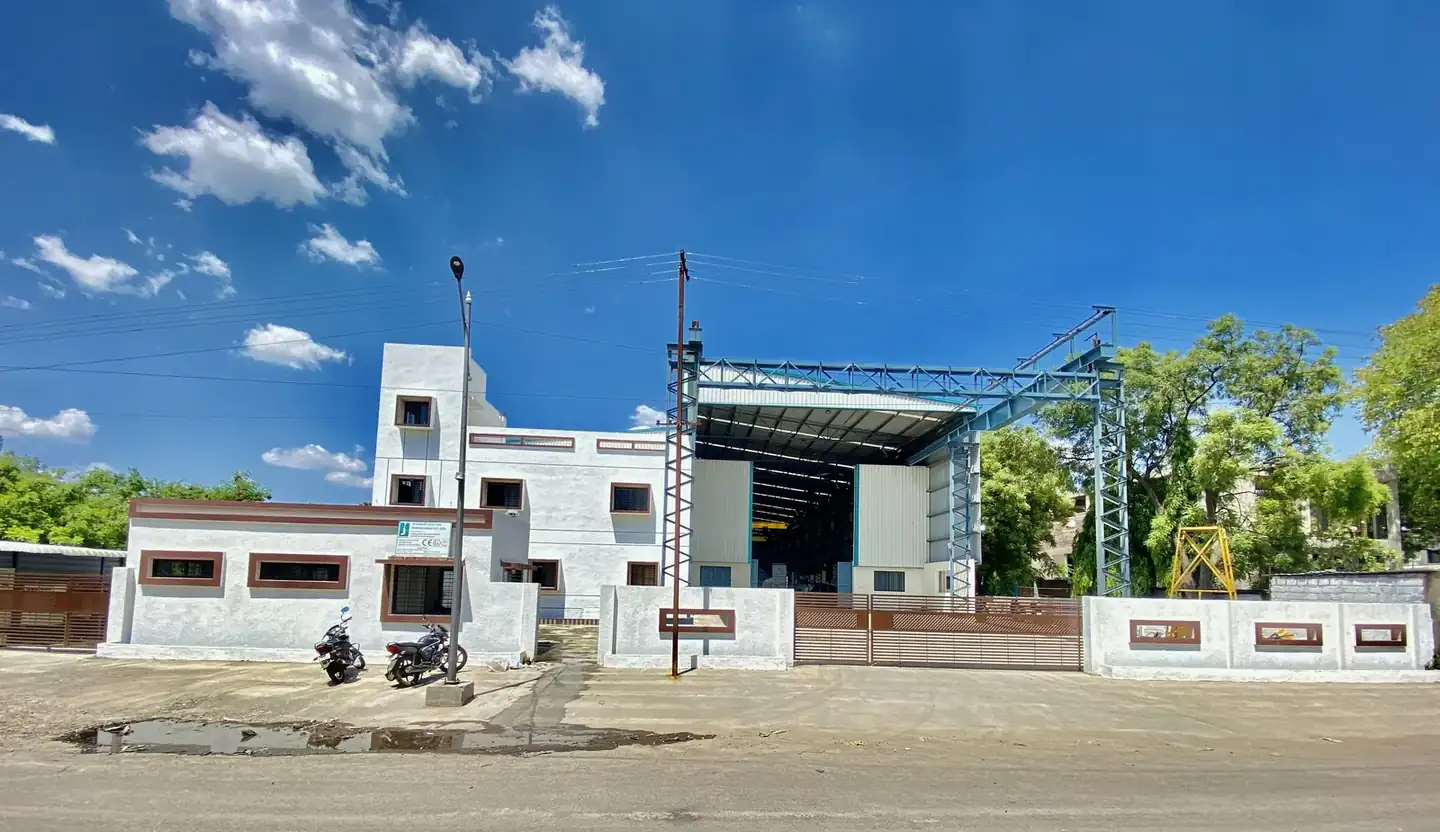
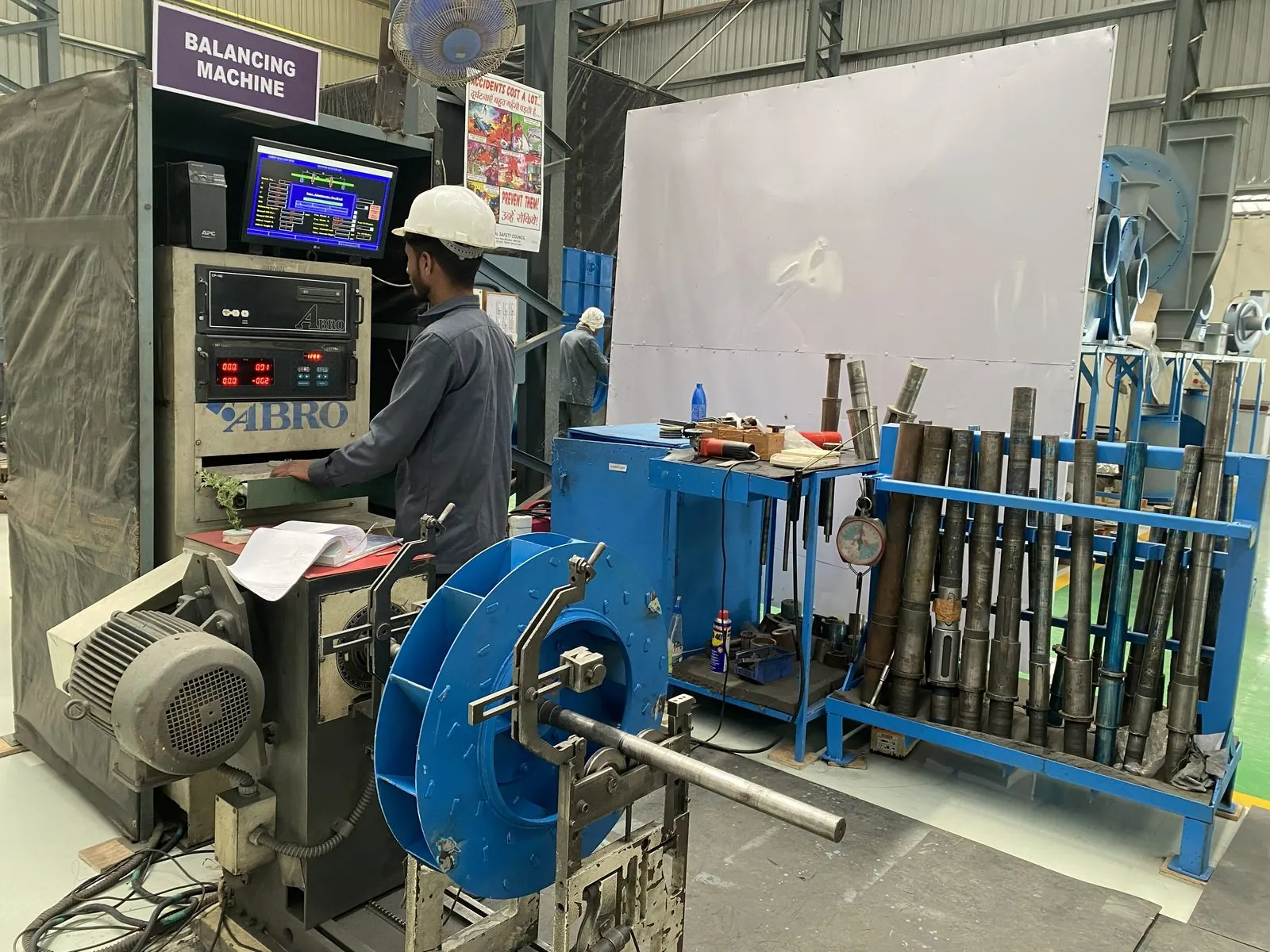
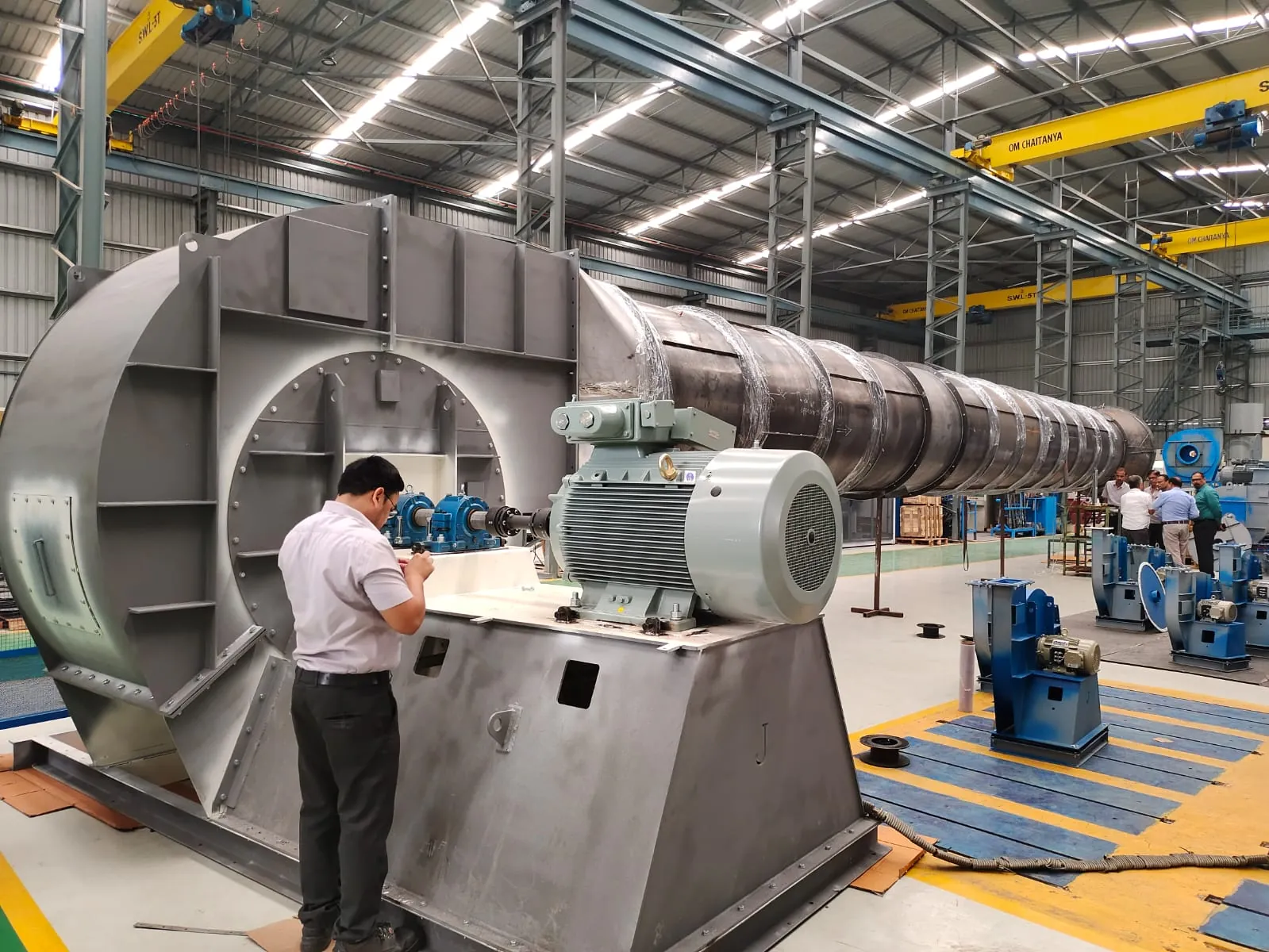
Centrifugal process-ventilation fan on the Jitamitra shop floor
Home  /  Applications  /  General / dilution ventilation
Applications

Process ventilation fans — for the air your operators breathe and your process tolerates.

General / dilution ventilation is moderate-temperature, continuous, often ATEX-rated extraction and supply: chemical plant halls, pharmaceutical production zones, food-processing facilities, electronics fabs, laboratories and workshops. Efficiency, reliability and hazardous-area scope are what matter — the fan runs 24×7 and rarely stops. We build process-ventilation fans from small in-line extraction at 5,000 CMH to hall systems beyond 1,00,000 CMH, across the full envelope below.

5,000–2,00,000CMH flow range
1,500mmWC max static
Zone 2ATEX self-declared
24×7continuous duty
15,000+
fans built since 2011
200 HP
VFD test rig · IS 4894 / AMCA 210
99%
on-time delivery
3
working days to quote — always
FROM THE PROCESS HALL · THROUGH FILTRATION · UNDER PRESSURE CASCADE · TO ATMOSPHERE
What it does

A process-ventilation fan does three jobs at once — and the air decides the design.

A process-ventilation fan manages general-purpose airflow: extracting from or supplying to a plant hall, cleanroom or process area, holding the room at its target pressure, and moving the air through filtration and ducting to or from atmosphere. What is in the air — and what is around the fan — sets the engineering.

  • 01
    Move

    Enough air for the hall air-change rate or hood face velocity — from 5,000 CMH in-line extraction to 1,00,000+ CMH hall ventilation.

  • 02
    Hold

    The room at its target pressure — positive in a cleanroom, negative in an airlock and process room — across the whole system resistance of 100–1,000 mmWC (to 1,500 mmWC on high-resistance filtration).

  • 03
    Survive

    What the air carries — solvent vapour, corrosive fume, or simply clean air at ambient to 80 °C (to 150 °C on warm-process duty) — for years without stopping.

INDUCED-DRAFT CENTRIFUGAL FAN Single-width single-inlet — scroll cut away to reveal the impeller inlet expansion joint MOTOR IE3 / VFD GAS IN GAS OUT n 1 2 3 4 5 6 7 8 9 10 1 Inlet cone (bell-mouth) 2 Backward-curved / radial-tipped impeller 3 Spiral volute casing 4 Replaceable AR wear plates (volute throat) 5 Shaft 6 Plummer-block bearings (L10 ≥ 40,000 h) 7 Shaft cooling disc (>400 °C duty) 8 Pedestal / base frame 9 Drive — motor + coupling 10 Outlet flange + duct take-off
Fig. 1Process-ventilation centrifugal fan — single-width single-inlet, scroll cut away to reveal the impeller. Numbered components keyed below the drawing.
Why it is hard

Three things decide whether a process fan is right for the duty.

What is in the air sets the materials, what is around the fan sets the ATEX scope, and the 8,760 hour/year run sets the efficiency and bearing life. Get all three right and the fan runs continuously for the design life. Get the metallurgy or the ATEX rating wrong, and it corrodes — or it cannot be installed at all.

01 — CORROSION

Gas composition vs. metallurgy

Solvent vapour, food-fryer exhaust and chemical fume attack mild steel. Pick the casing for clean air and a corrosive-vapour stream eats the wetted surfaces within a season.

How we engineer it out

Metallurgy matched to the gas: 316L SS or anti-corrosion coating for solvent vapour, 304 SS food-grade for fryer and dairy exhaust, duplex 2205 or PP-lined for aggressive chemical fume.

02 — IGNITION

Flammable-vapour areas

Solvent-handling, pharma granulation, alcohol-vapour and paint pre-treatment halls are flammable atmospheres. A sparking rotor or unbonded casing is an ignition source — and a non-ATEX fan cannot legally enter the zone.

How we engineer it out

ATEX Zone 2 build: aluminium impeller, bronze rub rings, bonded earthing, anti-static coatings and T-class temperature classification per the gas group. Self-declared Ex II 3G per 2014/34/EU Module A.

03 — RUN HOURS

24×7 efficiency & bearing life

These fans never stop. A few points of efficiency lost over 8,760 hours a year is real money, and a bearing sized for intermittent duty fails early on a fan that cannot come offline.

How we engineer it out

Backward-curved or airfoil wheel for peak efficiency on clean air, VFD control as default, and bearings rated L10h ≥ 40,000 h continuous with auto-lubrication where the fan is hard to reach.

How we design for it

Every choice is documented on the GA drawing you sign off — before we cut metal.

We don't sell a catalogue near-fit. The fan is engineered to your air — composition, pressure cascade, ATEX zone and run hours — not a default selection.

  • Materials per gas composition — MS + epoxy for clean air; 316L SS or anti-corrosion coating for solvent vapour; 304 SS food-grade for fryer / dairy exhaust; electropolished 316L for cleanroom; PP-lined or duplex 2205 / Hastelloy for aggressive chemical fume.
  • Wheel geometry — backward-curved or airfoil-bladed for highest efficiency on clean-air duty; radial-tipped only where light dust carry-over from an upstream process may occur.
  • Pressure-cascade & draft controlVFD default for new installations. Pharma facilities run a pressure cascade — positive in the cleanroom, negative in the airlock and process room — and VFD enables precise pressure-balance control across it.
  • ATEX & outdoor scopealuminium impeller, bronze rub rings, bonded earthing and anti-static coatings for Zone 2; IP55 motor minimum (IP66 for severe weather), outdoor coupling guard, corrosion-protected exterior and drain ports at the lowest casing point for rooftop units.
Engineered to your duty point

We size the fan where its curve crosses your system — then prove it on the rig.

No catalogue fan forced onto your spec. Your operating point is engineered onto the best-efficiency region of the selected wheel — because over a 24×7 duty, efficiency is the running cost — then verified on the 200 HP VFD test rig before dispatch.

avoid: unstable 0 40,000 80,000 1,20,000 1,60,000 2,00,000 VOLUME FLOW RATE  [ CMH ] 0 500 1000 1500 2000 STATIC PRESSURE  [ mmWC ] 0 25 50 75 100 STATIC EFFICIENCY  [ % ] Fan static pressure System resistance Static efficiency BEP 82% DUTY POINT 1,20,000 CMH · 450 mmWC Fan static pressure System resistance Static efficiency
Fig. 2Representative process-ventilation characteristic — fan static pressure, system resistance and static efficiency vs. flow, with the duty point engineered onto the best-efficiency region. Illustrative; every fan is sized to its own duty.
Capability envelope — general / dilution-ventilation service

What we can supply, and where it stretches on application.

ParameterStandardOn application
Volume flow5,000–1,50,000 CMH typicalup to 2,00,000 CMH on application
Static pressure100–1,000 mmWCup to 1,500 mmWC for high-resistance filtration
Operating temperatureambient to 80 °Cup to 150 °C for warm-process duty
ATEX classificationZone 2 (Cat 3G) self-declared for solvent / flammable-vapour areasZone 1 (Cat 2G) via Notified Body
Drive powerup to 250 HP (most general/dilution-ventilation duty)up to 400 HP on application
Speed600–1,800 RPM typicalper duty + sound limits
Balance qualityISO 21940 G6.3G2.5 / G1.0 on application
Bearing life (design target)L10h ≥ 40,000 h continuousL10h ≥ 100,000 h on application

The envelope above covers the great majority of process-ventilation duty. Sound is typically <85 dB(A) at 1 m for penthouse and rooftop locations, with <75 dB(A) available on a full acoustic package. For duty beyond this envelope — flow, pressure or temperature — we engineer to spec and quote on enquiry.

How a Jitamitra PV fan is specified

Specified, not picked from a shelf.

The same engineering language carries from your enquiry to the GA drawing to the nameplate — expressed in the standard AMCA conventions.

Specification fieldOptions
Arrangement (AMCA 99)Arr. 1 (overhung, fan bearings) / Arr. 4 (direct, motor on base) / Arr. 8 (overhung on common base) / Arr. 9 (overhung, motor side) / Arr. 10 (overhung, motor inside base) — selected by drive, access and installation.
Width / inletSWSI (single width, single inlet) default; DWDI (double width, double inlet) for high hall-ventilation flow at moderate pressure.
Wheel typeAirfoil or backward-curved (default, best efficiency on clean air) / radial-tipped (only where light dust carry-over from an upstream process occurs).
Class (by pressure / outlet velocity)Class I / II / III selected from the duty point on the pressure-vs-outlet-velocity limits; higher class = heavier construction for higher pressure and tip speed.
Materials of constructionMS + epoxy (clean air) / 316L SS or anti-corrosion coating (solvent vapour) / 304 SS food-grade (fryer, dairy) / electropolished 316L (cleanroom, low-particle) / PP-lined, duplex 2205 or Hastelloy (aggressive chemical fume); aluminium impeller for ATEX.
DriveDirect-coupled / V-belt / VFD (default for new installations and pressure-cascade control). Drive up to 400 HP across the envelope; speed typically 600–1,800 RPM.
Discharge & rotation (AMCA orientation)Rotation CW or CCW (viewed from drive side) with discharge angle per AMCA — e.g. TH/BH/UB/DB — set to match your duct take-off and installed footprint.
Accessories & ATEX scopeVFD control; inlet/outlet flexible connectors; aluminium impeller, bronze rub rings, bonded earthing and anti-static coatings with T-class temperature classification for Zone 2; IP55/IP66 motor, outdoor coupling guard, corrosion-protected exterior and casing drain ports for rooftop units; auto-lubrication on hard-to-reach bearings; acoustic package on application.
The proof, not the promise

We test before we ship — and you're welcome to witness it.

Every job's performance is verified at our works on the 200 HP VFD test rig, to the AMCA 210 / ISO 5801 method, before dispatch.

  • Customer-witnessed FAT on request — at no extra cost
  • Rotors balanced to ISO 21940 G6.3 as standard (G2.5 / G1.0 on application) before they leave the floor
  • Full NDT in-house — DP, MPI, UT, RT — to what the duty demands
30+ INDUSTRIES · 45 APPLICATION / DUTY TYPES
Where our process-ventilation fans run

Proven where the air must be clean, contained or hazardous-area-rated.

Pharmaceuticals

Cleanroom HVAC, granulation-hall ventilation, solvent-area extraction, dust-tight dispensing halls.

Chemicals & Petrochem

Process-hall ventilation, vent-gas extraction, laboratory fume-hood exhaust.

Food Processing

Production-hall ventilation, fryer exhaust, dairy spray-dryer area ventilation, oven ventilation.

Electronics & Semiconductors

Cleanroom HEPA-bank fans, fab makeup air, wet-bench exhaust.

Laboratory & R&D

Fume-hood exhaust, glovebox ventilation, BSL containment air.

Process Industry — general

Captive workshop ventilation, welding-shop exhaust, paint-preparation halls.

Cleanroom & Controlled Environments

Pressure-cascade ventilation across cleanroom, airlock and process room.

Your process

45 application/duty types engineered. Tell us yours.

Standards & conformity

Stated precisely — because procurement checks.

What our marks mean, in the words that survive an audit.

Performance

Tested to the AMCA 210 / ISO 5801 method, in-house on our 200 HP VFD rig. Tested-to-method — not AMCA-certified.

Quality system

ISO 9001:2015 — third-party certified. Our only third-party certification.

CE conformity

Self-declared per 2006/42/EC + 2014/35/EU (Module A). A self-declaration, not a notified-body certificate.

ATEX conformity

Self-declared, Zone 2/22, Category 3, per 2014/34/EU, where the area classification calls for it.

Oil & gas duty

Designed and built to API 673 as project-specific scope.

Welding

ASME Sec IX qualified welders + WPS for every joint.

Balance

ISO 21940 — G6.3 minimum, G2.5 / G1.0 on application.

Vibration

ISO 20816 evaluation; ISO 14694 for fan-specific limits.

Lead time & process

From enquiry to a tested fan on your dock.

StageStandard dutyAPI-673 / engineered
Offer / quotation3 working days — always7–10 working days
GA drawing for approval2–3 weeks from PO3–4 weeks from PO
Manufacture + balance + paint6–10 weeks10–14 weeks
Performance test + witnessed FAT~1 week1–2 weeks
Order-to-dispatch (total)9–14 weeks14–20 weeks

Shutdown-driven replacements: we have shipped fans within 6 weeks of a clean PO. Tell us your shutdown window and we commit to a dated plan.

Questions engineers ask

The eight we hear most before a PO.

Do I need an ATEX fan for my solvent or flammable-vapour area?
If the area is classified as a hazardous zone — solvent handling, pharma granulation, alcohol-vapour fermentation, paint pre-treatment — then yes. We build to ATEX Zone 2 (Category 3G) as standard for these areas: aluminium impeller, bronze rub rings, bonded earthing, anti-static coatings and a T-class temperature classification set to the gas group at risk. To be precise, this is a self-declaration of conformity per 2014/34/EU Module A, not a third-party certification. Zone 1 (Category 2G) is available through a Notified Body where the classification calls for it. Clean-air ventilation outside a classified zone does not need an ATEX build.
How do you choose the materials for my air stream?
By what is in the air. Clean air is mild steel with epoxy. Solvent-laden vapour in pharma, chemical or electronics duty is 316L stainless or an anti-corrosion coating. Food-fryer and dairy spray-dryer exhaust is 304 stainless food-grade with a sanitary finish. Aggressively corrosive chemical fume is duplex 2205 or PP-lined. Cleanrooms get electropolished 316L for low particle generation. We size the metallurgy to your gas composition, not a default — send the chemistry and we specify the wetted surfaces against it.
Can the fan control a pharma pressure cascade?
Yes. Pharma facilities run a pressure cascade — positive pressure in the cleanroom, negative in the airlock, negative in the process room — and the fan needs precise, stable pressure-balance control across it. VFD speed control is our default for this, since it holds the set-point without the throttling loss and hunting of a damper. We size the fan and its turndown to the cascade, and the GA drawing documents the control scheme before we cut metal.
These fans run 24×7 — how do you handle efficiency and bearing life?
Two ways. For efficiency, a backward-curved or airfoil wheel is the default on clean-air duty, with the operating point engineered onto the best-efficiency region of the selected wheel — over 8,760 hours a year, the efficiency is the running cost. For life, bearings are rated L10h ≥ 40,000 h continuous as standard (L10h ≥ 100,000 h on application), with self-aligning auto-lubrication where the fan is rooftop-mounted or hard to reach — the operator services it once every six months, not weekly.
Is the fan suitable for rooftop or outdoor installation?
Yes, with the outdoor scope specified. We fit an IP55 motor minimum (IP66 for severe weather), an outdoor-rated coupling guard, a corrosion-protected casing exterior and drain ports at the lowest casing point so condensate clears. Auto-lubrication on the bearing housing keeps the maintenance interval long for a unit that is awkward to reach. Tell us the environment — indoor, outdoor or rooftop — and we build the protection into the offer.
Do you supply GMP documentation for pharma cleanroom duty?
Yes, on application. For pharma and cleanroom service we supply IQ/OQ qualification protocols, MOC certificates and surface-finish records, with electropolished 316L for low particle generation where required. Tell us the documentation pack you need and we quote it as part of the offer. The fan itself is built and performance-tested to the same engineering standard as the rest of our range.
Do you performance-test before dispatch, and can we witness it?
Yes. Every fan is performance-tested in-house to the AMCA 210 / ISO 5801 method on our 200 HP VFD test rig, and dynamically balanced to ISO 21940 G6.3 as standard (G2.5 / G1.0 on application). The test and FAT take about a week and are customer-witnessed on request. You see the curve and the balance report before the fan leaves the floor.
What about CE, ATEX and API 673 requirements?
CE is self-declared per 2006/42/EC and 2014/35/EU for EU export and the Middle East. ATEX Zone 2/22 is self-declared per 2014/34/EU (Category 3) where the area classification calls for it. We also design and build to API 673 for process-ventilation duty in a refinery or petrochem context as project-specific scope. To be precise: CE and ATEX are self-declarations of conformity, not third-party certifications; our only third-party certification is ISO 9001:2015.

Across the range

Where general/process-ventilation fans fit — the fans that run them, related duties, and the industries served.

The same engineering, viewed three ways — by fan family, by duty, and by industry. Follow the cross-references.

Take it further

Specs an engineer can use — not a brochure.

Engineer to engineer

Send us the duty point.
We'll quote in 3 working days — always.

No model numbers needed. Give us the operating conditions — flow, static, gas temperature, composition, particulate, and any tender standard — and our application engineers size the fan and quote it. Attach a spec or GA if you have one.

+91 90110 09155  ·  mihir.jitamitra@gmail.com