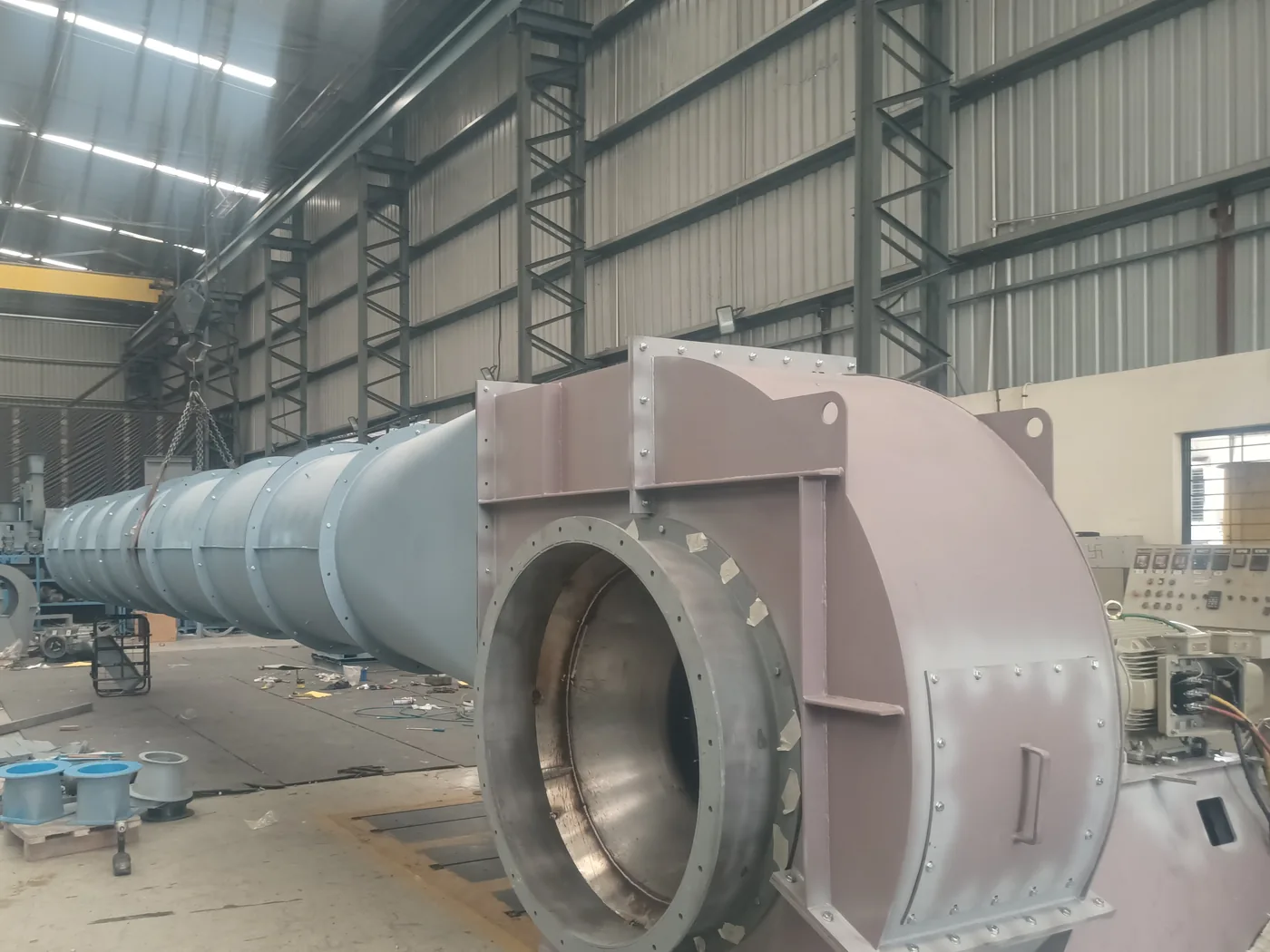
Fired-heater draught, combustion air, flare and vapour-recovery blowers and large process-air fans — engineered against your API 673 datasheet, with every departure written into a deviation list before the order rather than found at inspection.
Fans above the rig's 200 HP are run at derated speed and scaled to the specified duty by the fan laws.
API 673 is the petroleum-industry standard for special-purpose centrifugal fans: it sets the mechanical design, rotor dynamics, materials, inspection and testing a refinery or petrochemical buyer can hold the maker to. Jitamitra builds to API 673 against your datasheet, lists any departure as a written deviation before the order, balances in house to ISO 21940-11 and tests on our own 200 HP VFD rig to the IS 4894 / AMCA 210 method. There is no API monogram for a centrifugal fan, so built to is the accurate phrase and the only one we use.
It is written for special-purpose centrifugal fans on petroleum, chemical and gas service, and it reaches further into the machine than a general industrial standard does. These are the five places it lands on an order, and what we do at each.
Shaft and rotor sized for the duty with the critical speed separated from the running speed range, bearing life assessed against the load, and the drive train arranged so the bearings live where they can be maintained. How L10 bearing life is read →
Two-plane balancing to ISO 21940-11 at G 6.3, or G 2.5 where tip speed or the specification calls for it, with works vibration acceptance to AMCA 204 and the in-situ limits kept separate. Balance grade G 2.5 explained →
Plate, bar and fastener grades to the datasheet, with mill certificates carried against the job so the metallurgy on the fan is the metallurgy on the paperwork. Stainless, duplex and wear-lined carbon steel builds are all standard work here. The materials we build in →
An inspection and test plan with your hold, witness and review points marked, dimensional and weld inspection, NDT where the specification calls for it, and a performance test on our own 200 HP VFD rig to the IS 4894 / AMCA 210 method. Testing, inspection and certification →
Datasheet and deviation list, GA drawing for approval before metal is cut, material and test certificates, the balancing and run-test record, the inspection release and the O and M documentation, assembled as one dossier against the job. The standards behind each citation →
Where your specification also invokes API 560 Annex E for a fired heater, or a client standard on top of API 673, both are read together and the deviation list covers the pair.
Aerofoil centrifugal blowers for combustion air — to 91,800 m³/h at 178 mmWC and 51,000 m³/h at 241 mmWC — built to API 673, third-party witness-tested at our works.
On our test rig before dispatch — an export project in the Middle East.
Fans for oil and gas → · Combustion and process air → · More oil and gas builds →
Send: the API 673 datasheet if one exists, or the duty — volume flow, static pressure, gas temperature, gas composition and density, dust loading, arrangement and drive, inlet and outlet orientation, area classification and the control method. A P and ID extract or a GA of the adjacent equipment helps more than it costs you to attach.
Back: a priced offer with the fan selection and curve, the materials for each wetted part, the balance grade, the inspection and test plan we propose, and a deviation list. API 673 work is a special project, so the offer takes 5 to 7 working days rather than the standard 3 to 5.
On order: a GA drawing for your approval before metal is cut, then manufacture, inspection at the points you marked, the performance and run test, and the dossier.
It means the fan is designed, manufactured, inspected and tested against the API 673 requirements your datasheet invokes, and that anything we cannot meet is written into a deviation list you see before the order, not discovered at inspection. API 673 is a design and acceptance standard, not a licensing scheme, so the honest phrase is built to it.
No. The API monogram programme covers specific product specifications, and API 673 special purpose fans is not one of them, so no fan maker anywhere holds a monogram licence for it. What a buyer can hold us to instead is the datasheet, the deviation list, the inspection and test plan, and the test record.
Fired-heater forced and induced draught fans, combustion air blowers, flare and vapour recovery blowers, and the larger process air fans. Utility and building ventilation on the same site is usually specified to a general industrial standard instead. If your specification is mixed, send it and we will mark which fans we are pricing to API 673.
Two-plane dynamic balancing to ISO 21940-11: G 6.3 as standard, and G 2.5 above 50 metres per second tip speed or wherever the specification calls for it. Balancing is done in house, and G 2.5 is priced rather than returned as a deviation. Works vibration acceptance follows AMCA 204 with BV-3 as the industrial default, kept separate from the in-situ limits.
Yes. Customer and third-party witness inspection and Factory Acceptance Test are offered at no extra cost on domestic orders and add about three days to the schedule; on export contracts the cost of third-party inspection is to the importer's account. Performance is tested on our own 200 HP VFD rig to the IS 4894 / AMCA 210 method.
The API 673 datasheet if you have one, or the duty: volume flow, static pressure, gas temperature, gas composition and density, dust loading, arrangement and drive, inlet and outlet orientation, the area classification, and the control method. API 673 work is a special project, so the offer takes 5 to 7 working days rather than the standard 3 to 5.
Flow, static, gas temperature, composition and area classification — or attach the API 673 datasheet and the specification. Engineer to engineer.
ISO 9001:2015 quality system · performance-tested to IS 4894 / ISO 5801 / AMCA 210 method · witnessed FAT on request.
This site sets no cookies of its own. Google Analytics loads only if you accept. It sets two cookies, so we can see which fan topics people actually read. Decline and no analytics loads — the site works exactly the same. What we collect →