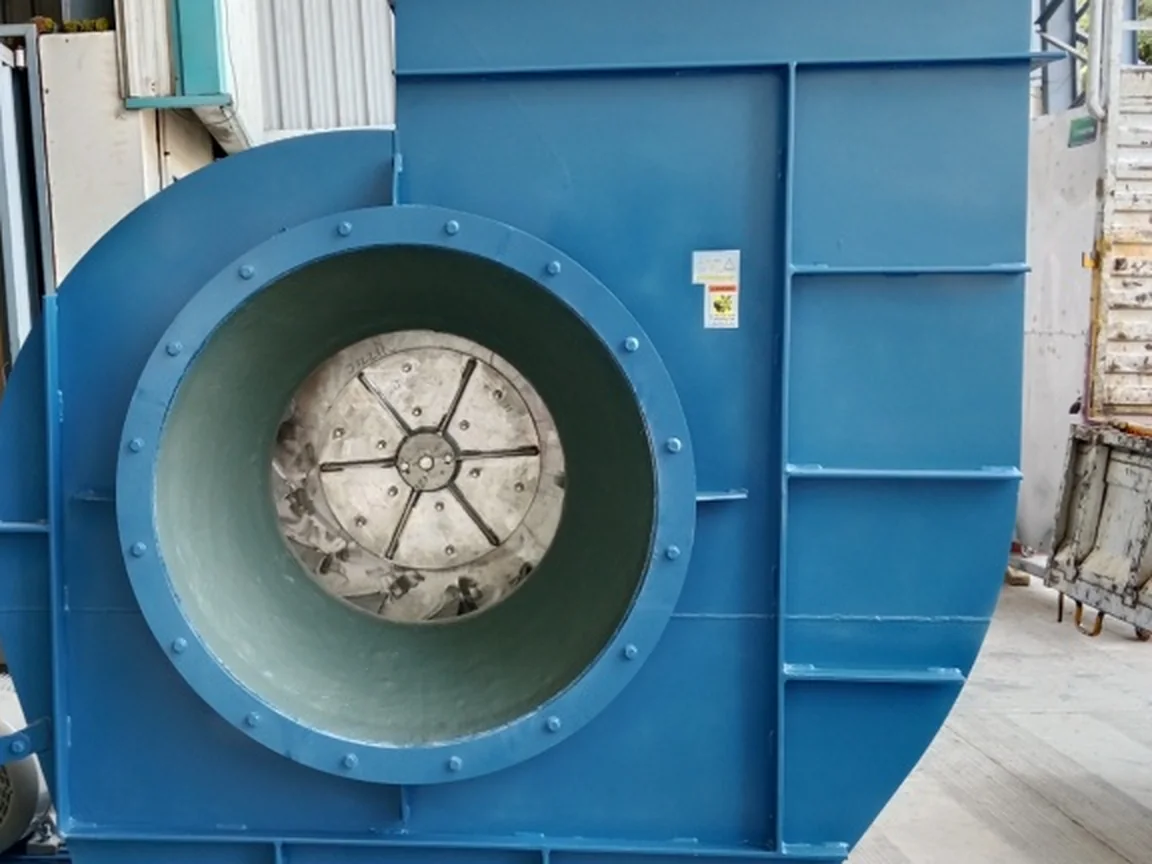
Carbon and structural steels, stainless and duplex grades, Hardox wear liners, aluminium and brass for spark-resistant builds, and corrosion-resistant construction for acid fume. The grade for every part is chosen from the process medium, temperature and dust you state — and written on the GA drawing you approve, before we cut metal.
Materials of construction (MOC) are the grades a fan's casing, impeller, shaft and wetted parts are made from. On a centrifugal fan they are set by what the airstream carries — its chemistry, moisture and dew point, temperature and dust — and by where the fan sits: a wash-down food hall, a coastal plant, a hot kiln line. The same duty point in clean air and in acid fume needs different metal, and the difference is usually the difference between a fan that lasts and one that is replaced.
We work from the process medium you state: the gas or vapour and its concentration, moisture and dew point, operating and upset temperature, dust loading and abrasiveness, and any wash-down or hygiene regime. Where only the airstream sees the corrosion, we put the alloy where the gas is — airstream-only stainless on a carbon-steel frame — rather than building the whole fan in the costlier grade.
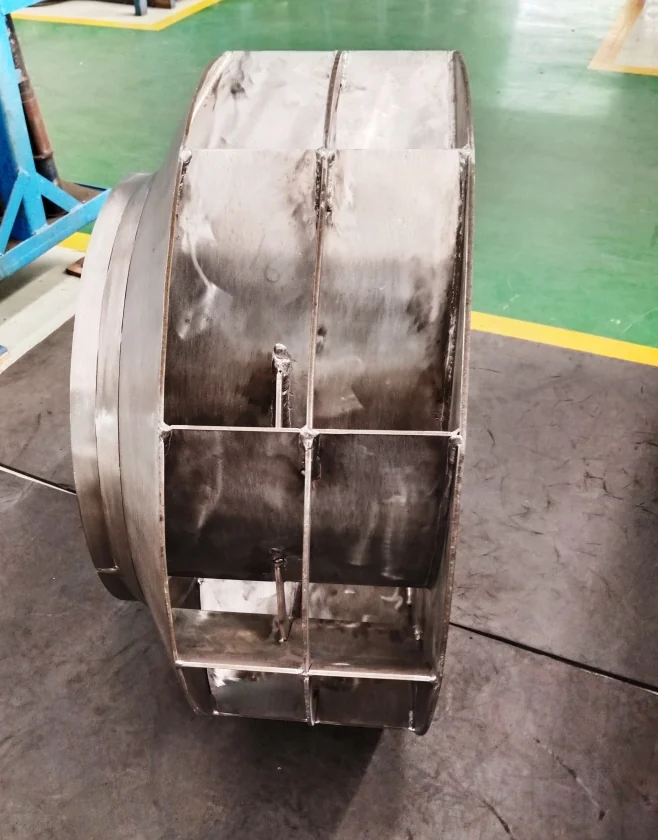
Carbon and structural steel grades we have built fans in
| Grade | Family | Where it goes on a fan | Service it suits |
|---|---|---|---|
| IS 2062 E-250 | Structural carbon steel | Casings, base frames, pedestals | Clean or mildly dusty air at moderate temperature, with a paint system |
| IS 2062 E-350 | Higher-strength structural steel | Casings and impeller plate | Larger fans where strength per plate thickness decides the section |
| IS 2062 E-450 | High-strength structural steel | Impeller back plates, blades, stiffeners | Heavier wheels where yield strength sets the design |
| IS 513 CRCA | Cold-rolled carbon steel sheet | Light-gauge casings, inlet cones, guards | Clean-air duty that wants a smooth sheet finish |
| SA 516 Gr 60 / Gr 70 | Pressure-vessel quality carbon steel plate | Gas-tight casings, flanges, inlet boxes | Sealed casings and elevated-temperature duty |
| ASTM A-36 | Structural carbon steel (ASTM) | Casings and frames | Where your specification names ASTM plate |
| Domex 700 / SC 700 MC | High-strength cold-formable steel, 700 MPa class | Impeller blades and plates | High tip-speed wheels, where a stronger plate keeps the rotor lighter |
| Corten | Weathering steel | Casings and outlet sections | Outdoor exposure, and flue gas running near its acid dew point — selected to your stated gas analysis |
This allocation is typical practice. The grade for every part of your fan is set by your duty, not by the table.
Stainless and duplex grades we have built fans in
| Grade | Family | Where it goes on a fan | Service it suits |
|---|---|---|---|
| SS 304 | Austenitic stainless | Impellers, casing liners, full stainless fans | Food, pharma and hygienic duty; mild, dry or oxidising corrosive air |
| SS 304L | Low-carbon austenitic stainless | Welded impellers and wetted casings | Welded parts that must keep their corrosion resistance at the weld |
| SS 316 | Molybdenum-bearing austenitic stainless | Impellers and wetted casings | Chloride-bearing or acid-laden air |
| SS 316L | Molybdenum-bearing low-carbon austenitic stainless | Impellers, wetted casings, full stainless fans | Chlorides, acid fume, coastal air and wash-down duty |
| SS 310 | Heat-resisting austenitic stainless | Hot-side impeller and casing parts | Oxidising hot gas, up to our 500 °C gas-temperature ceiling |
| SS 321 | Titanium-stabilised austenitic stainless | Welded hot-side parts | Hot duty that cycles through temperature, up to 500 °C |
| SS 409 | Ferritic stainless | Casings and duct interfaces | Warm exhaust and moderately corrosive air |
| SS 410 | Martensitic stainless | Shafts | Stainless builds where shaft strength and hardness lead |
| Duplex 2205 | Duplex stainless | Impellers and wetted casings | Chloride-bearing gas with a stress-corrosion risk — selected to your process medium |
Choosing between 304 and 316? Read SS 304 vs SS 316 for fan construction →
On dust-laden duty — fly ash, cement, clinker, foundry sand, mineral grit — we line the wear zones with Hardox 400, 450, 500 or 600 abrasion-resistant plate: the scroll, the volute throat, the outlet and the inlet. The liners are replaceable, so on abrasive duty the wear surface is the part that is renewed. Blade leading edges are hard-faced where the dust calls for it. Hardox is a wear liner in our builds — the casing and the impeller stay in the structural or stainless grade the duty asks for.
Wear protection: AR plate, hardfacing and ceramic · Dust extraction · Pneumatic conveying · Induced draft · Aftermarket & repair
PP casing and wetted parts, with your choice of SS 316L or FRP-coated impeller — and we state the expected impeller life on your duty, in the offer, and supply the standby.
Where a carbon-steel fan suits the duty, its gas-touched surfaces can carry an acid-resistant FRP coating. Where the chemistry allows a metal, SS 316L or Duplex 2205 on the wetted parts is the alternative, selected to your stated gas analysis and dew point; where neither holds, we step up to a higher alloy against your specification. Bare steel is never left in a saturated acid airstream.
Surface coating & plating · Corrosive gas exhaust · Acid dew point and ID fan corrosion · Executed plating-line fans
For flammable vapour and combustible dust, spark-resistant construction to AMCA 99 Type A, B or C uses aluminium on the airstream parts, and brass as rub rings, linings and plates. Which type applies is a consequence of your area classification and the material in the airstream, so we build to the type your specification states rather than offering one as standard.
Spark-resistant fans: AMCA Type A, B and C · ATEX and paint-booth exhaust
Carbon-steel fans are blast-cleaned to Sa 2½ and finished in an epoxy or PU paint system, with the dry-film thickness checked before dispatch. Where your specification names its own system, we build to that instead and record it on the drawing.
Manufacturing & quality profile · Quality & certifications · Testing & certification
Flow, static, gas temperature, application — or attach a spec, GA drawing or a multi-fan schedule. Engineer to engineer.
ISO 9001:2015 quality system · performance-tested to IS 4894 / ISO 5801 / AMCA 210 method · witnessed FAT on request.
*For our standard range. ATEX and special projects need 5 to 7 working days.
This site sets no cookies of its own. Google Analytics loads only if you accept. It sets two cookies, so we can see which fan topics people actually read. Decline and no analytics loads — the site works exactly the same. What we collect →