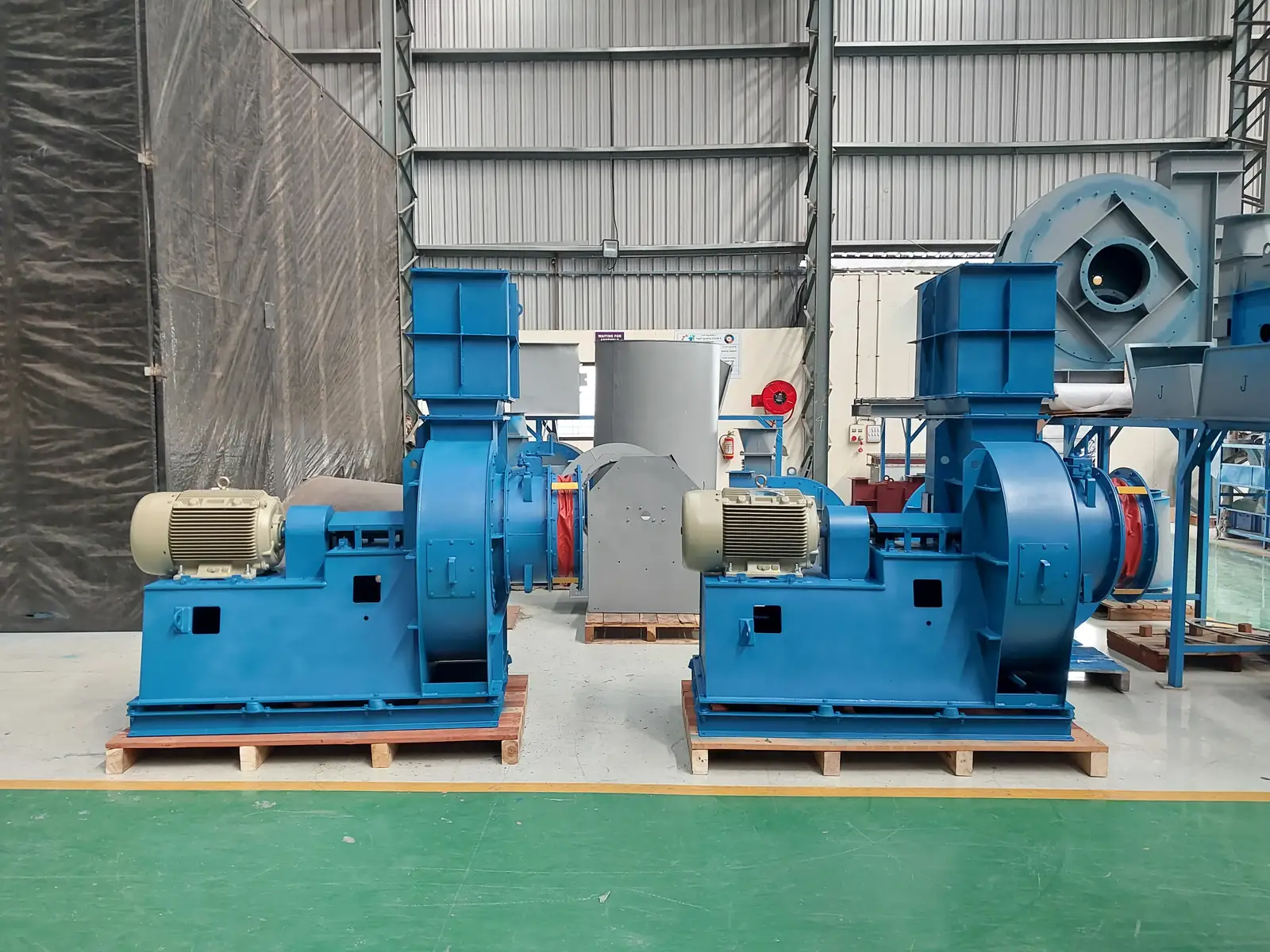
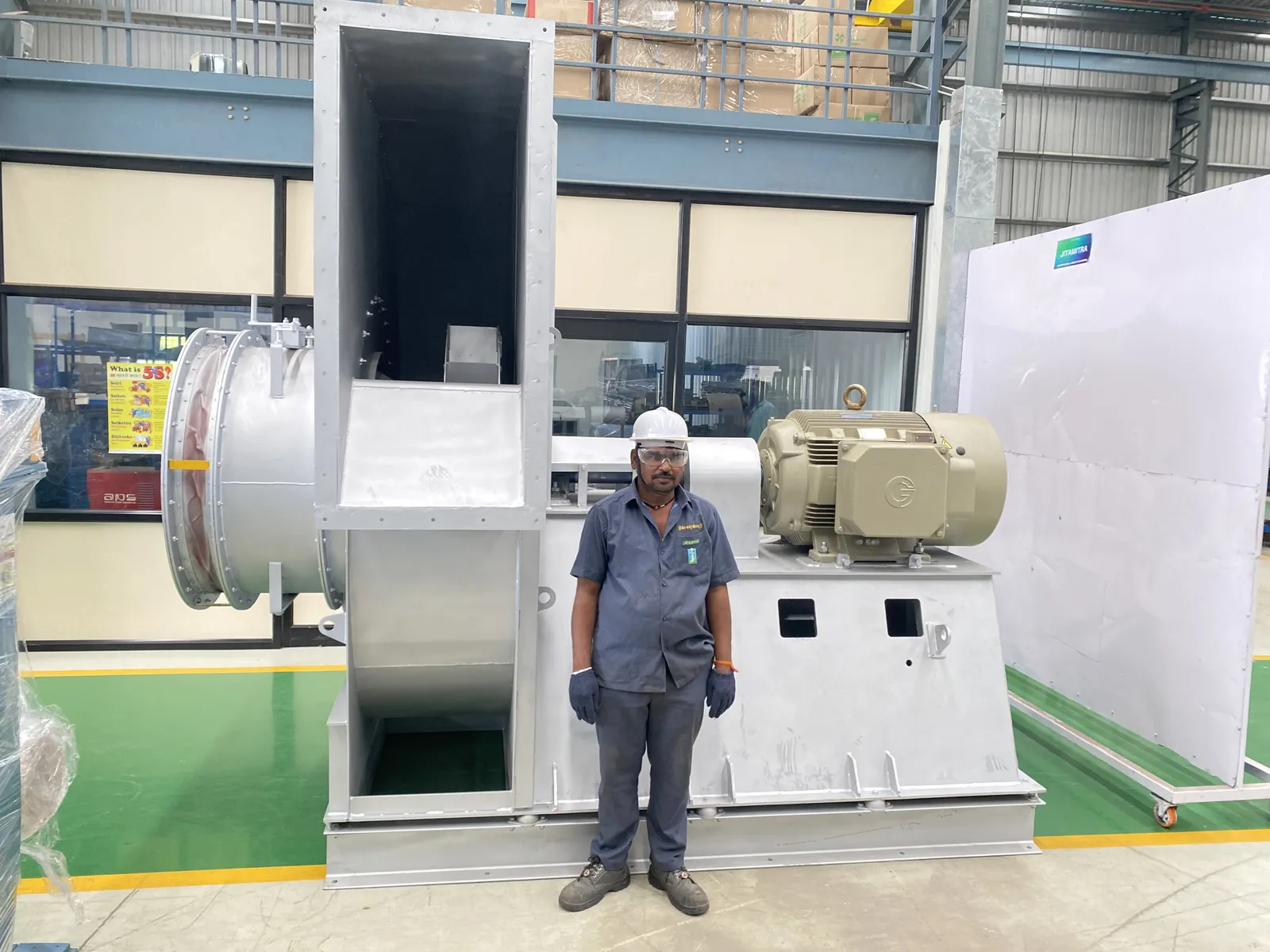
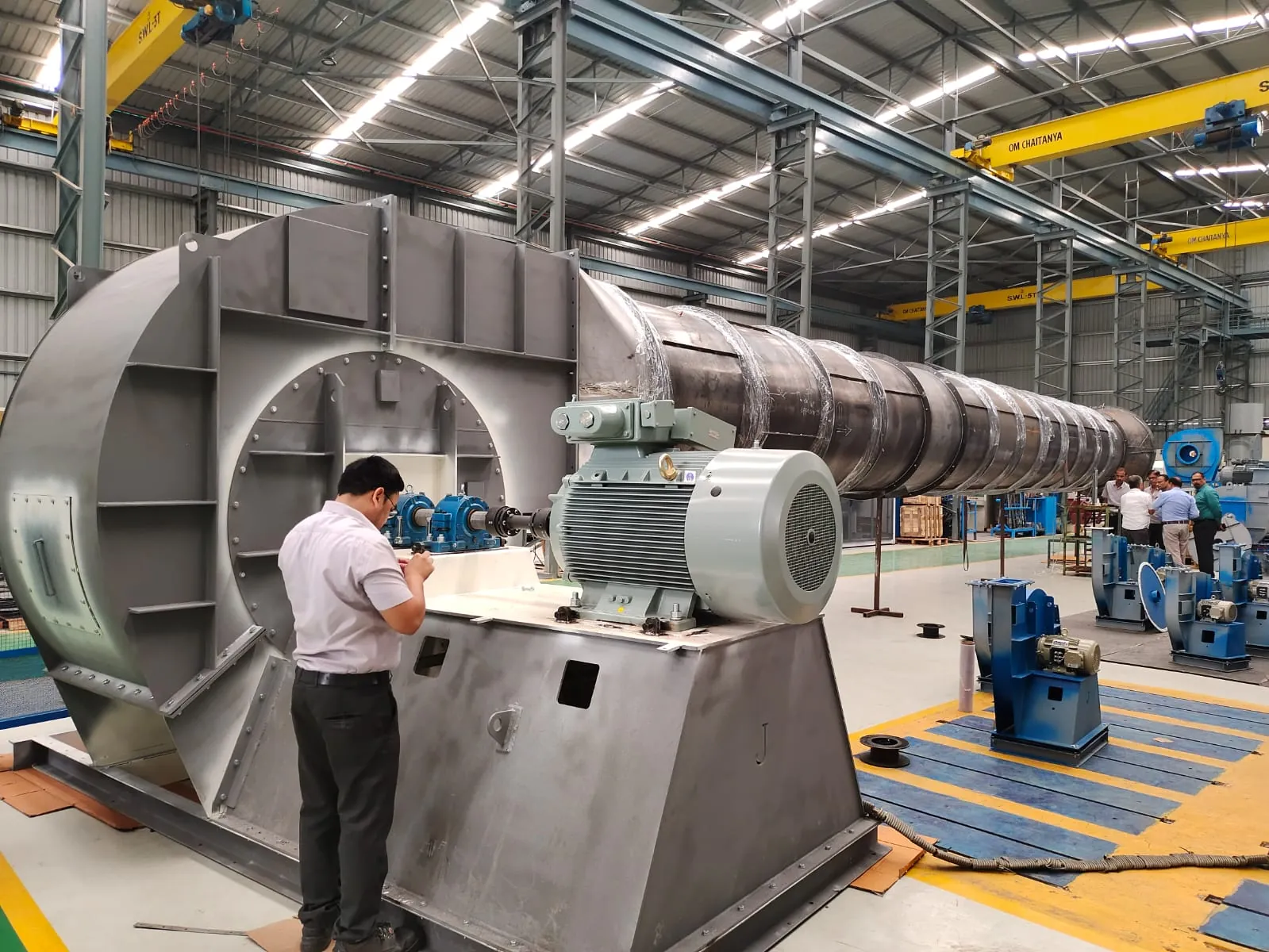
Corrosion-resistant centrifugal booster fan for a flue-gas desulphurisation train on the Jitamitra shop floor
Home  /  Applications  /  FGD / scrubber booster
Applications

FGD / scrubber booster fans — built for wet, corrosive, saturated gas.

A booster fan makes up the pressure drop a wet or dry flue-gas desulphurisation (FGD) or scrubber train adds to the flue-gas path. Unlike a dry ID fan, this duty runs below the water dew point: the gas leaves the absorber saturated, acidic and carrying droplets, so the fan wall is permanently wet and every wetted surface is under corrosion attack. Get the metallurgy or lining and the drainage right and it runs for years; treat it as a dry gas fan and it thins through in months. We build FGD / scrubber booster fans across power, cement, iron & steel and chemicals, across the full envelope below — up to 2,00,000 CMH, 2,000 mmWC and 400 HP.

2,00,000CMH max flow
2,000mmWC max static
wetbelow dew point
400 HPdrive power
15,000+
fans built since 2011
200 HP
VFD test rig · IS 4894 / AMCA 210
99%
on-time delivery
3
working days to quote — always
AFTER THE ABSORBER · SATURATED ACIDIC GAS · BELOW THE DEW POINT · DRIVING THROUGH THE FGD TRAIN
What it does

A booster fan makes up the FGD pressure drop — and the whole duty is wet.

An FGD / scrubber booster fan sits in the flue-gas path to overcome the extra resistance the desulphurisation train adds: pushing gas through the absorber, mist eliminator and outlet ducting, holding the draught the upstream boiler or kiln needs, and doing it on gas that has left the absorber saturated and acidic — permanently below the water dew point.

  • 01
    Boost

    Make up the resistance the FGD train adds on top of the base draught — the absorber, spray zone and mist eliminator alone can add 100–400 mmWC, depending on whether the fan sits upstream or downstream of the absorber.

  • 02
    Hold

    The draught the boiler or kiln upstream depends on. A booster is often retrofitted into an existing path, so we size it to the real, measured system resistance across the added train, not a nameplate figure.

  • 03
    Survive wet

    Saturated, acidic gas 45–70 °C carrying droplets and sometimes fine gypsum or lime carry-over. The gas is below the dew point by design, so the fan runs permanently wet — metallurgy, lining and drainage carry the duty, not wear plates.

INDUCED-DRAFT CENTRIFUGAL FAN Single-width single-inlet — scroll cut away to reveal the impeller inlet expansion joint MOTOR IE3 / VFD GAS IN GAS OUT n 1 2 3 4 5 6 7 8 9 10 1 Inlet cone (bell-mouth) 2 Backward-curved / radial-tipped impeller 3 Spiral volute casing 4 Replaceable AR wear plates (volute throat) 5 Shaft 6 Plummer-block bearings (L10 ≥ 40,000 h) 7 Shaft cooling disc (>400 °C duty) 8 Pedestal / base frame 9 Drive — motor + coupling 10 Outlet flange + duct take-off
Fig. 1FGD / scrubber booster centrifugal fan — single-width single-inlet, scroll cut away to reveal the impeller, with the casing drain and corrosion-resistant lining indicated. Numbered components keyed below the drawing.
Why it is hard

Below the dew point, three wet-gas failure modes decide whether the fan lasts years or months.

This is not a dry ID fan. The gas leaves the absorber saturated and acidic, so the fan runs permanently below the water dew point — the wall never dries out. Corrosion, condensate handling and gypsum fouling attack the same wetted casing and wheel. Design for the wet gas, and the fan runs 8+ years between overhauls. Specify it as a dry gas fan and the acid takes the wetted surfaces down in 6–18 months.

01 — CORROSION

Wet acid attack below the dew point

Saturated FGD gas condenses dilute sulphuric, hydrochloric and fluoric acid on every wetted surface. Below the dew point the casing and wheel never dry out, so pitting and general thinning run continuously — the mode that destroys an FGD fan built as if it were dry.

How we engineer it out

Wetted-surface metallurgy matched to the condensate chemistry — 316L / duplex / super-duplex, or an FRP construction or rubber / ebonite lining on carbon steel where chlorides rule out austenitic steel — selected against your absorber outlet gas analysis, not a default.

02 — CONDENSATE

Droplet carry-over and standing liquid

Downstream of the absorber the gas carries entrained droplets and mist-eliminator carry-over. Liquid collects in the scroll; if it cannot drain it pools, accelerates corrosion at the low point and unbalances the wheel as it swings with load.

How we engineer it out

Self-draining casing geometry with a low-point drain, sloped scroll and continuous run-off, a shaft seal rated for the wet acidic gas, and — on a downstream-of-absorber position — an inlet arrangement that sheds droplets rather than pooling them.

03 — FOULING

Gypsum / lime deposition and balance loss

Wet-limestone and semi-dry scrubbers carry fine gypsum or lime solids that build up on the blades. The deposit is sticky and uneven, so the wheel drifts out of balance and the vibration climbs long before any structural wear — a fouling problem, not an erosion one.

How we engineer it out

A backward-curved / radial-tip wheel that sheds solids from the blade root rather than packing them, a wash-water / soot-blower connection and access doors for in-place cleaning, and balance margin held so a modest deposit does not push the fan past its vibration limit.

How we design for it

Every choice is documented on the GA drawing you sign off — before we cut metal.

We don't sell a catalogue near-fit. The fan is engineered to your absorber outlet gas analysis, saturation temperature, droplet and solids carry-over and the measured pressure drop of your train — made to order, not off a shelf.

  • Materials & corrosion protection — Wetted-surface selection driven by the condensate chemistry — 316L for mild acid; duplex / super-duplex for aggressive chloride-bearing gas; FRP construction, or rubber / ebonite lining on a carbon-steel shell, where chlorides rule out stainless. The corrosion allowance and lining spec are set against your gas analysis.
  • Wheel geometry — Backward-curved or radial-tip by default for good efficiency and solids-shedding on the wet, lightly-loaded gas; the geometry is chosen to keep the blade root clear of gypsum build-up rather than to resist heavy abrasion, which is not the dominant mode here.
  • Drainage & sealing — Self-draining scroll with a low-point drain so condensate cannot stand; a shaft seal (mechanical or purged labyrinth) rated for the wet acidic gas; and a wash-water connection for periodic de-scaling without dismantling the fan.
  • Control — VFD as default — FGD draught varies with boiler load and absorber operation, so speed control earns its place. VFD is our default — it avoids the throttling loss of a damper at part load and keeps the fan off its surge line as the train pressure drop moves; inlet vane or outlet dampers remain available for legacy retrofit.
Engineered to your duty point

We size the fan onto the added FGD resistance — then prove the curve on the rig.

No catalogue fan forced onto your spec. Your operating point is engineered onto the best-efficiency region of the selected wheel against the measured system resistance across the added FGD train — including the wet-gas density at saturation — then verified on the 200 HP VFD test rig before dispatch.

avoid: unstable 0 40,000 80,000 1,20,000 1,60,000 2,00,000 VOLUME FLOW RATE  [ CMH ] 0 500 1000 1500 2000 STATIC PRESSURE  [ mmWC ] 0 25 50 75 100 STATIC EFFICIENCY  [ % ] Fan static pressure System resistance Static efficiency BEP 82% DUTY POINT 1,20,000 CMH · 450 mmWC Fan static pressure System resistance Static efficiency
Fig. 2Representative FGD-booster characteristic — fan static pressure, the added-train system resistance and static efficiency vs. flow, with the duty point engineered onto the best-efficiency region. Illustrative; every fan is sized to its own duty and gas density.
Capability envelope — FGD / scrubber booster service

What we can supply, and where it stretches on application.

ParameterStandardOn application
Volume flowup to 2,00,000 CMHhigher on enquiry
Static pressureup to 2,000 mmWCsized to the measured added-train resistance
Gas conditionsaturated, below dew point 45–70 °Chigher on a reheated / upstream-of-absorber position
Wetted metallurgy316L / duplex on the wetted surfacessuper-duplex, FRP or rubber / ebonite lining per gas analysis
Drainageself-draining scroll + low-point drainwash-water / de-scale connection on application
Drive powerup to 400 HPhigher with custom motor sourcing
Speed600–1,800 RPM typicalper duty + sound limits
Balance qualityISO 21940 G6.3G2.5 / G1.0 on application

The envelope above covers the great majority of FGD / scrubber booster duty. The defining condition is that the gas is saturated and below the water dew point, so metallurgy, lining and drainage carry the design, not wear protection — wetted surfaces run 316L or duplex as standard, super-duplex, FRP or rubber / ebonite lining where chlorides rule out austenitic steel. Solids carry-over from a wet-limestone or semi-dry scrubber is a fouling / balance problem, managed with solids-shedding wheel geometry and a wash-water connection rather than heavy hard-facing. Bearing life is a design target of L10h ≥ 40,000 h continuous, longer on application. For duty beyond the envelope we engineer to spec and quote on enquiry.

How a Jitamitra FGD fan is specified

Specified, not picked from a shelf.

The same engineering language carries from your enquiry to the GA drawing to the nameplate — expressed in the standard AMCA conventions, with the wetted metallurgy and drainage scope alongside.

Specification fieldOptions
Arrangement (AMCA 99)Arr. 1 (overhung, fan bearings) / Arr. 4 (direct, motor on base) / Arr. 8 (overhung on common base) / Arr. 9 (overhung, motor side) / Arr. 10 (overhung, motor inside base) — selected by drive, access and the wet-gas shaft-seal arrangement.
Width / inletSWSI (single width, single inlet) default for booster duty; DWDI (double width, double inlet) for high flow at moderate pressure where the added-train resistance is modest.
Wheel typeBackward-curved (default, best efficiency on the wet lightly-loaded gas) / radial-tip (heavier gypsum or lime carry-over, better solids-shedding) — geometry chosen to keep the blade root clear of build-up.
Class (by pressure / outlet velocity)Class I / II / III selected from the duty point on the pressure-vs-outlet-velocity limits; higher class = heavier construction for higher pressure and tip speed.
Materials of construction316L on the wetted surfaces (mild acid) / duplex or super-duplex (aggressive chloride-bearing gas) / FRP construction or rubber / ebonite lining on a carbon-steel shell where chlorides rule out austenitic steel — selected against the absorber outlet gas analysis.
DriveDirect-coupled / V-belt / VFD (default for variable-draught control). Drive up to 400 HP across the envelope; speed typically 600–1,800 RPM.
Discharge & rotation (AMCA orientation)Rotation CW or CCW (viewed from drive side) with discharge angle per AMCA — e.g. TH/BH/UB/DB — set to match your duct take-off and installed footprint, with the drain kept at the low point.
Accessories & wet-duty scopeSelf-draining scroll with low-point drain; shaft seal (mechanical or purged labyrinth) rated for wet acidic gas; wash-water / de-scale connection and access doors; expansion joints at the flanges; inlet vane or outlet damper or VFD control; special coating / paint on non-wetted external surfaces; drain and inspection doors.
The proof, not the promise

We test before we ship — and you're welcome to witness it.

Every job's performance is verified at our works on the 200 HP VFD test rig, to the AMCA 210 / ISO 5801 method, before dispatch.

  • Customer-witnessed FAT on request — at no extra cost
  • Rotors balanced to ISO 21940 G6.3 as standard (G2.5 / G1.0 on application) before they leave the floor
  • Full NDT in-house — DP, MPI, UT, RT — to what the duty demands
30+ INDUSTRIES · 45 APPLICATION / DUTY TYPES
Where our FGD / scrubber booster fans run

Proven on the wet side of the desulphurisation train.

Power Generation

Wet-limestone and semi-dry FGD booster fans downstream of utility and cogen boilers.

Cement & Lime

Kiln-line SO₂ scrubber and semi-dry absorber booster fans.

Iron & Steel

Sinter-plant and coke-oven flue-gas desulphurisation and wet-scrubber boosters.

Chemicals & Petrochem

Acid-gas and tail-gas scrubber booster fans on process off-gas.

Pollution-control OEMs

Booster fans supplied as a sub-package to wet-scrubber and FGD builders — wetted metallurgy and interface documented up front.

Waste-to-Energy

Wet and semi-dry scrubber booster fans on chloride-laden incinerator flue gas.

Non-Ferrous & Smelting

SO₂-rich smelter off-gas scrubber booster duty on corrosion-resistant construction.

Your process

45 application/duty types engineered. Tell us yours.

Standards & conformity

Stated precisely — because procurement checks.

What our marks mean, in the words that survive an audit.

Performance

Tested to the AMCA 210 / ISO 5801 method, in-house on our 200 HP VFD rig. Tested-to-method — not AMCA-certified.

Quality system

ISO 9001:2015 — third-party certified. Our only third-party certification.

CE conformity

Self-declared per 2006/42/EC + 2014/35/EU (Module A). A self-declaration, not a notified-body certificate.

ATEX conformity

Self-declared, Zone 2/22, Category 3, per 2014/34/EU, where the area classification calls for it.

Oil & gas duty

Designed and built to API 673 as project-specific scope.

Welding

ASME Sec IX qualified welders + WPS for every joint.

Balance

ISO 21940 — G6.3 minimum, G2.5 / G1.0 on application.

Vibration

ISO 20816 evaluation; ISO 14694 for fan-specific limits.

Lead time & process

From enquiry to a tested fan on your dock.

StageStandard dutyAPI-673 / engineered
Offer / quotation3 working days — always7–10 working days
GA drawing for approval2–3 weeks from PO3–4 weeks from PO
Manufacture + balance + paint6–10 weeks10–14 weeks
Performance test + witnessed FAT~1 week1–2 weeks
Order-to-dispatch (total)9–14 weeks14–20 weeks

Shutdown-driven replacements: we have shipped fans within 6 weeks of a clean PO. Tell us your shutdown window and we commit to a dated plan.

Questions engineers ask

The eight we hear most before a PO.

Why is an FGD booster fan different from a normal ID fan?
A dry ID fan sits in hot flue gas above the acid dew point, so its wetted surfaces stay dry and the failure modes are erosion and wear. An FGD booster sits after the absorber, where the gas has left the scrubber saturated and acidic and runs permanently below the water dew point. The casing and wheel never dry out, so the dominant failure mode is wet acid corrosion, backed by droplet carry-over and gypsum or lime fouling. That is why the design leads with metallurgy, lining and drainage rather than wear plates. We size the fan to your absorber outlet gas, not a generic ID rating.
What materials do you use on the wetted surfaces?
It depends on your condensate chemistry, which we take from the absorber outlet gas analysis. For mild acid we use 316L. For aggressive chloride-bearing gas we move to duplex or super-duplex stainless. Where the chloride level rules out austenitic stainless we use an FRP construction, or a rubber or ebonite lining on a carbon-steel shell. The corrosion allowance and lining specification are set against your gas analysis and dew-point margin, not a default, because the wrong metallurgy on a wet acidic gas thins through in months.
The gas is saturated and carries droplets. How do you handle the condensate?
We design the fan to stay self-draining. The scroll is sloped to a low-point drain so condensate cannot pool, the shaft seal is rated for the wet acidic gas, and on a downstream-of-absorber position the inlet arrangement sheds entrained droplets rather than pooling them. Standing liquid is what accelerates corrosion at the low point and unbalances the wheel as it swings with load, so continuous run-off is a design requirement, not an accessory. Tell us the droplet and mist-eliminator carry-over and we build the drainage to it.
Our scrubber carries gypsum and lime. Will the fan foul and go out of balance?
Wet-limestone and semi-dry scrubbers carry fine gypsum or lime solids that build up on the blades. The deposit is sticky and uneven, so the wheel drifts out of balance and vibration climbs before there is any structural wear. This is a fouling problem, not an erosion one, so we use a backward-curved or radial-tip wheel that sheds solids from the blade root rather than packing them, add a wash-water connection and access doors for in-place cleaning, and hold balance margin so a modest deposit does not push the fan past its vibration limit. Heavy hard-facing is the wrong answer here.
Should the booster sit upstream or downstream of the absorber?
Both positions are used and the answer changes the whole build. Upstream of the absorber the gas is hotter and drier but the fan still adds the train pressure drop; downstream the gas is saturated, acidic and droplet-laden, which is the harder, fully wet duty. A downstream fan gets the full wetted-metallurgy, drainage and seal package; an upstream or reheated position may allow a lighter build. Tell us where the fan sits and the reheat scheme, and we build to that position rather than assuming the worst or the best.
It is a retrofit into an existing flue-gas path. Can you size to the real system?
Yes, and a booster is usually a retrofit. We size to the measured system resistance across the added FGD train, not a nameplate figure, so the fan makes up the real pressure drop without robbing the upstream boiler or kiln of draught. We reverse-engineer to the existing duct orientation, bearing centres and foundation where you want a drop-in fit, and we account for the wet-gas density at saturation, which is lower than the dry gas the original path was sized for. Send the measured train resistance, the gas analysis and the existing GA and we match it.
Do you supply just the fan to a scrubber or FGD OEM as a sub-package?
Yes. We supply booster fans separately to wet-scrubber manufacturers and FGD builders. You specify the duty, the absorber outlet gas analysis and the integration interface — flange dimensions, wetted metallurgy or lining, drainage and seal scope, electrical interface and control protocol — and we document it up front and deliver the fan ready to mate. The engineering is identical to a direct-buyer fan; only the integration interface and who buys it differ. We have executed this duty on a handful of projects and build every one to its own gas analysis.
Do you build to API 673, CE and ATEX, and what do those claims actually mean?
We design and build to API 673 for oil and gas and refinery duty as project-specific scope (allow 7 to 10 working days for the offer). CE is self-declared per 2006/42/EC and 2014/35/EU, and ATEX Zone 2/22 is self-declared per 2014/34/EU (Category 3) where the area classification calls for it. To be precise, those are self-declarations of conformity, not third-party certifications. Performance is tested in-house to the AMCA 210 / ISO 5801 method on our 200 HP VFD test rig, not AMCA-certified, and we are not an AMCA member. Balance is to ISO 21940 G6.3 as standard, with G2.5 or G1.0 on application, and bearing life is a design target of L10h at or above 40,000 hours. Our only third-party certification is ISO 9001:2015.

Across the range

Where fgd / scrubber booster fans fit — the fans that run them, related duties, and the industries served.

The same engineering, viewed three ways — by fan family, by duty, and by industry. Follow the cross-references.

Take it further

Specs an engineer can use — not a brochure.

Engineer to engineer

Send us the duty point.
We'll quote in 3 working days — always.

No model numbers needed. Give us the operating conditions — flow, static, gas temperature, composition, particulate, and any tender standard — and our application engineers size the fan and quote it. Attach a spec or GA if you have one.

+91 90110 09155  ·  mihir.jitamitra@gmail.com