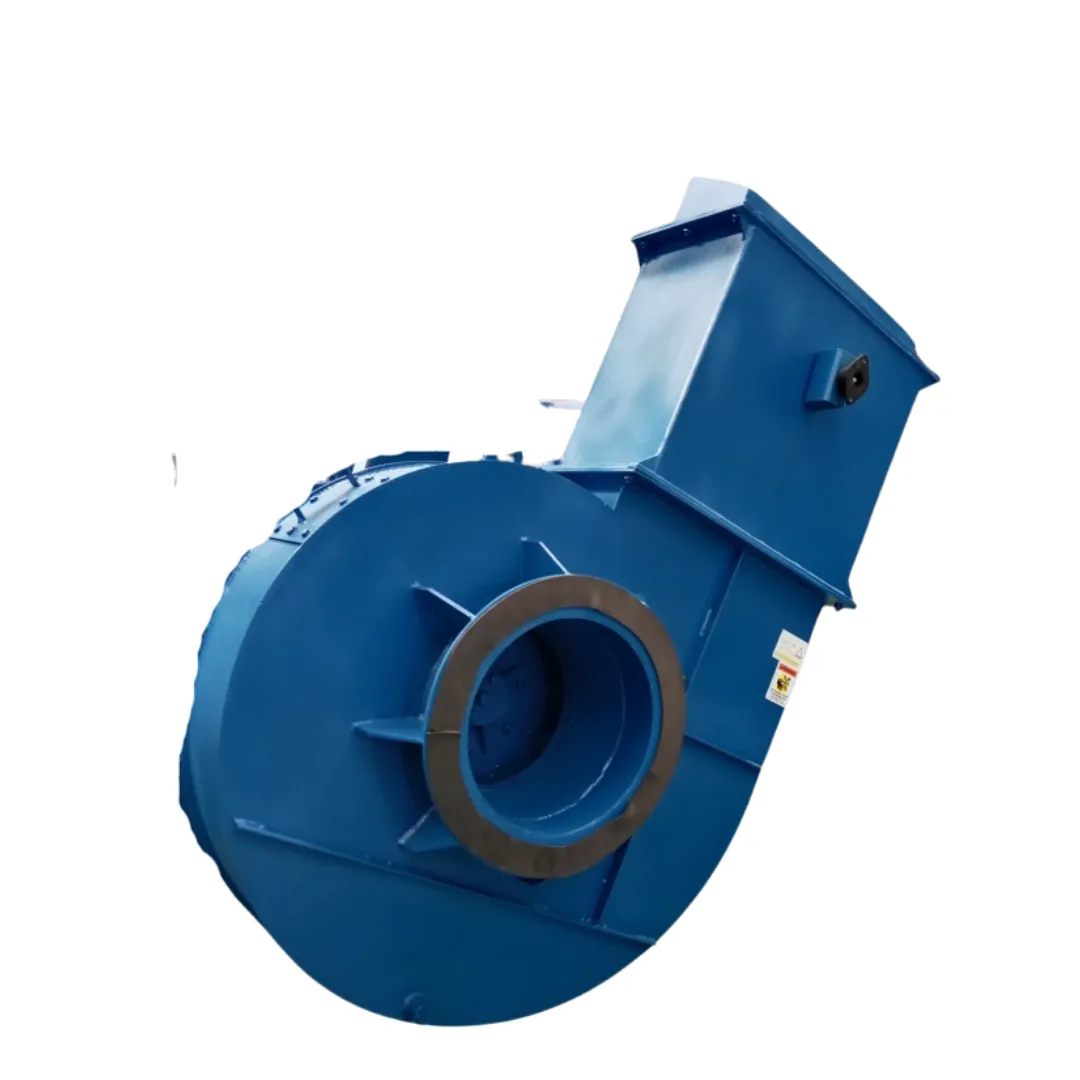
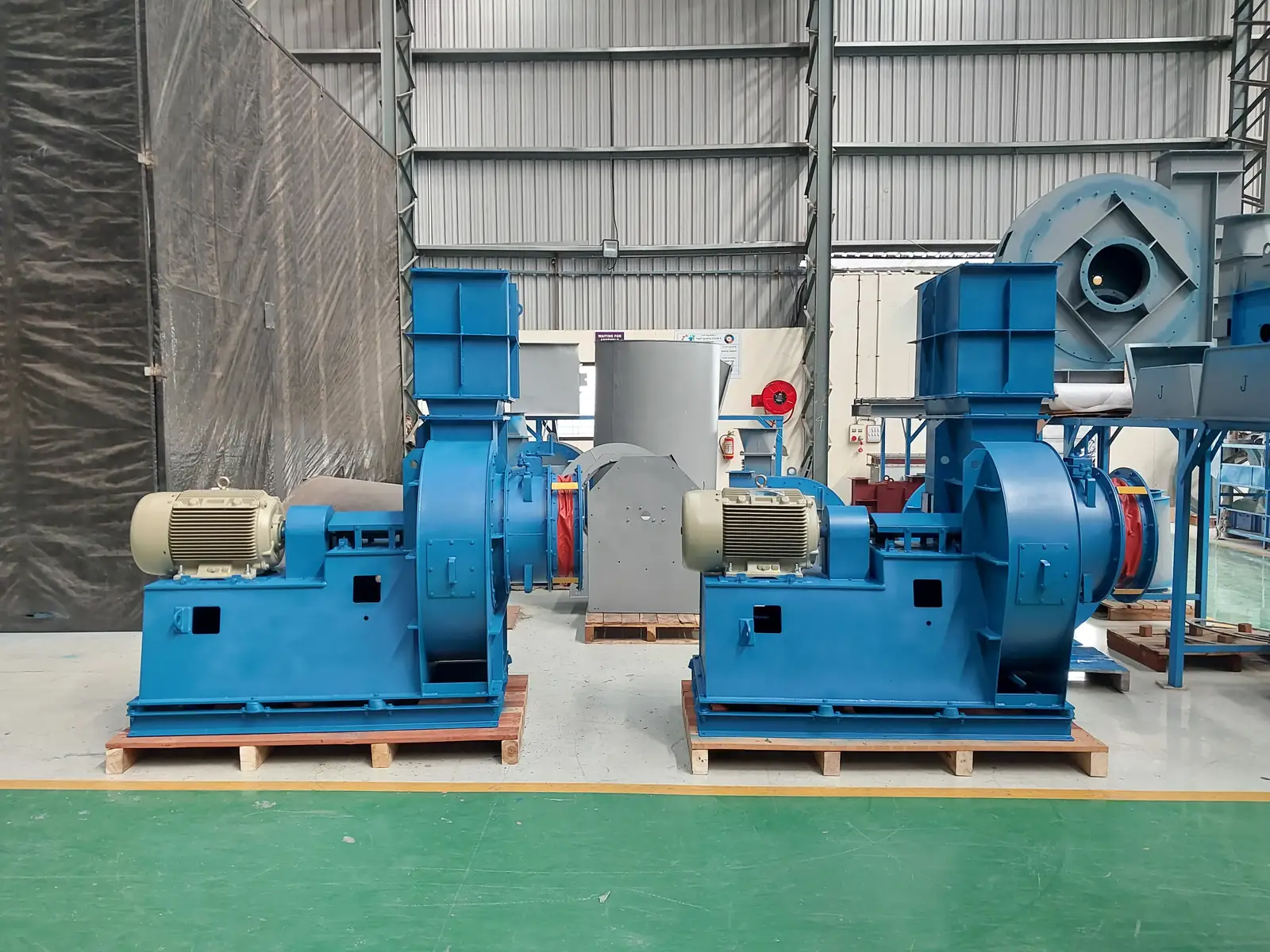
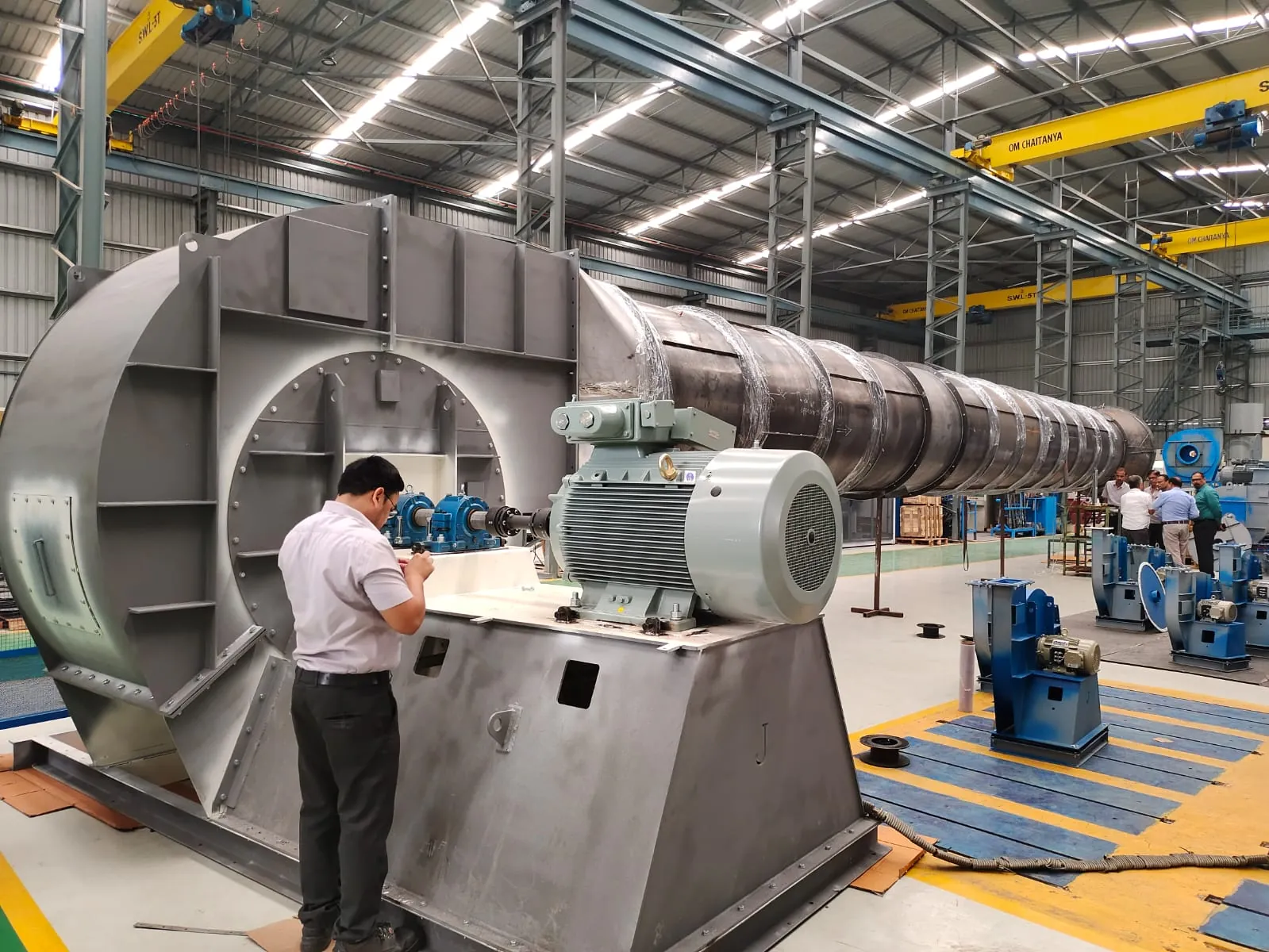
Large clean-side centrifugal draught fan downstream of a baghouse on the Jitamitra shop floor
Home  /  Applications  /  ESP / baghouse main fan
Applications

ESP / baghouse main fan — the high-flow draught that pulls the whole train to stack.

The main fan sits at the tail of the gas-cleaning train: pulling process gas through the electrostatic precipitator or baghouse, holding the collector and ducting under negative pressure, and discharging clean gas to the stack. It runs clean-side, so dust is low — but it is usually the largest single motor in the plant, and the collector's pressure drop moves under it every hour. We build main draught fans across cement, power, iron & steel and pollution-control OEMs, from single-field ESPs to large multi-field baghouses, across the full envelope below — up to 2,00,000 CMH, 2,000 mmWC and 400 HP. This is one of our strongest applications: 34 customer duties and counting.

2,00,000CMH max flow
2,000mmWC max static
600 °Cgas temperature
400 HPdrive power
15,000+
fans built since 2011
200 HP
VFD test rig · IS 4894 / AMCA 210
99%
on-time delivery
3
working days to quote — always
DOWNSTREAM OF THE COLLECTOR · NEGATIVE DRAFT · CLEAN GAS AFTER ESP / BAGHOUSE · TO STACK
What it does

It moves the whole gas train — but the resistance under it never sits still.

An ESP / baghouse main fan sits downstream of the collector: pulling process gas through the entire cleaning train, holding the collector and upstream ducting under negative pressure, and discharging cleaned gas out to the stack. The gas is clean after collection — the engineering fight is the moving system resistance and the sheer size of the motor.

  • 01
    Pull

    The full system resistance — collector, ducting, dampers, stack — which on a multi-field ESP or baghouse train totals 150–1,500 mmWC and rises as the bags load or fields foul.

  • 02
    Hold

    The collector and process under target negative draft so no gas escapes to the shop — typically −10 to −50 mmWC at the fan inlet, held steady while the collector dP swings.

  • 03
    Deliver clean

    Gas after the ESP or bag filter runs light — inlet loading light in normal service. Wear is minimal; the focus shifts to efficiency, curve stability and the upset case.

INDUCED-DRAFT CENTRIFUGAL FAN Single-width single-inlet — scroll cut away to reveal the impeller inlet expansion joint MOTOR IE3 / VFD GAS IN GAS OUT n 1 2 3 4 5 6 7 8 9 10 1 Inlet cone (bell-mouth) 2 Backward-curved / radial-tipped impeller 3 Spiral volute casing 4 Replaceable AR wear plates (volute throat) 5 Shaft 6 Plummer-block bearings (L10 ≥ 40,000 h) 7 Shaft cooling disc (>400 °C duty) 8 Pedestal / base frame 9 Drive — motor + coupling 10 Outlet flange + duct take-off
Fig. 1ESP / baghouse main fan — single-width single-inlet, scroll cut away to reveal the backward-curved impeller. Numbered components keyed below the drawing.
Why it is hard

Clean gas, big motor — three things decide whether the main fan is cheap to run or a stall risk.

Low dust does not make the duty easy. The main fan is usually the plant's biggest single power draw, so efficiency sets the lifetime bill; the collector's pressure drop moves under it across every pulse-clean cycle and field, so the curve must stay stable; and a bag burst or ESP upset can dump abrasive dust onto a wheel never meant to carry it. Design for those, and the fan runs 10+ years between major overhauls. Size it as a fixed-point clean-air fan, and the moving resistance drives it into instability.

01 — MOVING dP

Collector pressure drop that never sits still

Baghouse dP climbs as media loads between pulse-clean cycles and steps back down after each pulse; an ESP fouls and is rapped clean by field. Sized onto a single fixed duty point, the fan drifts toward its curve limits as the resistance moves and can hunt or stall.

How we engineer it out

We size the operating point onto the falling, stable portion of the selected wheel — typically 5–15% right of the peak — and set the curve to span the clean-collector and fully-loaded points without running at a control limit. VFD default holds draft as the dP moves.

02 — EFFICIENCY

The plant's biggest single motor

The main draught fan is usually the largest motor on the line, running continuously at high power. A few points of static efficiency, held for 8,000 h/yr across a 20-year life, decides whether the fan is quietly cheap or quietly expensive to run.

How we engineer it out

Backward-curved / backward-inclined wheels for high static efficiency on standard clean-gas duty; airfoil-bladed impellers for higher efficiency on the large continuous-duty builds where the hours justify the CAPEX. VFD instead of a throttling damper across the load range.

03 — UPSET

Bag burst and ESP upset dust carryover

Clean-side is only clean while the collector works. A burst bag row, a tripped ESP field or a start-up puff dumps abrasive dust straight onto a wheel selected for light loading — the documented way an otherwise-clean main fan loses balance early.

How we engineer it out

Impeller geometry and material chosen with the upset case in mind, not just the nominal duty; optional hard-faced leading edges and bolted-in AR400 wear plates at the throat and outlet where the collector's failure mode warrants it — replaceable in place, not welded in.

How we design for it

Every choice is documented on the GA drawing you sign off — before we cut metal.

We don't sell a catalogue near-fit. The fan is engineered to your gas, collector type, dP range, temperature and operating point — made to order, not off a shelf.

  • Impeller geometry — Backward-curved or backward-inclined for the highest static efficiency on clean-gas duty; airfoil-bladed on the largest continuous-duty builds where the hours justify the CAPEX. Geometry chosen with the collector's upset case in mind, not just the nominal loading.
  • Materials & upset protection — Mild steel + epoxy coating standard for clean-gas service; optional hard-faced (chrome-carbide) leading edges and bolted-in AR400 wear plates where a bag burst or ESP trip can carry abrasive dust; 316L / Corten where the gas carries acid dew-point risk.
  • Control — VFD as default — The collector dP swings and the process turns down, so the duty is inherently variable. VFD speed control holds draft across the moving resistance and is more efficient than an inlet damper across the range because it avoids the throttling loss at part-load; inlet vane dampers remain available for legacy retrofit.
  • Thermal & dew-point handling — Clean-side gas commonly runs 120–200 °C, higher on hot-ESP service to 350 °C and beyond; casing upgraded to IS 2062 or 16Mo3, expansion joints for thermal growth, and casing insulation + tracing where the wall risks falling below acid dew point.
Engineered to your duty point

We size the fan to span the collector's dP range on the stable side of its curve — then prove it on the rig.

No catalogue fan forced onto your spec. Your operating point is engineered across the clean-collector and fully-loaded range — onto the falling, stable portion of the selected wheel, 5–15% right of the peak — and verified on the 200 HP VFD test rig before dispatch.

avoid: unstable 0 40,000 80,000 1,20,000 1,60,000 2,00,000 VOLUME FLOW RATE  [ CMH ] 0 500 1000 1500 2000 STATIC PRESSURE  [ mmWC ] 0 25 50 75 100 STATIC EFFICIENCY  [ % ] Fan static pressure System resistance Static efficiency BEP 82% DUTY POINT 1,20,000 CMH · 450 mmWC Fan static pressure System resistance Static efficiency
Fig. 2Representative main-fan characteristic — fan static pressure, system resistance (clean and loaded collector) and static efficiency vs. flow, with both operating points engineered onto the falling, stable region right of the peak. Illustrative; every fan is sized to its own duty.
Capability envelope — ESP / baghouse main-fan service

What we can supply, and where it stretches on application.

ParameterStandardOn application
Volume flowup to 2,00,000 CMHhigher on enquiry
Static pressureup to 2,000 mmWChigher on enquiry
Gas temperature120–200 °C typical clean-sideup to 600 °C on hot-ESP service with special metallurgy
Inlet dust loadinglight on clean-side normal serviceupset-case wear protection on application
Static efficiencyhigh on standard dutyhigher on high-efficiency airfoil builds
Drive powerup to 400 HPhigher with custom motor sourcing
Speed600–1,800 RPM typicalper duty + sound limits
Balance qualityISO 21940 G6.3G2.5 / G1.0 on application

The envelope above covers the great majority of ESP / baghouse main-fan duty. For duty beyond it, we engineer to spec and quote on enquiry. Inlet loading is normally light on clean-side service — light downstream of a working collector — but we size the impeller and optional wear scope for the upset case (bag burst, ESP field trip, start-up puff), not just the nominal loading. Gas temperature runs 120–200 °C on most clean-side duty and up to 600 °C on hot-ESP service with special metallurgy. Bearing life is a design target of L10h ≥ 40,000 h continuous, with longer L10 on application.

How a Jitamitra ESP fan is specified

Specified, not picked from a shelf.

The same engineering language carries from your enquiry to the GA drawing to the nameplate — expressed in the standard AMCA conventions.

Specification fieldOptions
Arrangement (AMCA 99)Arr. 1 (overhung, fan bearings) / Arr. 4 (direct, motor on base) / Arr. 8 (overhung on common base) / Arr. 9 (overhung, motor side) / Arr. 10 (overhung, motor inside base) — selected by drive, access and temperature.
Width / inletSWSI (single width, single inlet) default for main-fan duty; DWDI (double width, double inlet) for the high flow at moderate pressure typical of large collector trains.
Wheel typeBackward-curved or backward-inclined (default, best efficiency on clean gas) / airfoil-bladed (highest-efficiency, large continuous-duty builds) / radial-tipped where upset carryover warrants a self-cleaning wheel.
Class (by pressure / outlet velocity)Class I / II / III selected from the duty point on the pressure-vs-outlet-velocity limits; higher class = heavier construction for higher pressure and tip speed.
Materials of constructionMild steel + epoxy coating (standard clean-gas) / optional chrome-carbide-faced wheel and AR400 bolted wear plates for upset carryover / IS 2062 or 16Mo3 casing for hot-ESP heat / 316L or Corten for acid dew-point service.
DriveDirect-coupled / V-belt / VFD (default for the moving-dP and turndown control). Drive up to 400 HP across the envelope; speed typically 600–1,800 RPM.
Discharge & rotation (AMCA orientation)Rotation CW or CCW (viewed from drive side) with discharge angle per AMCA — e.g. TH/BH/UB/DB — set to match your stack take-off and installed footprint.
Accessories & thermal scopeInlet vane damper or VFD control; isolation / shut-off damper for collector maintenance; flexible connection / expansion joints for thermal growth; optional bolted-in AR400 wear plates and access doors for upset carryover; casing insulation and heat tracing for acid dew-point service; inlet / discharge silencers and acoustic-lagged casing where the fan sits near occupied space; drain and inspection doors.
The proof, not the promise

We test before we ship — and you're welcome to witness it.

Every job's performance is verified at our works on the 200 HP VFD test rig, to the AMCA 210 / ISO 5801 method, before dispatch.

  • Customer-witnessed FAT on request — at no extra cost
  • Rotors balanced to ISO 21940 G6.3 as standard (G2.5 / G1.0 on application) before they leave the floor
  • Full NDT in-house — DP, MPI, UT, RT — to what the duty demands
30+ INDUSTRIES · 45 APPLICATION / DUTY TYPES
Where our main fans run

Proven pulling the whole train through the collector to stack.

Cement & Lime

Kiln / raw-mill ESP main fan, bag-house main fan, cooler and clinker de-dusting draught.

Power Generation

Boiler ESP main fan, clean-side draught downstream of the precipitator on utility and cogen units.

Iron & Steel

Sinter-plant and pellet-plant ESP main fan, de-dusting baghouse draught to stack.

Pollution-control OEMs

Main fans supplied as a sub-package to ESP and baghouse builders — interface documented up front.

Chemicals & Petrochem

Process-collector main draught, dryer and calciner de-dusting to stack.

Foundry & Casting

Melt-shop and shake-out baghouse main fans pulling the de-dusting train.

Glass & Ceramics

Furnace and dryer ESP / baghouse main fan on the clean side of the collector.

Your process

45 application/duty types engineered. Tell us yours.

Standards & conformity

Stated precisely — because procurement checks.

What our marks mean, in the words that survive an audit.

Performance

Tested to the AMCA 210 / ISO 5801 method, in-house on our 200 HP VFD rig. Tested-to-method — not AMCA-certified.

Quality system

ISO 9001:2015 — third-party certified. Our only third-party certification.

CE conformity

Self-declared per 2006/42/EC + 2014/35/EU (Module A). A self-declaration, not a notified-body certificate.

ATEX conformity

Self-declared, Zone 2/22, Category 3, per 2014/34/EU, where the area classification calls for it.

Oil & gas duty

Designed and built to API 673 as project-specific scope.

Welding

ASME Sec IX qualified welders + WPS for every joint.

Balance

ISO 21940 — G6.3 minimum, G2.5 / G1.0 on application.

Vibration

ISO 20816 evaluation; ISO 14694 for fan-specific limits.

Lead time & process

From enquiry to a tested fan on your dock.

StageStandard dutyAPI-673 / engineered
Offer / quotation3 working days — always7–10 working days
GA drawing for approval2–3 weeks from PO3–4 weeks from PO
Manufacture + balance + paint6–10 weeks10–14 weeks
Performance test + witnessed FAT~1 week1–2 weeks
Order-to-dispatch (total)9–14 weeks14–20 weeks

Shutdown-driven replacements: we have shipped fans within 6 weeks of a clean PO. Tell us your shutdown window and we commit to a dated plan.

Questions engineers ask

The eight we hear most before a PO.

How is a main draught fan different from an ID fan or a dust-extraction fan?
They are close cousins that sit at different points. An ID fan can sit either side of the collector and is defined by the boiler or kiln draft it holds. A dust-extraction fan often sits dirty-side, ahead of the collector, and takes the full abrasive load. The ESP / baghouse main fan is specifically the clean-side draught fan at the tail of the gas train: it pulls the whole system through the precipitator or baghouse to the stack, handling gas that is already collected and therefore light on dust. Because it is clean-side, the engineering focus is efficiency, curve stability across the moving collector dP, and the upset case, rather than the continuous erosion that dominates a dirty-side fan.
The baghouse pressure drop keeps changing as the bags load. How do you size for that?
That moving resistance is the core of the duty. Baghouse dP climbs as media loads between pulse-clean cycles and steps back down after each pulse; an ESP fouls and is rapped clean field by field. We size the operating point onto the falling, stable portion of the selected wheel, typically 5 to 15 percent to the right of the peak, and set the curve to span the clean-collector and fully-loaded points so the fan never runs at a control limit as the resistance moves. VFD speed control is our default so the fan holds target draft across the dP swing instead of hunting. We then verify the curve on the 200 HP VFD test rig before dispatch.
It is clean-side, so do I still need wear protection?
Usually not for the nominal duty, but the upset case matters. Downstream of a working collector the inlet loading is light, so a plain backward-curved wheel is fine. But clean-side is only clean while the collector works: a burst bag row, a tripped ESP field or a start-up puff can dump abrasive dust onto a wheel selected for light loading, which is the documented way an otherwise-clean main fan loses balance early. We choose the impeller geometry and material with that upset case in mind, and where your collector's failure mode warrants it we offer hard-faced leading edges and bolted-in AR400 wear plates that are replaceable in place. We size the protection to your collector, not a default.
This is the biggest motor on the line. How efficient are your main fans?
We design for high static efficiency on standard clean-gas duty and higher again on high-efficiency airfoil builds. It matters more here than almost anywhere because the main draught fan is usually the largest single motor in the plant, running continuously at high power. A few points of static efficiency held for 8,000 hours a year across a 20-year life decides whether the fan is quietly cheap or quietly expensive to run, and the efficiency choice can outweigh the original purchase price. We tell you the offered efficiency on the quote, not a generic catalogue figure.
Should I specify VFD or an inlet vane damper for control?
VFD is our default, and this duty makes the case for it plainly. The collector dP swings across every pulse-clean cycle and the process turns down, so the operating point is inherently variable. VFD speed control holds target draft across that moving resistance and is more efficient than an inlet vane damper across the range because it avoids the throttling loss at part-load. Inlet vane dampers remain available for legacy retrofit where the existing motor and starter cannot accommodate a drive. We quote whichever your installation calls for.
Can the fan handle hot-ESP service or acid dew-point risk?
Yes. Most clean-side main fans run 120 to 200 °C, but a hot-side ESP can put 350 °C or more into the fan, and some gas carries acid dew-point risk near the stack. For elevated temperature we upgrade the casing to IS 2062 or 16Mo3, fit expansion joints for the thermal growth and size the shaft accordingly. Where the wall risks falling below the acid dew point (typically around 120 to 150 °C for sulphur-bearing gas) we add casing insulation and heat tracing and select corrosion-resistant metallurgy such as 316L or Corten on the wetted surfaces. We size the material and the dew-point margin to your gas analysis, not a default.
We're a pollution-control OEM building the ESP or baghouse. Can you supply just the fan?
Yes. We supply main draught fans separately to precipitator and baghouse builders as a sub-package. You specify the duty and the integration interface — flange dimensions, mounting orientation, damper and expansion-joint scope, electrical interface and control protocol — and we document it up front and deliver the fan ready to mate to your collector and stack. The engineering is identical to a direct-buyer fan; only the integration interface and who buys it differ. The main fan is one of our strongest applications by track record, with 34 customer duties across cement, power, iron and steel and pollution-control OEMs.
Do you performance-test before dispatch, and what standards actually apply?
Yes. Every fan is performance-tested in-house to the AMCA 210 / ISO 5801 method on our 200 HP VFD test rig, and dynamically balanced to ISO 21940 G6.3 as standard, with G2.5 or G1.0 on application. To be precise about the claims: that is testing to the AMCA 210 method in-house, not an AMCA certification, and we are not an AMCA member. CE is self-declared per 2006/42/EC and 2014/35/EU, and ATEX Zone 2/22 is self-declared per 2014/34/EU (Category 3) where the area classification calls for it — self-declarations of conformity, not third-party certifications. Our only third-party certification is ISO 9001:2015. Bearing life is a design target of L10h at least 40,000 hours. The test and FAT take about a week and are customer-witnessed on request.

Across the range

Where esp / baghouse main fan fans fit — the fans that run them, related duties, and the industries served.

The same engineering, viewed three ways — by fan family, by duty, and by industry. Follow the cross-references.

Take it further

Specs an engineer can use — not a brochure.

Engineer to engineer

Send us the duty point.
We'll quote in 3 working days — always.

No model numbers needed. Give us the operating conditions — flow, static, gas temperature, composition, particulate, and any tender standard — and our application engineers size the fan and quote it. Attach a spec or GA if you have one.

+91 90110 09155  ·  mihir.jitamitra@gmail.com