What exactly does an SCR / DeNOx booster fan do?
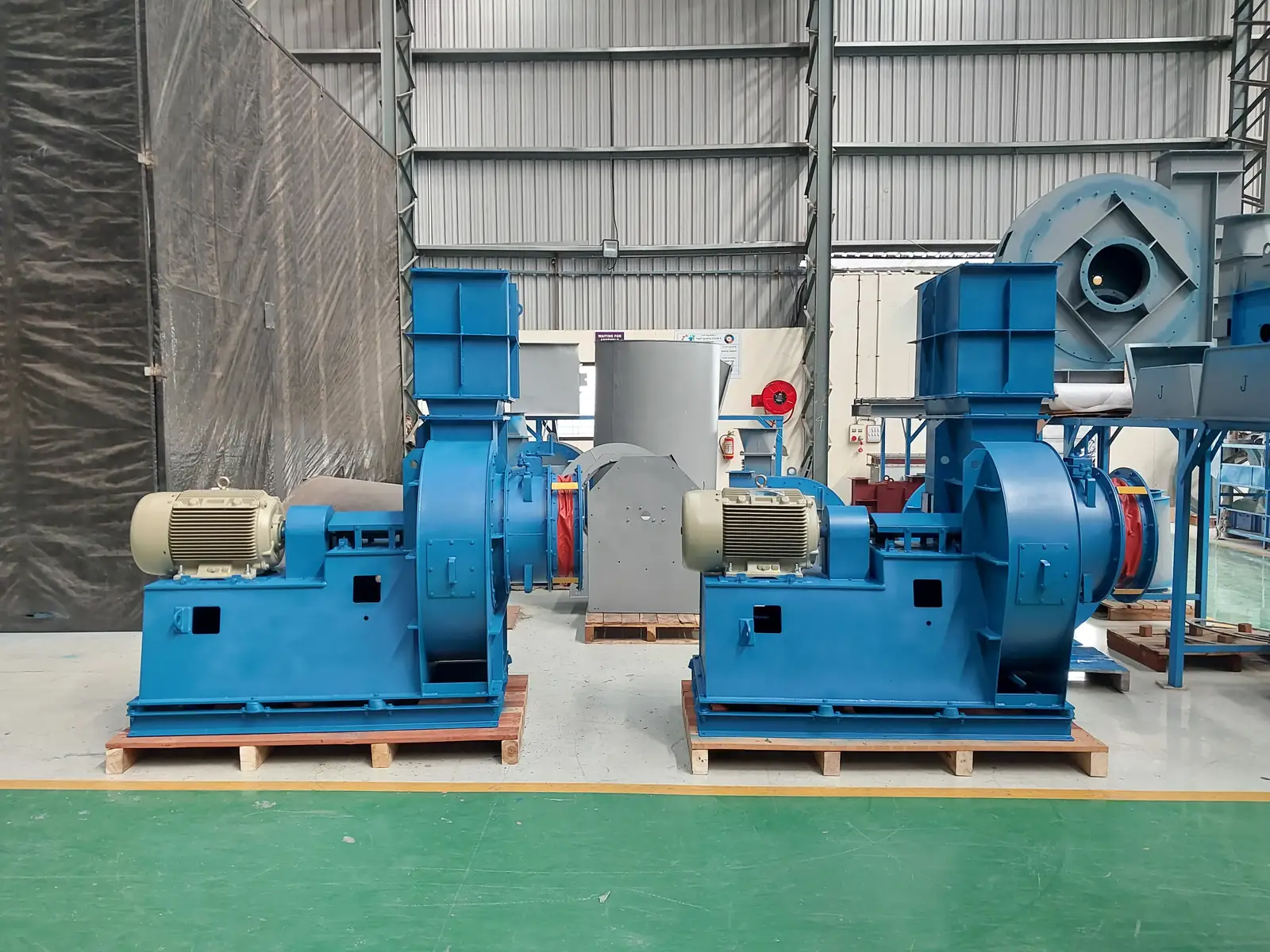
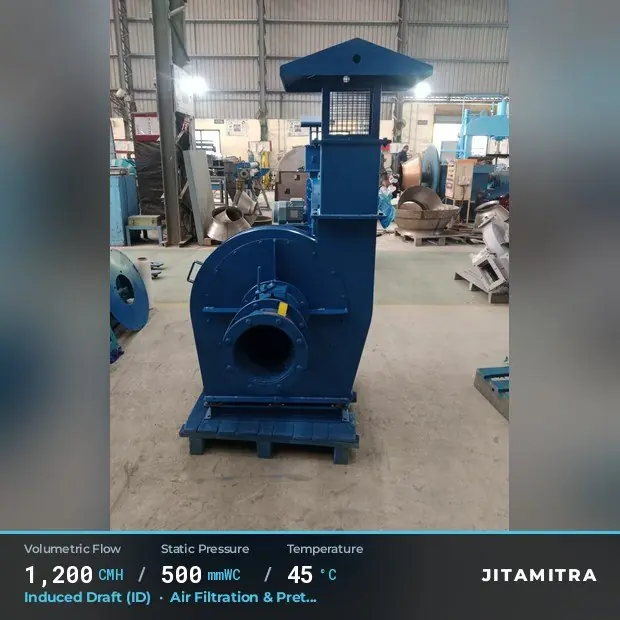
It makes up the pressure drop that a selective-catalytic-reduction (SCR) DeNOx reactor adds to the flue-gas path. When you fit an SCR reactor for NOx control, the catalyst layers, flow grid and ash-management hardware consume pressure the original draught train was never sized for. The booster fan is sized to supply that make-up rise on top of the existing ID draught, supporting steady furnace draft across the load range and leaving combustion tuning to your plant. It handles the same hot, dusty flue gas the ID fan does, plus the ammonia and ammonium bisulphate the SCR introduces. It is a booster sized around a catalyst, not a general-purpose ID or FD fan.
How do you size the fan when the catalyst pressure drop keeps rising?
That moving pressure drop is the central design problem. Catalyst ΔP climbs across a campaign as fly ash bridges the bed and ammonium bisulphate loads it, so a fan sized only to the clean-catalyst point loses draught margin and can hit its control limit before the catalyst is spent. We size the head to your stated end-of-campaign ΔP with a 20 to 30 percent margin over the clean point, place the duty point on the falling, stable part of the curve so it does not stall, and default to VFD so speed control holds draught as the bed fouls. Give us the clean and end-of-campaign reactor pressure drops and we size to the fouled case.
What is ammonium bisulphate and why does it matter for the fan?
SCR injects ammonia to reduce NOx, and a small amount of unreacted ammonia (ammonia slip) leaves the reactor. Where that slip meets SO₃ in the gas below roughly 200 to 230 °C, it forms ammonium bisulphate (ABS) — a sticky, acidic compound that plates onto the blade and casing. On the fan it does two things: it builds up unevenly and unbalances the wheel, and it corrodes the metal. We counter it by choosing wheel geometry and blade loading that shed deposit rather than collect it, holding the casing wall above the ABS condensation window with insulation and heat tracing, and selecting corrosion-resistant metallurgy such as 316L or higher alloy on the wetted surfaces where the temperature margin is thin.
Does the booster sit before or after the dust collector?
Both layouts exist and they change the fan. On a high-dust (raw-gas) SCR the reactor and booster sit ahead of the ESP or bag filter, so the fan handles a heavy hot fly-ash load and gets the full wear package — radial-tipped wheel, chrome-carbide hard-facing and bolted-in AR400 wear plates. On a tail-end (clean-side) SCR the reactor sits after collection, so inlet loading is low, wear is minimal, and the design focus moves to temperature, ABS handling and curve stability. Tell us which layout you have and we build to that position.
How hot can the gas be, and how do you manage the temperature?
Continuous duty up to 500 °C across the envelope, though most SCR boosters run 150 to 400 °C. Above 400 °C we fit a shaft cooling disc as standard, upgrade the casing to IS 2062 or SA 516 Gr 70, and add metal or fabric expansion joints sized for the thermal growth, of order 25 mm on a long run at 400 °C. Bearings are selected for a sustained 80 to 100 °C housing temperature. The fan is built for your stated gas temperature and excursion case, not a generic rating.
What experience stands behind your SCR / DeNOx booster fans?
Directly relevant experience: hot, dust-laden, corrosive flue-gas fans are our core ID and high-temperature work, and the SCR / DeNOx booster shares that engineering. We engineer it with the same discipline — sized and computed to your duty — build it in the same materials, and prove it on the same 200 HP VFD test rig. Fans above the rig's 200 HP are run at derated speed and scaled to the specified duty by the fan laws. Tell us your gas and catalyst data and we design to it; if you want proof of the underlying flue-gas fan work, ask and we will show relevant references by sector.
Do you performance-test the booster before dispatch?
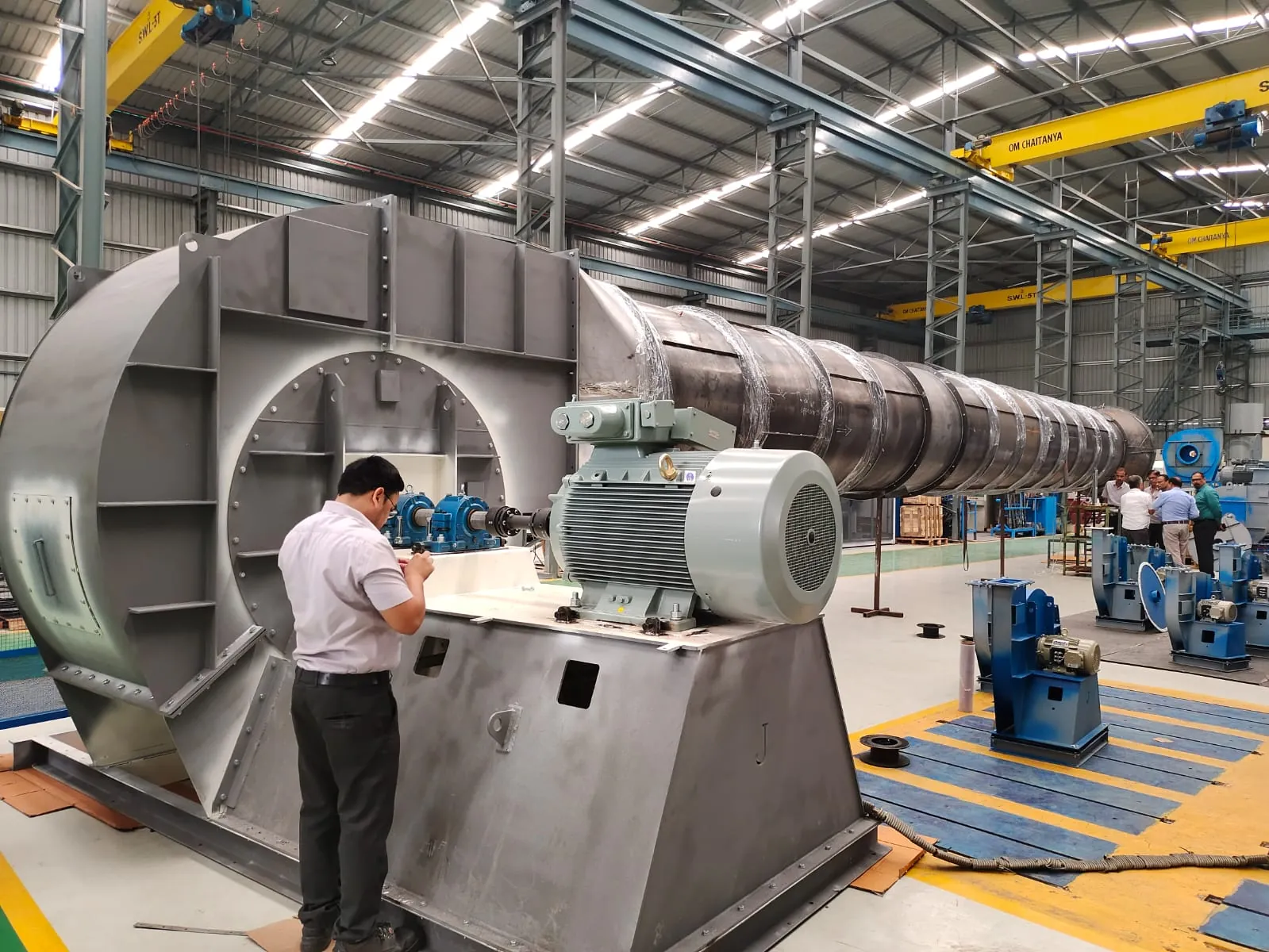
Yes. Every fan is performance-tested in-house to the IS 4894 / ISO 5801 / AMCA 210 method on our 200 HP VFD test rig, and dynamically balanced to ISO 21940 G6.3 as standard, with G2.5 or G1.0 on application. We verify the curve against your sized duty point — including the margin to the fouled-catalyst pressure — before the fan leaves the floor, and the test and FAT are customer-witnessed on request. You see the curve and the balance report before dispatch.
What do CE, ATEX, AMCA and ISO actually mean on your quote?
To be precise about the claims: CE is self-declared per 2006/42/EC and 2014/35/EU, and ATEX Zone 2/22 is self-declared per 2014/34/EU (Category 3) where the area classification calls for it — those are self-declarations of conformity, not third-party certifications. Performance is tested in-house to the IS 4894 / ISO 5801 / AMCA 210 method on our 200 HP VFD rig; that is testing to the AMCA 210 method, not an AMCA certification, and we are not an AMCA member. Balancing is to ISO 21940 (G6.3 standard, G2.5 or G1.0 on application). Our only third-party certification is ISO 9001:2015.