When an air-filtration and dust-collection systems OEM builds a bag-house, the ID fan pulls every cubic metre of dust-laden air through the filter. That is the fan we build for them — and have built, order after order, for years.
The number that decides the selection here is the static: 475 mmWC. Pulling 44,600 CMH of dust-laden air through filter media against that static is a real fan-selection problem — and the filter’s resistance moves between cleaning cycles, so the duty point has to sit on the stable part of the fan curve, not at its edge.
On a dust-collection duty the fan must also never become an ignition source. So this fan is built spark-resistant: an aluminium impeller, a brass spark-proof rub ring and a brass shaft seal — AMCA Type B construction — driven by a flameproof motor on a VFD. Get the selection or the construction wrong and the fan does not slowly degrade — it fails, or it becomes the hazard.
This is the discipline, stated plainly: the static is engineered for, and the spark risk is designed out.
Spark-resistant bag-house ID fans, each one selected to the customer's GA drawing — made to order, not pulled off a shelf. On the drawing: a backward-curved aluminium impeller coupled to a 120 HP, 4-pole flameproof motor on a VFD; a brass spark-proof ring and a brass shaft seal; an inlet damper, an outlet silencer and flexible bellows at both connections; the rotor dynamically balanced to ISO 21940 G6.3 and held to ISO 14694 vibration limits. Everything is engineered and verified to the exact operating point — computed, not estimated.
Every fan is performance-tested in-house on our 200 HP VFD test rig, to the IS 4894 / AMCA 210 method, before it leaves the works. You get the measured curve for your fan — proof, not promises.
This has not been a single order. It has been sustained, multi-year, repeat supply — a systems OEM that puts our fans at the heart of the bag-houses it sells, and keeps coming back to do it again. That is the plainest quality signal we can offer: an OEM stakes its own reputation on the fan inside its system, order after order.
If you have a dust-laden, high-static duty — bag-house or otherwise — send us the numbers or the GA drawing. We will tell you honestly whether it sits inside our envelope and how we would build for it. No parameter is too specific to start the conversation.
— Mihir Kulkarni, Director, Jitamitra Electro Engineering
Engineered for Every Application.
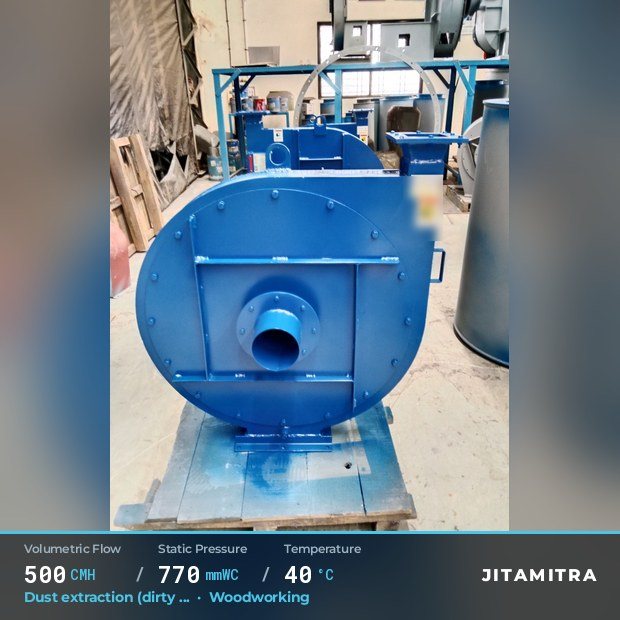
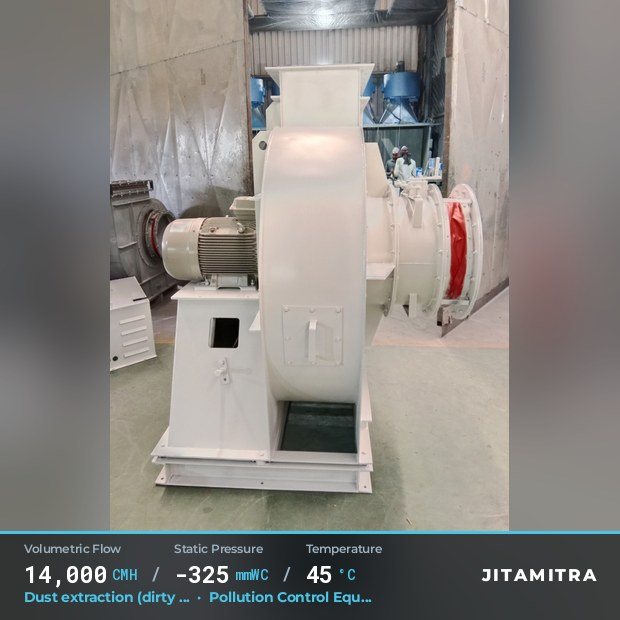
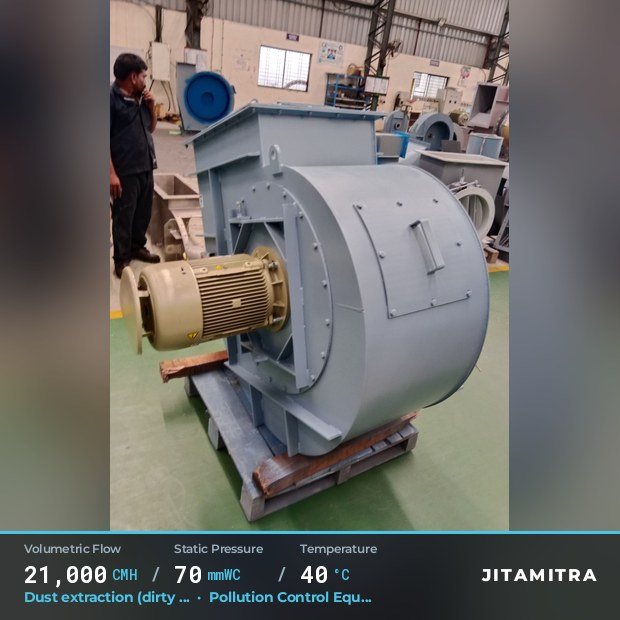
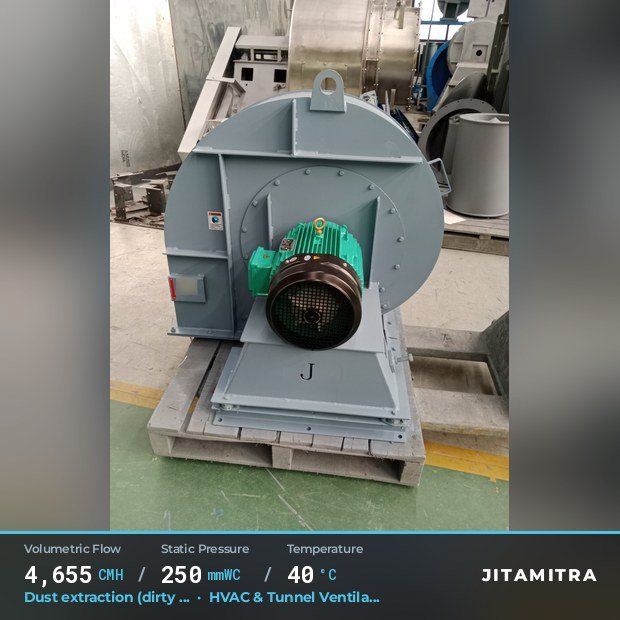
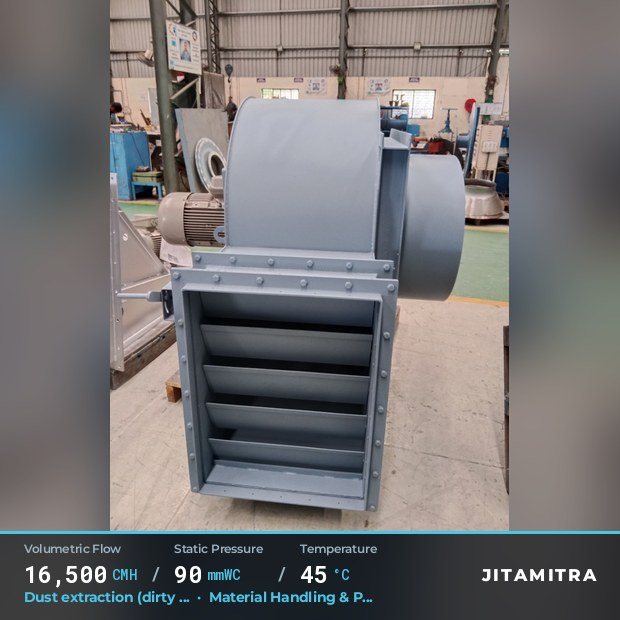
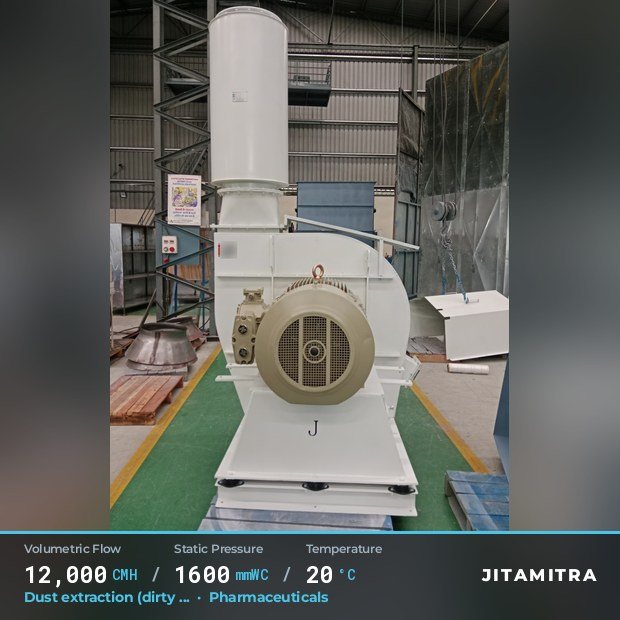
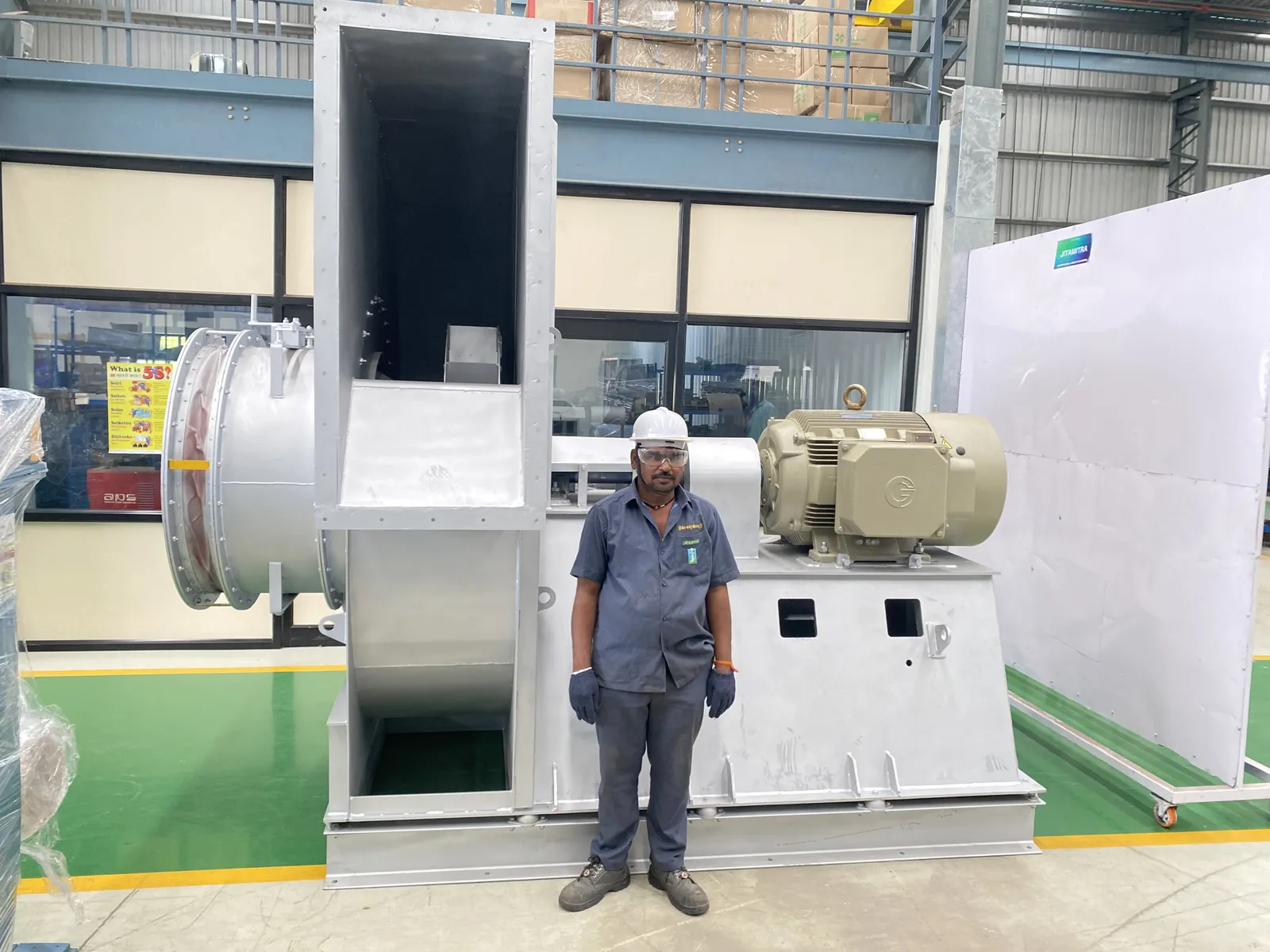
Real dispatched fans from this duty class — nameplate-scrubbed. Representative of the work; not the customer's own unit.
By building it spark-resistant. This fan carries AMCA Type B construction: an aluminium impeller, a brass spark-proof rub ring and a brass shaft seal, so a rub cannot strike a ferrous spark, with a flameproof motor on the drive. The construction is written on the GA drawing the customer approves.
The static and the filter. The fan has to generate 475 mmWC of static to pull the air through filter media whose resistance moves between cleaning cycles, so the impeller is selected with the duty point on the stable part of its curve. Material grades, blade profile and the shaft-and-bearing arrangement are chosen for the duty, then engineered and verified to your exact operating point — computed, not estimated. Each fan is selected to the customer's GA drawing, made to order, not pulled off a shelf.
Every fan is performance-tested in-house on our 200 HP VFD test rig, to the IS 4894 / AMCA 210 method, before it leaves the works. You get the measured curve for your fan — proof, not promises. A witnessed FAT is available on request.
Repeatedly. This has not been a single order — it has been sustained, multi-year, repeat supply to a systems OEM that puts our fans at the heart of the bag-houses it sells. That is the plainest quality signal we can offer: an OEM stakes its own reputation on the fan inside its system, order after order.
No. They are real dispatched fans from this duty class, nameplate-scrubbed — representative of the work, not the customer's own unit. The duty itself is real: 44,600 CMH of dust-laden air against 475 mmWC of static, on a 120 HP motor. That is the fan we build for this OEM, order after order.
Yes. If you have a dust-laden, high-static duty — bag-house or otherwise — send us the numbers or the GA drawing. We will tell you honestly whether it sits inside our envelope and how we would build for it. No parameter is too specific to start the conversation.
Flow, static, gas temperature, application — or attach a spec, GA drawing or a multi-fan schedule. Engineer to engineer.
ISO 9001:2015 quality system · performance-tested to IS 4894 / ISO 5801 / AMCA 210 method · witnessed FAT on request.
*For our standard range. ATEX and special projects need 5 to 7 working days.
This site sets no cookies of its own. Google Analytics loads only if you accept. It sets two cookies, so we can see which fan topics people actually read. Decline and no analytics loads — the site works exactly the same. What we collect →