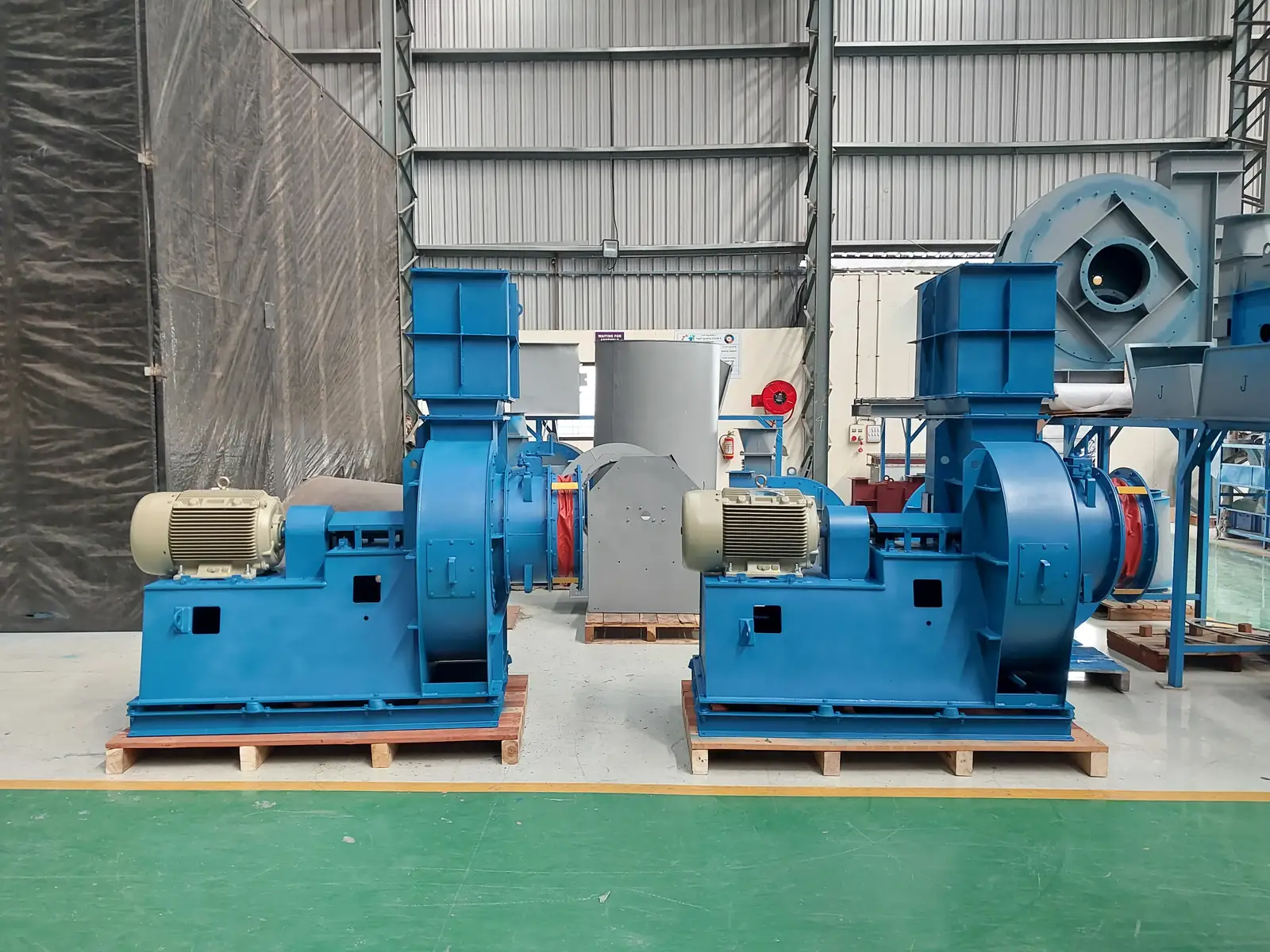
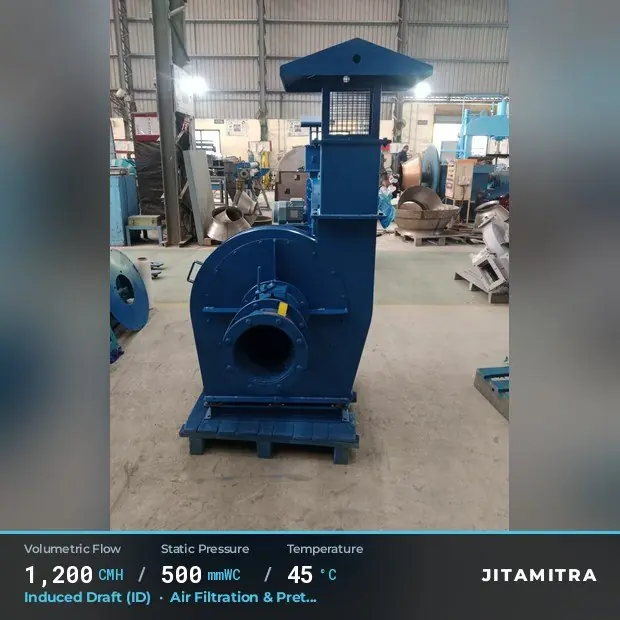
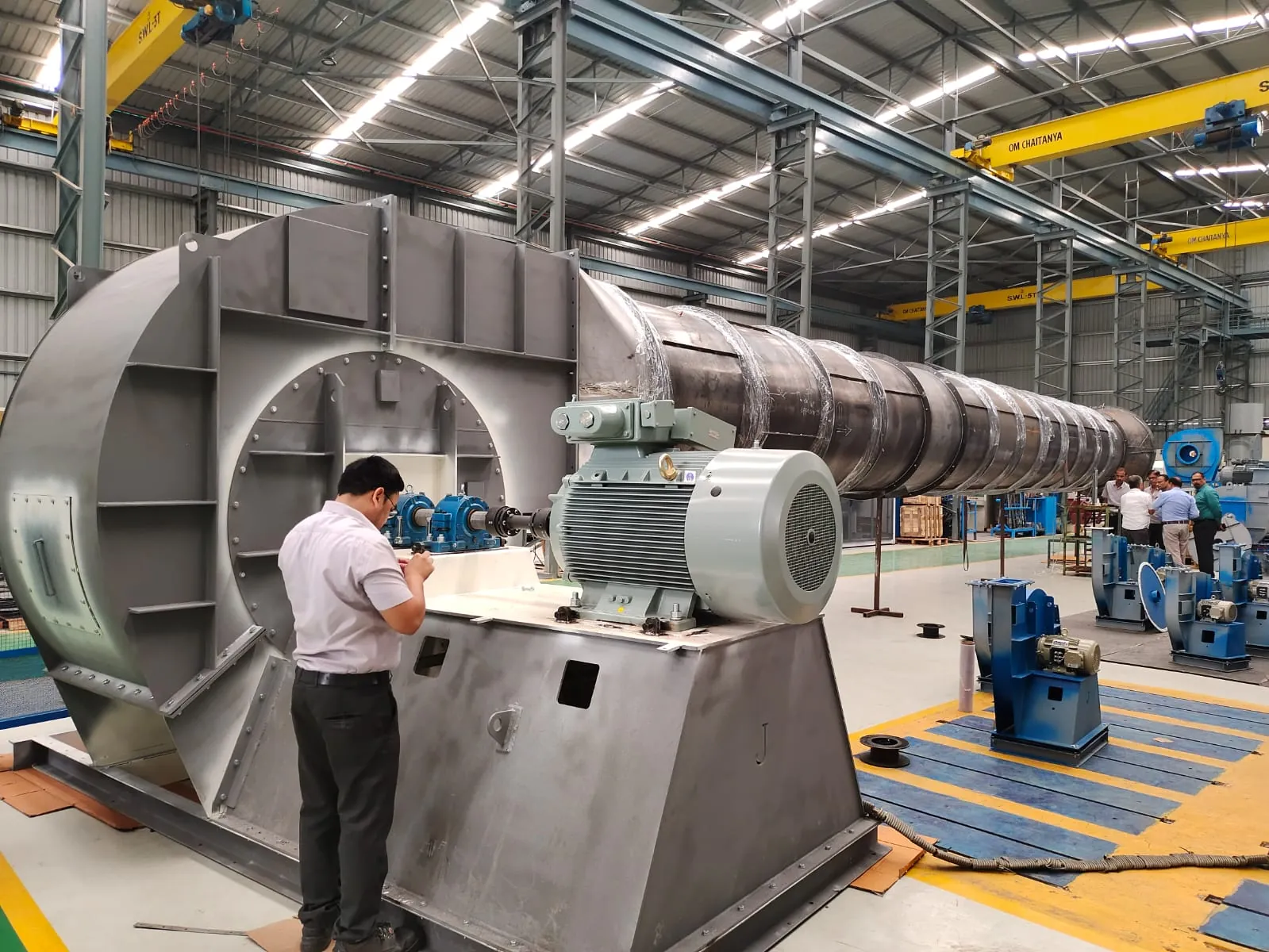
What makes a waste-to-energy ID fan different from an ordinary boiler ID fan?
Chloride. A coal-boiler ID fan mostly fights heat, fly-ash erosion and SO₃ acid dew point. A waste-to-energy fan fights all of that plus HCl and HF from chlorinated plastics and refuse, alkali and heavy-metal salts, and — after a wet scrubber — saturated gas at its acid dew point. Chloride drives pitting and stress-corrosion cracking that plain 304 or mild steel cannot resist, so the metallurgy is the whole design decision. We select the wetted material against your measured gas analysis rather than fitting a standard flue-gas fan to a duty it was never built for.
Where in the APC train does the fan sit, and why does it matter?
It decides the metallurgy and the temperature case. A hot-side ID fan sits ahead of the scrubber, handling gas at 150 to 350 °C that is dust-laden and acidic but above the dew point, so we hold the casing wall hot with insulation and tracing and pick an alloy for the chloride. A wet-side fan sits after a quench or wet scrubber, handling cooled, saturated gas sitting at or below the water and acid dew point, so it needs a fully-drained casing, a condensate-shedding flow path and often an FRP or rubber-ebonite lining. Tell us the position and the gas condition at the fan and we build to it; the two positions are genuinely different fans.
We have high HCl and chloride. What materials do you use?
We match the wetted metallurgy to the measured gas. 316L is the floor for moderate chloride; for high HCl, HF and stress-corrosion risk we move to duplex stainless or a higher alloy against your specification; and where the gas leaves a wet scrubber saturated and cold, an FRP coating or a rubber-ebonite lining is often the right and more economical answer. The correct choice depends on your HCl, HF, SO₂/SO₃, chloride and dew-point figures, so we size the material and the dew-point margin to your gas analysis, not to a default 'stainless'.
The gas leaves our wet scrubber saturated. How do you stop condensate corroding the fan?
Below the water and acid dew point the design changes from a hot fan to a wet one. We drain the casing fully with a low-point drain, keep the flow path smooth and corrosion-resistant so condensate sheds rather than pools, and select a wetted surface built for saturated acid gas — a higher alloy, or an FRP or rubber-ebonite lining, depending on the chemistry. Where the fan is meant to run hot we instead keep the wall above dew point with insulation and heat tracing. Which of the two applies is set by your gas condition at the fan flange, and we state it on the GA drawing.
Waste dust cakes onto the blades and unbalances the fan. How do you handle fouling?
Waste-line dust is fine, alkaline and hygroscopic, and dry-scrubber reagent carry-over (lime, activated carbon) makes it stickier, so it cakes onto the blades and throws the wheel out of balance. We default to a radial or radial-tip self-cleaning wheel that throws deposit off the blade root instead of packing it in, add bolted-in wear plates and access doors for in-place cleaning, and fit a shaft seal that keeps salt slurry out of the bearing housing. Inspection and wheel-washing ports are available where the fouling is heavy. The wear and cleaning package is sized to your loading, and on clean-side duty after the bag filter it is minimal.
Can you build a replacement to match our existing WtE fan's duty and footprint?
Yes. We reverse-engineer to the existing duty point (flow, static pressure, temperature, gas density), bearing centres, inlet and outlet orientation and foundation bolt pattern so the unit drops onto the existing base and ducting, and we take the opportunity to correct the metallurgy if the original was under-specified for the chloride. Made to your installation, not a nearest-catalogue substitute. Send the old GA, the nameplate, a recent gas analysis and a curve if you have one and we will match it.
How fast can you ship a shutdown replacement, and what is a normal lead time?
Shutdown replacements ship within 6 weeks of a clean PO where the metallurgy is a standard stainless. A standard engineered WtE ID fan runs roughly 10 to 16 weeks order-to-dispatch: GA approval 2 to 3 weeks, manufacture, balance and paint 7 to 11 weeks, test and FAT about a week. A higher-alloy or lined build adds material-procurement time and run longer, so we confirm a dated commitment against your shutdown window — a real date, not a placeholder.
Do you build to API 673, CE and ATEX, and how do you test?
We design and build to API 673 for oil-and-gas and refinery-adjacent duty as project-specific scope (allow 5 to 7 working days for the offer). CE is self-declared per 2006/42/EC and 2014/35/EU, and ATEX Zone 2/22 is self-declared per 2014/34/EU (Category 3) where the area classification calls for it. To be precise, those are self-declarations of conformity, not third-party certifications. Performance is tested in-house to the IS 4894 / ISO 5801 / AMCA 210 method on our 200 HP VFD test rig, not AMCA-certified, and every fan is balanced to ISO 21940 G6.3 as standard (G2.5 / G1.0 on application). Our only third-party certification is ISO 9001:2015.