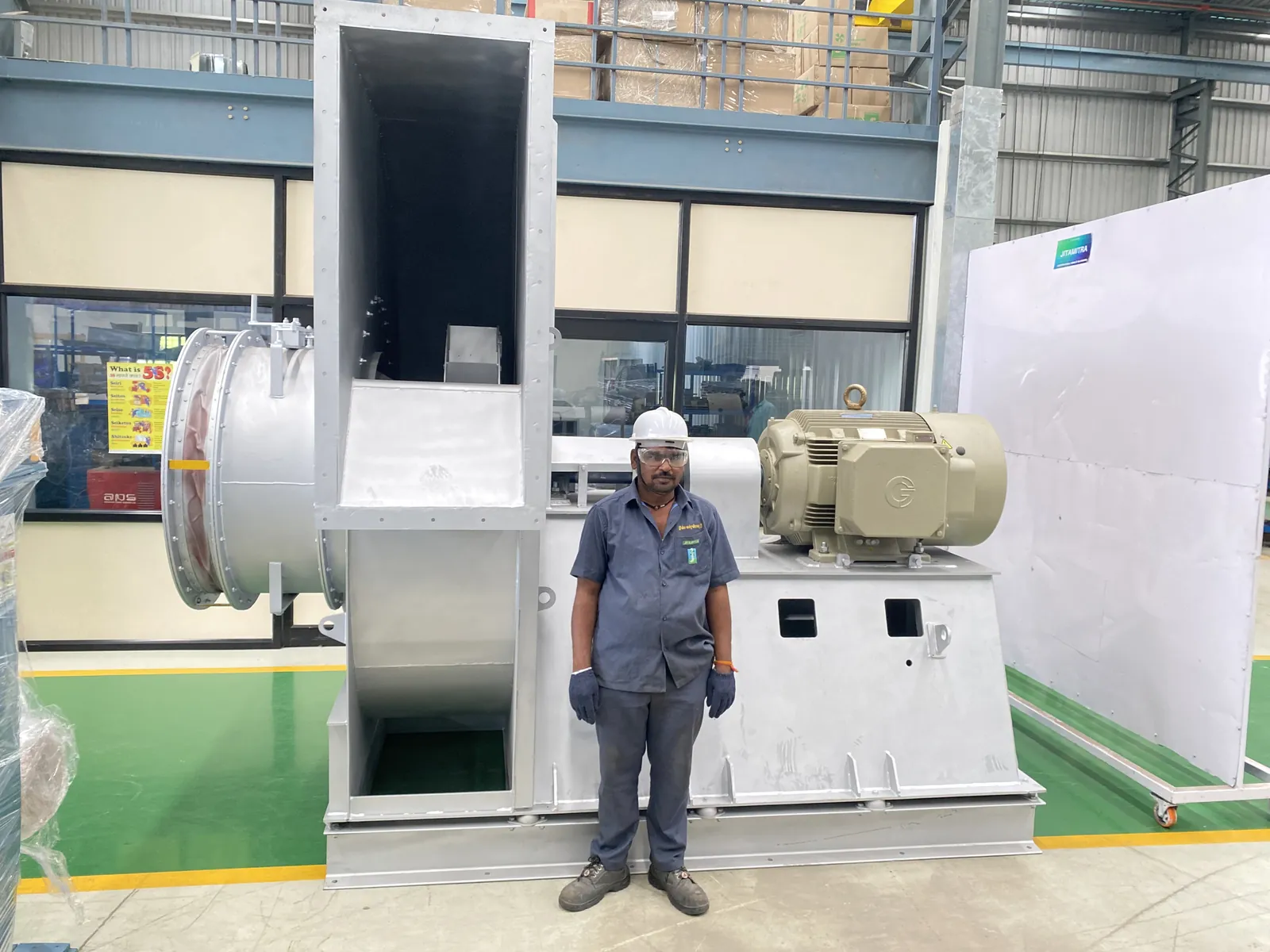
A food- and pharma-process equipment company in Haryana needed a fan to circulate hot air, designed for 500 °C: the highest design temperature we have delivered, and the top of the envelope we publish.
27,000 m³/h at 85 mmWC static, in air at a design temperature of 500 °C. At that temperature the air weighs 0.45 kg/m³, under 40 % of standard air, so the fan develops far less pressure for its size than it would in cold air. It is selected by referring the duty to standard air — 85 mmWC at 0.45 kg/m³ reads as about 227 mmWC on a standard-air curve — and then rated at the real density.
The harder part of a 500 °C duty is not the air; it is what the heat does to the fan. The wheel, the casing and the shaft run at gas temperature, and the shaft carries that heat towards the bearings.
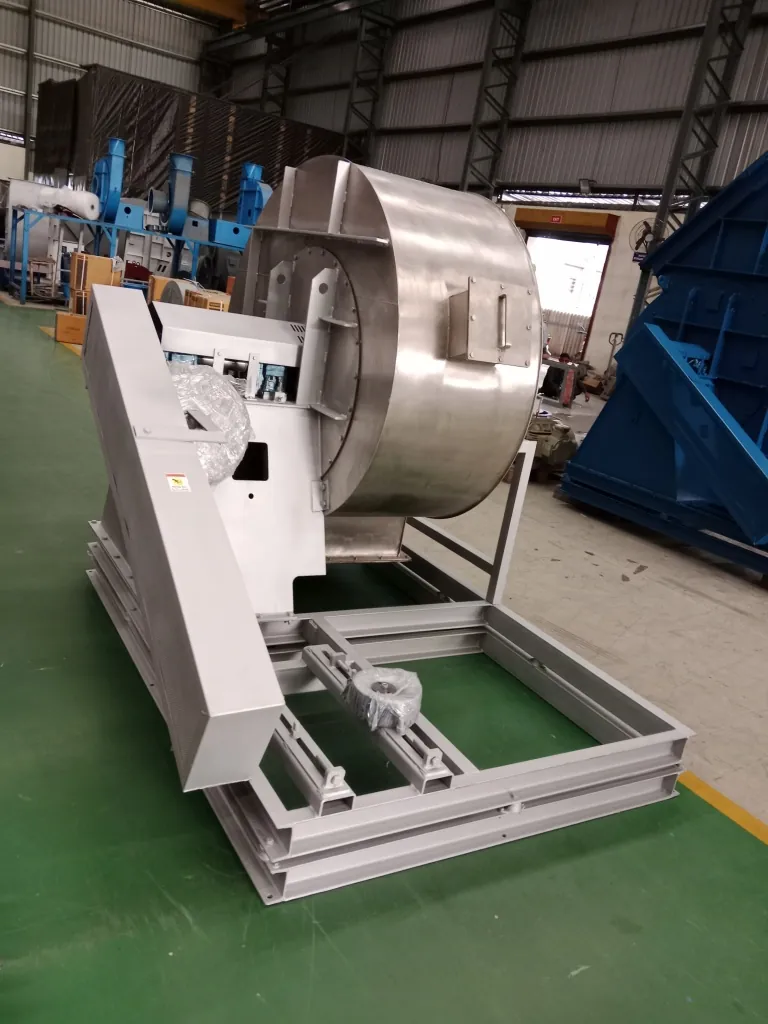
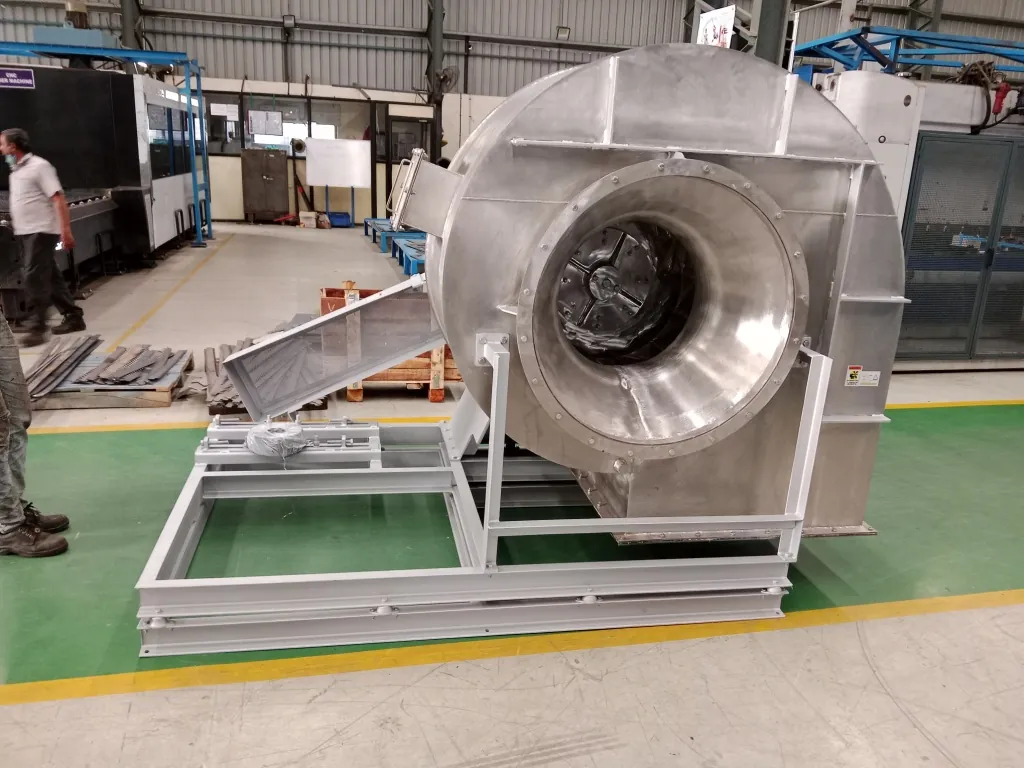
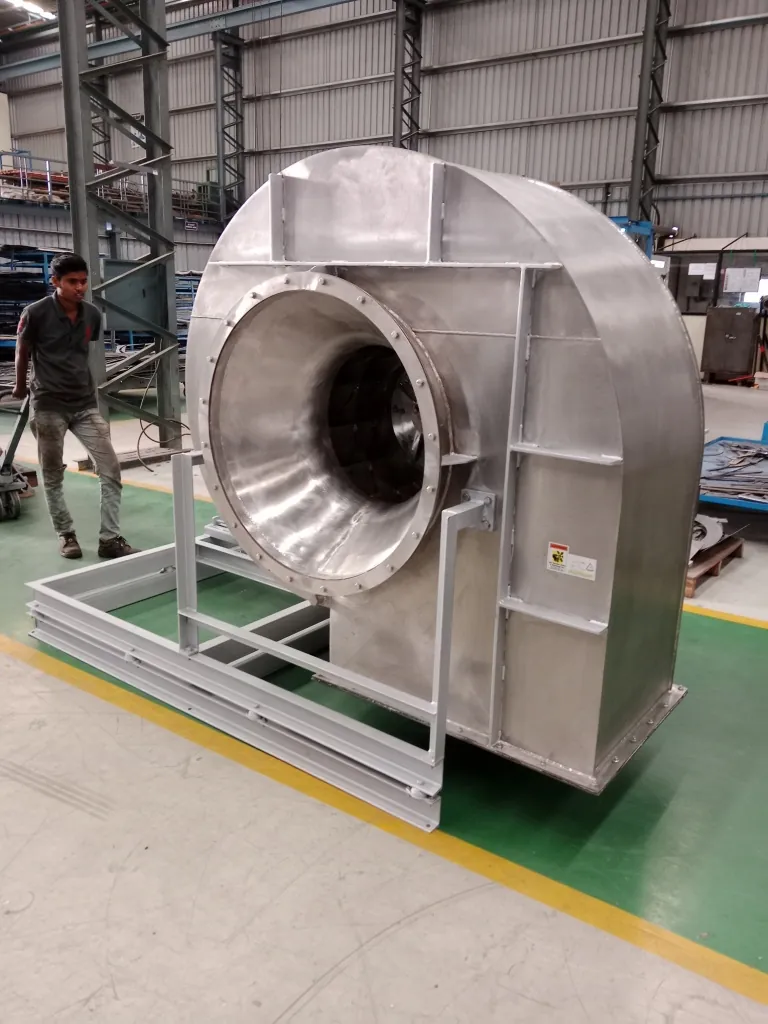
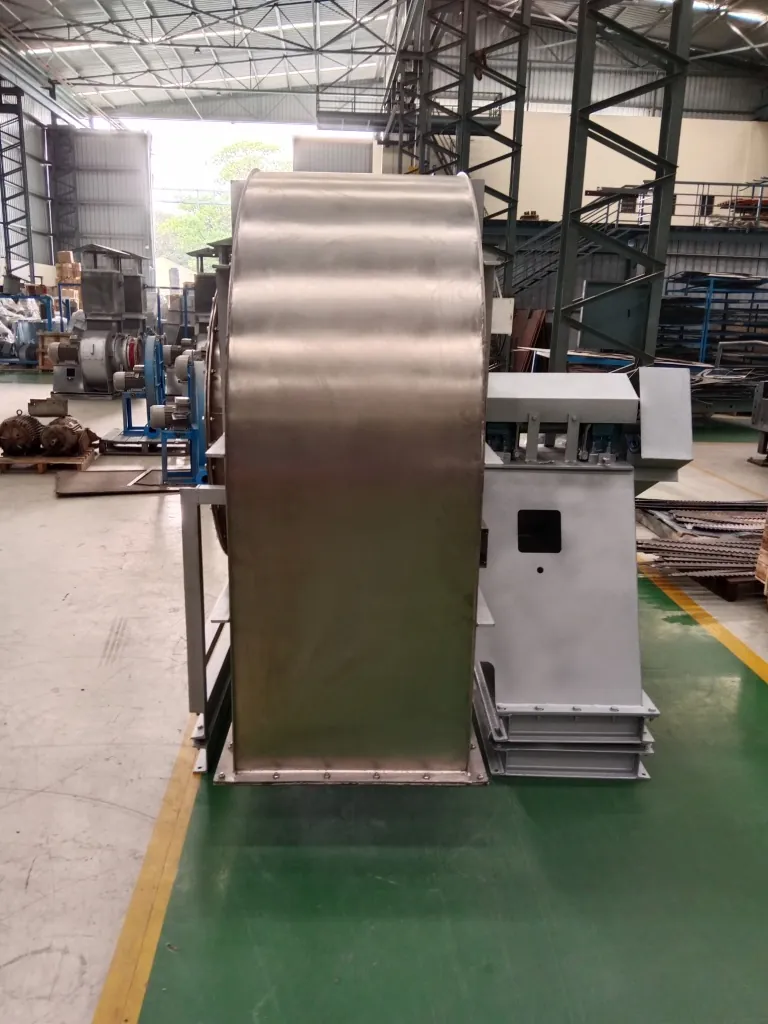
One single-inlet centrifugal fan with a backward-inclined impeller, built in SS 304: back plate and blades 6 mm, shroud 5 mm, casing 4 mm, on a stainless shaft. The bearings sit outside the hot casing in oil-cooled plummer-block housings, with an aluminium heat slinger on the shaft between casing and bearings and an aluminium shaft seal where the shaft leaves the casing. The drive is by belt at 1,460 rpm, which keeps the motor out of the hot zone.
The motor, in the customer’s scope, was specified at 40 HP for the cold start: air at room temperature is more than twice as dense as at 500 °C, and the fan draws power in proportion until the system heats up. The rotor is dynamically balanced to G2.5 per ISO 1940, vibration is held to ISO 14694 category BV-3, the first critical speed is at least 1.4 times the running speed, and testing to IS 4894 is written into the drawing the customer approved in October 2023.
The same company has since come back to us for larger fans, including double-inlet units for far higher volumes.
If your process runs hot, send us the duty with the operating, maximum and cold-start temperatures and the site elevation. We will tell you plainly whether it sits inside our envelope and how we would build it.
— Mihir Kulkarni, Director, Jitamitra Electro Engineering
Engineered for Every Application.
The SS 304 hot-air circulation fan in this case study, photographed at our works before dispatch.
500 °C, the design temperature of this hot-air circulation fan and the top of our published envelope. Anything above that is assessed on enquiry.
By keeping the heat away from them. The bearings sit outside the hot casing in oil-cooled housings, an aluminium heat slinger on the shaft sheds heat between the casing and the bearings, and the belt drive keeps the motor out of the hot zone.
Because cold air is denser. At room temperature air is more than twice as dense as at 500 °C, and a fan's power rises in proportion to density, so the drive is sized for the start, before the system heats up.
Flow, static, gas temperature, application — or attach a spec, GA drawing or a multi-fan schedule. Engineer to engineer.
ISO 9001:2015 quality system · performance-tested to IS 4894 / ISO 5801 / AMCA 210 method · witnessed FAT on request.
*For our standard range. ATEX and special projects need 5 to 7 working days.
This site sets no cookies of its own. Google Analytics loads only if you accept. It sets two cookies, so we can see which fan topics people actually read. Decline and no analytics loads — the site works exactly the same. What we collect →