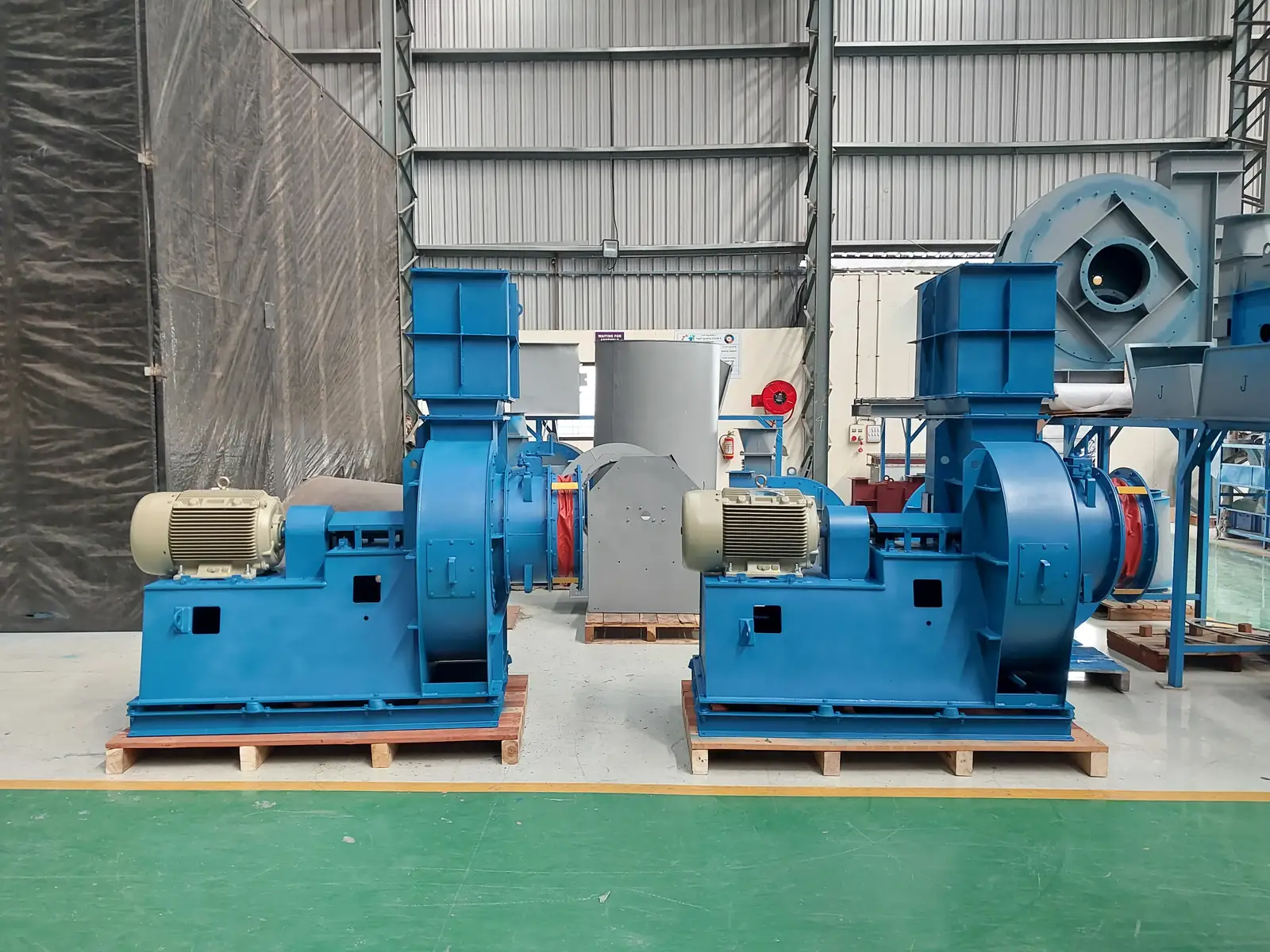
Can you supply the fans across the whole aluminium flowsheet, or only one duty?
Across the whole flowsheet. We have delivered aluminium & non-ferrous fans spanning anode-bake and remelt furnace exhaust, fume extraction off molten metal at the remelt and casting bays, dirty-side dust extraction, corrosive potline and gas-treatment-centre duty, combustion and process air to the furnaces, and the fine-metal LEV. Each fan is engineered to its own gas, temperature, corrosion and explosion case — the fluoride potline fan and the ATEX dust fan are different machines — but they come from one partner, on one engineering convention across the plant.
Fine aluminium and magnesium dust is explosible. How do you build the extraction fans for ATEX?
We build the fine-dust extraction and LEV fans to ATEX Zone 2/22, self-declared per 2014/34/EU (Category 3), sized to the area classification you declare. That means a non-sparking wheel and inlet-cone material pairing, generous running clearances so the wheel cannot rub, earthing continuity across the whole assembly to bleed off static, and casing detailing to suit the dust group. To be precise, ATEX Zone 2/22 is a self-declaration of conformity, not a third-party certification. Tell us your dust Kst and Pmax, the zone and the motor rating you need, and we engineer the fan into your dust-explosion safety case rather than bolting an ATEX label onto a standard fan.
Potline gas carries hydrogen fluoride and our casting bays carry chloride. What metallurgy do you use?
We size the metallurgy to your gas analysis. On hydrogen-fluoride-laden potline and gas-treatment-centre duty, and on chloride-laden casting-bay fume, we select 316L or a higher alloy on the wetted surfaces where the corrosive gas condenses, use protective coatings where a full alloy is not warranted, and hold the casing wall above dew point with insulation so the corrosive film does not condense on the steel. The right answer depends on your HF and chloride concentration, moisture and temperature, so we engineer it to your gas, not a default rating.
What is the maximum gas temperature you handle on an anode-bake or remelt furnace exhaust fan?
Continuous duty up to 500 °C across the envelope. Potline gas-treatment fans typically run 100 to 200 °C, while anode-bake and remelt furnace exhaust can reach the ceiling. Above about 350 °C we fit a shaft cooling disc to keep heat off the bearings, keep the bearings outside the airstream, and add expansion joints for the thermal growth. The fan is built for your stated gas temperature and excursion case, not a generic rating.
Fume off molten metal cakes on the wheel and unbalances the fan. How do you handle that?
Sticky oxide fume off molten aluminium is a fouling problem, so we design against build-up rather than just replacing wheels. A rugged radial wheel and blade geometry chosen so the fume does not key onto the blade; access and cleanout doors so the wheel can be washed down in place without dismantling the fan; and, where the fume load is heaviest, on-line or off-line cleaning provision built into the casing. We also balance to ISO 21940 G6.3 as standard so the fan starts from a clean, tight baseline that any build-up is measured against.
Do you performance-test the fans, and what about AMCA, CE, ATEX and quality certification?
Every fan is performance-tested in-house to the IS 4894 / ISO 5801 / AMCA 210 method on our 200 HP VFD test rig, and dynamically balanced to ISO 21940 G6.3 as standard (G2.5 / G1.0 on application). Fans above the rig's 200 HP are run at derated speed and scaled to the specified duty by the fan laws. Because the rig runs cold air, hot furnace-exhaust operation is extrapolated by fan-law correction for density. To be precise: that in-house testing is to the IS 4894 / ISO 5801 / AMCA 210 method, not AMCA-certified; CE is self-declared per 2006/42/EC and 2014/35/EU, and ATEX Zone 2/22 is self-declared per 2014/34/EU (Category 3) where the fine-metal dust classification calls for it — those are self-declarations of conformity, not third-party certifications. Our only third-party certification is ISO 9001:2015.