The exhaust is corrosive acid and solvent vapour. What do you build the fan from?
We match the flow path to your fume chemistry, because on lab exhaust the wetted surface is the whole design. For wet acid vapour such as hydrochloric, nitric or hydrofluoric acid the impeller and casing carry an acid-resistant FRP lining. For mixed solvent and acid fume we use 316L or a higher alloy. Where a full resin build is not viable we line a mild-steel casing with FRP, rubber or ebonite instead. We select the material against your stated fume analysis and the temperature, not a default, and we mark it on the GA drawing you sign off. Tell us the chemistry, concentration and temperature and we specify the metallurgy to it.
How do you make sure corrosive fume can't leak back into the lab?
Containment is the point of the whole system, so we build it leak-tight end to end. The hood, duct and fan run under negative pressure so fume is drawn away from people; the risk is on the positive-pressure discharge side of the fan, at the shaft seal and casing joints. We fit a purged or double-lip shaft seal, weld and gasket-seal the casing joints, and keep the fan on the negative-pressure side of the plume stack wherever the layout allows. On high-containment duty such as radionuclide or biohazard exhaust, the whole flow path is bag-in/bag-out serviceable and pressure-decay leak-tested to a stated leakage class before dispatch.
Why does the fan need a high-plume discharge, and how do you engineer it?
If the exhaust discharges too slowly or too low, the plume hugs the roof, gets caught in the building wake, and is pulled straight back through the building's own fresh-air intakes, so the fume the lab expelled returns to the people it was meant to protect. To prevent that re-entrainment we engineer the discharge for an exit velocity around 15 metres per second and above, and build that stack loss into the fan static rather than leaving the system to absorb it. On stringent sites we add a bypass-air, or induced-dilution, nozzle that draws in ambient air to raise the effective exit velocity and dilute the plume without adding fan power. We leave the discharge open so the plume rises clear.
Fume-hood sashes open and close all day. How do you hold the capture velocity?
A fume hood only protects the operator if the face velocity across the sash stays at its rated value, typically around 0.5 metres per second, whatever the sashes are doing. As sashes open and close across a lab the system demand moves, so we size the fan across that varying-sash range rather than a single point, and make VFD control the default so the fan tracks demand and holds constant hood face velocity instead of over-exhausting when sashes close or starving the hood when they open. On a manifolded lab block we engineer the fan to hold the design velocity at every hood on the run, and we prove the curve on the 200 HP VFD test rig before dispatch. Fans above the rig's 200 HP are run at derated speed and scaled to the specified duty by the fan laws.
We exhaust flammable solvent vapour. Are you ATEX-rated for that?
Where the exhaust carries combustible solvent vapour or combustible dust we self-declare ATEX Zone 22 per 2014/34/EU, Category 3D, combined with spark-resistant construction so both the ember and the vapour cases are covered by one build. The configuration uses a non-sparking impeller, bonded earthing throughout, anti-static coatings and T-class bearing-temperature control. To be precise, that is a self-declaration of conformity, not a third-party certification. See the testing and standards question below for how we handle the AMCA method, CE and ISO 9001.
Can you build a lab exhaust fan to our duty?
Yes. Laboratory and fume-hood exhaust calls for the same corrosion-resistant, leak-tight, made-to-order engineering we apply across our 45 application and duty types, and the FRP-lined, 316L, containment and high-plume scope here are standard tools in that kit. Specify your duty and we design and quote to it exactly as we would any engineered fan, and we will tell you plainly where a requirement sits at the edge of our envelope.
The lab is critical and can't lose containment. Can you supply duty/standby redundancy?
Yes. On a critical lab where a single fan trip must never drop containment we supply an N+1 duty and standby arrangement with automatic changeover, so the standby fan starts and picks up the duty on a fault without the hoods losing face velocity. Each fan is isolated with leak-tight dampers so the offline unit can be serviced without breaking containment on the running one, and on high-containment duty the flow path is bag-in/bag-out serviceable. We engineer the changeover logic and the isolation scheme to your control philosophy and document it on the GA drawing.
Do you performance-test before dispatch, and what standards actually apply?
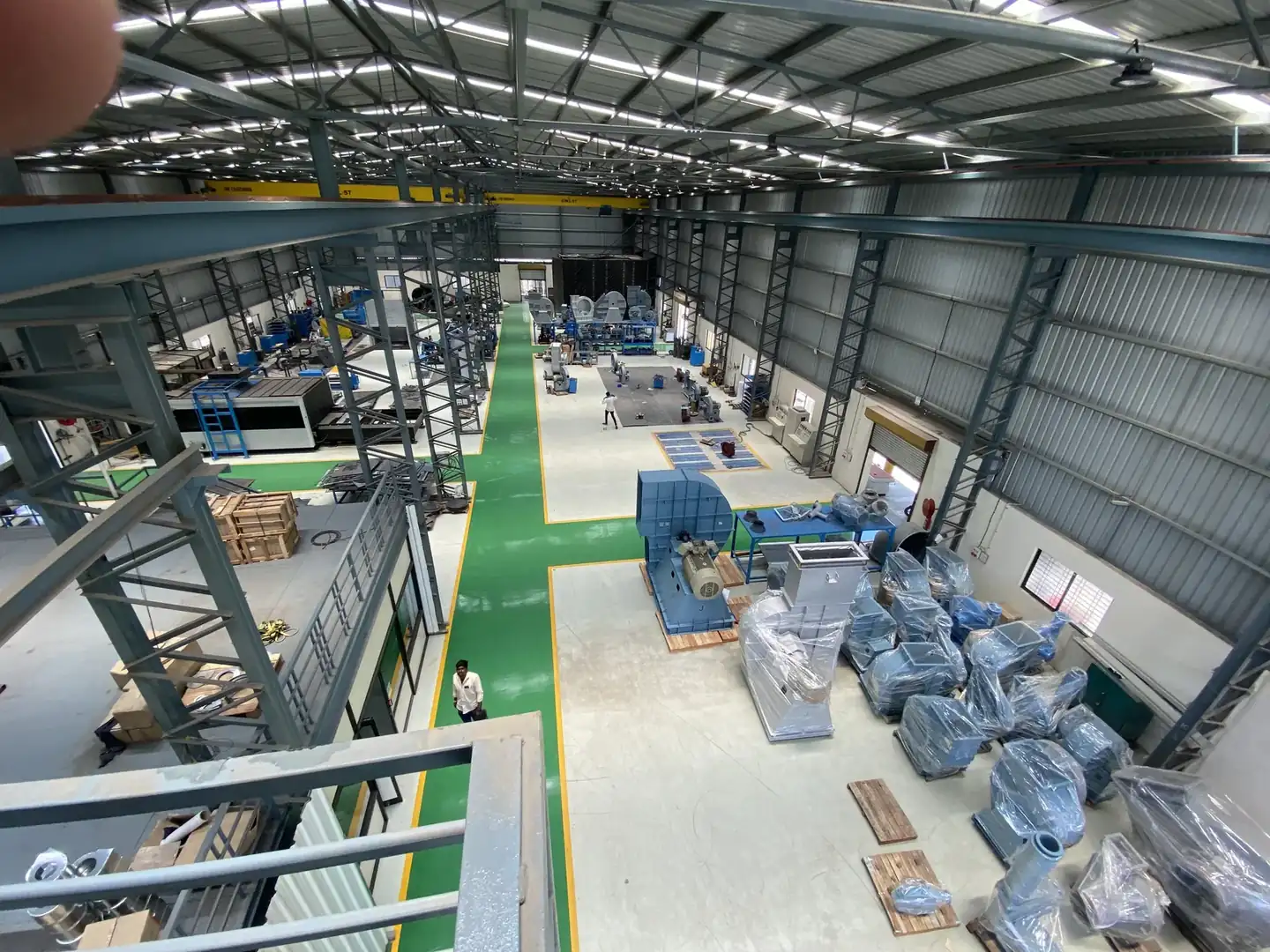
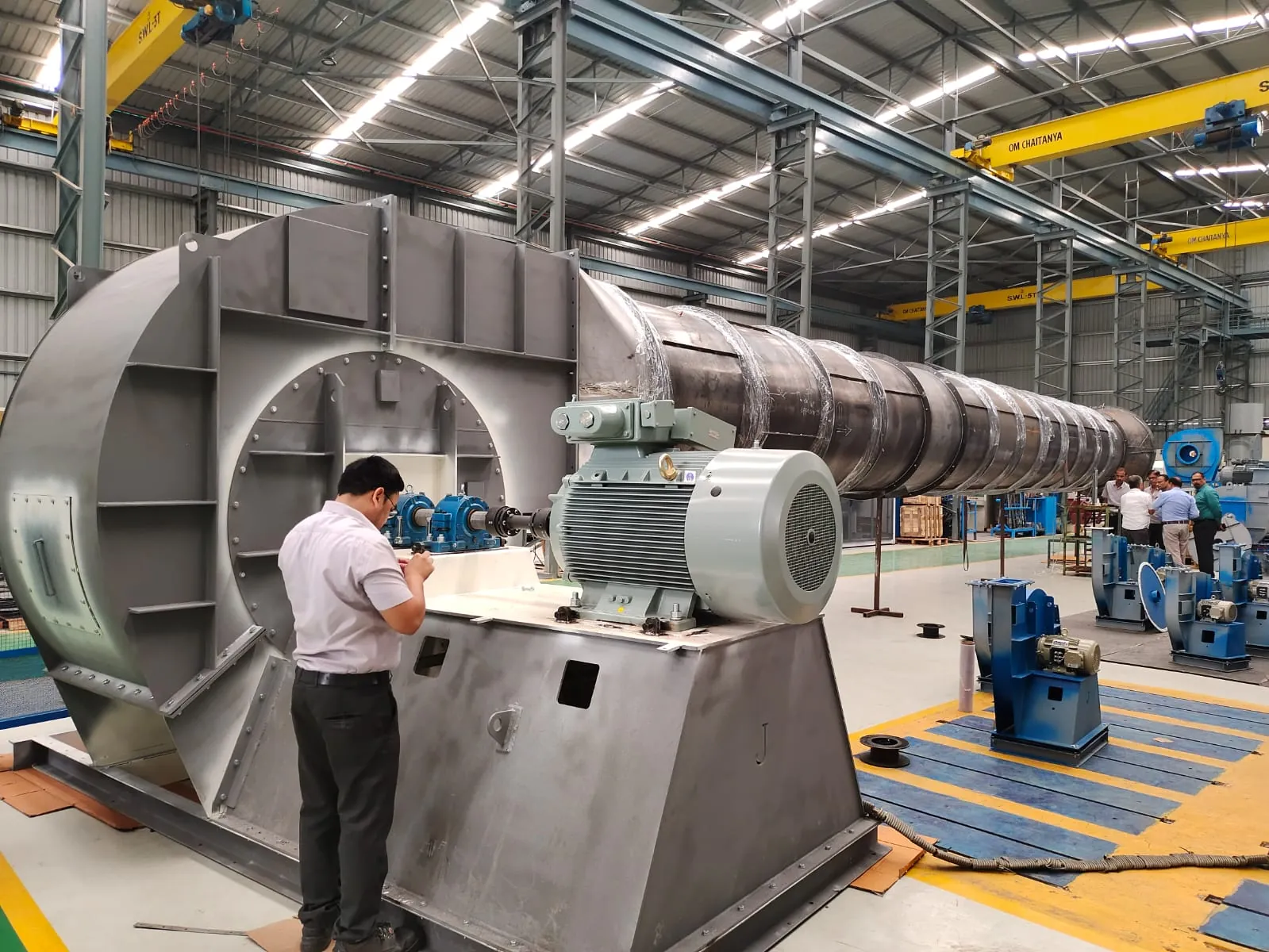
Yes. Every fan is performance-tested in-house to the IS 4894 / ISO 5801 / AMCA 210 method on our 200 HP VFD test rig, and dynamically balanced to ISO 21940 G6.3 as standard, with G2.5 or G1.0 on application. To be precise about the claims: that is testing to the AMCA 210 method in-house, not an AMCA certification, and we are not an AMCA member; spark-resistant construction is built to AMCA 99; and CE and ATEX are self-declared per the relevant EU directives, not third-party certified. Our only third-party certification is ISO 9001:2015. For a standard corrosion-resistant lab exhaust fan the offer turns around in 3 to 5 working days; an FRP-lined, high-containment or ATEX build adds material lead time and file preparation. The test and FAT are customer-witnessed on request.