The filter dP swings with every pulse-clean cycle. How do you keep the fan stable across it?
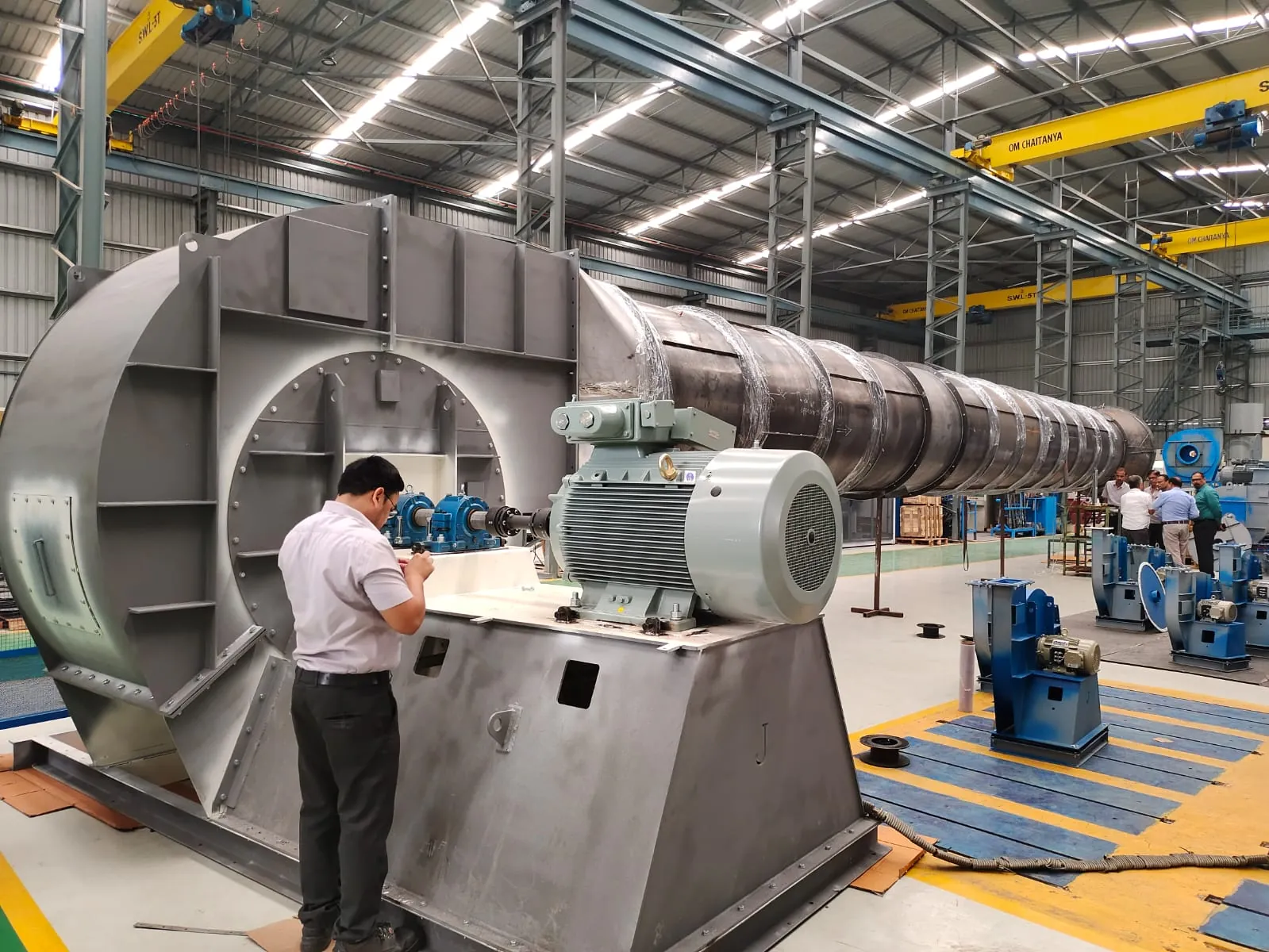
That swing is the defining problem of this duty, and we size for it directly rather than to a single design point. Each pulse drops the cake off the bags and the dP steps down; between pulses the cake rebuilds and dP climbs, so the fan works against a live band of resistance, often 50 to 200 mmWC across the cycle. We engineer the operating band onto the falling, stable portion of the wheel curve so flow barely moves as the resistance swings, keep a 15 to 20 percent flow margin at the clean-filter condition, and default to VFD so speed holds duct and hood velocity as the cake rebuilds instead of letting it coast down. We then verify the curve on the 200 HP VFD test rig before dispatch. Fans above the rig's 200 HP are run at derated speed and scaled to the specified duty by the fan laws.
Should the fan sit on the clean side or the dirty side of the baghouse?
Clean side, downstream of the collector, is the common position and the easier duty. Outlet loading on a healthy baghouse is light residual dust, so wear is light and the design focus is curve stability across the pulse cycle, dew-point margin and noise. Dirty side, ahead of the collector, is harder: the fan handles raw dust at heavy inlet loading, so it gets the full wear package and a self-cleaning wheel. Some duties call for a dirty-side fan, and every clean-side fan still needs a sensible margin for the day a bag tears and dust carries over. Tell us the position and we build to it; where carryover is a real risk we assume it rather than the average.
What happens to the fan if a bag fails and dust carries over?
On a bag tear, a cage that has worn through a bag, or a compartment pulsed off-line, the fan can see a slug of raw dust it was never balanced for, and on a plain curved wheel uneven deposit and abrasion throw it out of balance quickly. Where carryover is a realistic risk we specify a radial-tip self-cleaning wheel that sheds deposit from the blade root, add chrome-carbide hard-facing on the leading edges, and bolt in AR400 wear plates at the throat and outlet with access doors so they are replaced in place, not cut out and re-welded. On a genuinely clean-side duty after a well-maintained baghouse that package is usually not needed, and we say so rather than sell it into the quote.
Our gas can drop below its acid or water dew point. How do you protect the fan and the bags?
Below the water or acid dew point, typically around 120 to 150 °C on sulphur-bearing gas, moisture condenses on the bags and blinds them so dP climbs and stays climbed, and sulphuric acid condenses on the fan casing and corrodes it. We hold the casing wall above dew point with insulation and heat tracing, select corrosion-resistant metallurgy such as Corten or 316L on the wetted surfaces to your gas analysis, and put a drain at the scroll low point so any condensate leaves the casing rather than pooling. We size the dew-point margin and the material to your actual SO₂/SO₃ and moisture, not a default, because the right answer depends on the gas.
Should I specify VFD or an inlet vane damper for control?
VFD is our default on this duty for two reasons. First, filter loading shifts the air demand across every pulse-clean cycle, and speed control holds duct and hood capture velocity as the cake rebuilds instead of letting the fan coast down. Second, VFD turns the fan down with process load and is more efficient than an inlet vane damper across the operating range because it avoids the throttling loss at part-load. Inlet vane dampers remain available for legacy retrofit where the existing motor and starter cannot take a drive. We quote whichever your installation calls for.
Can your bag-filter draught fans handle hot gas?
Yes. Many bag-filter draughts run ambient to 200 °C clean-side, but hot-gas trains reach up to 500 °C at the ceiling of the envelope. On hot duty we upgrade the casing to IS 2062 or SA 516 Gr 70, fit expansion joints for the thermal growth, add a shaft cooling disc where temperature requires, and select bearings for a sustained 80 to 100 °C housing temperature. The fan is built for your stated gas temperature and excursion case, not a generic rating; confirm your filter media rating matches that stated temperature so the two agree.
We're a pollution-control OEM. Can you supply just the draught fan as a sub-package?
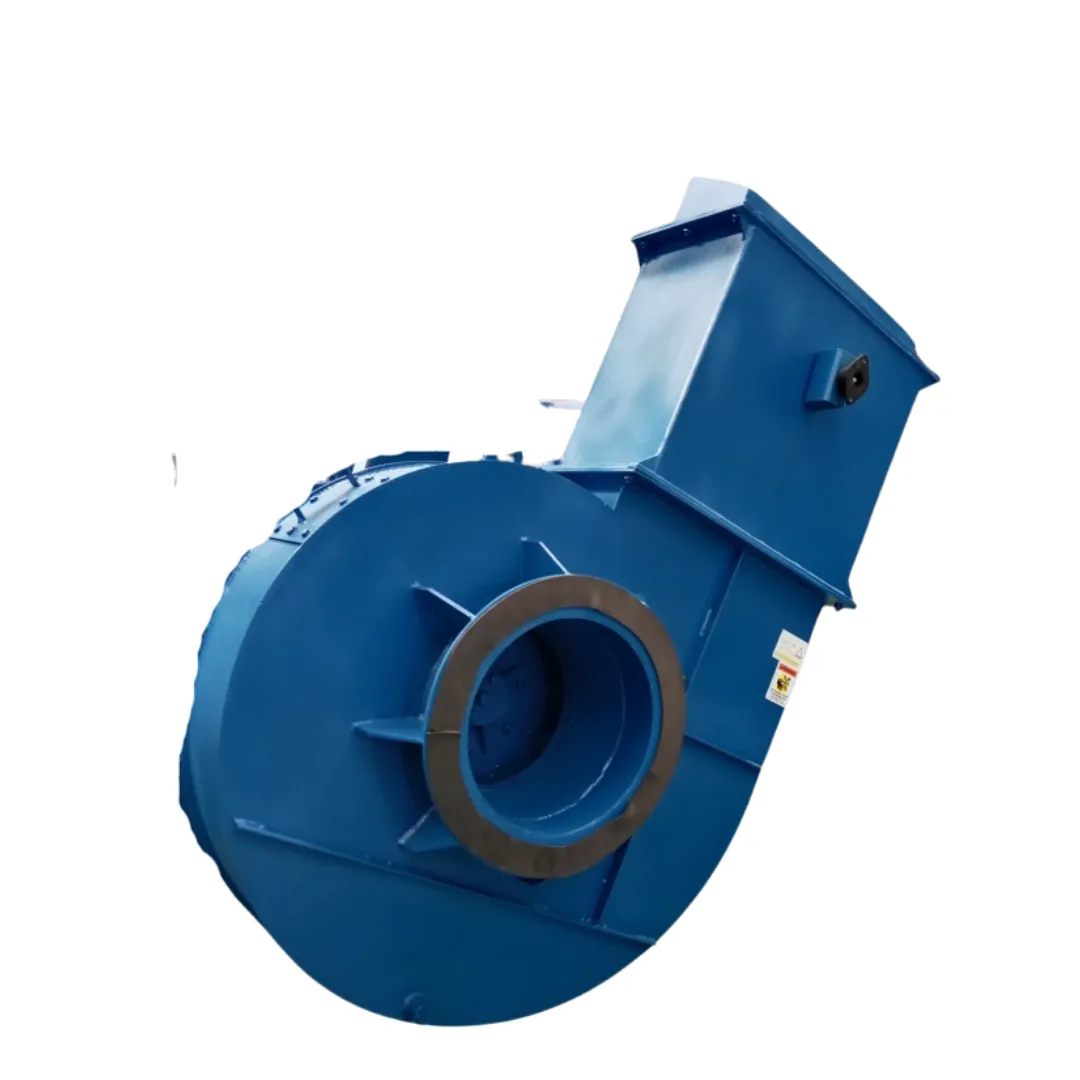
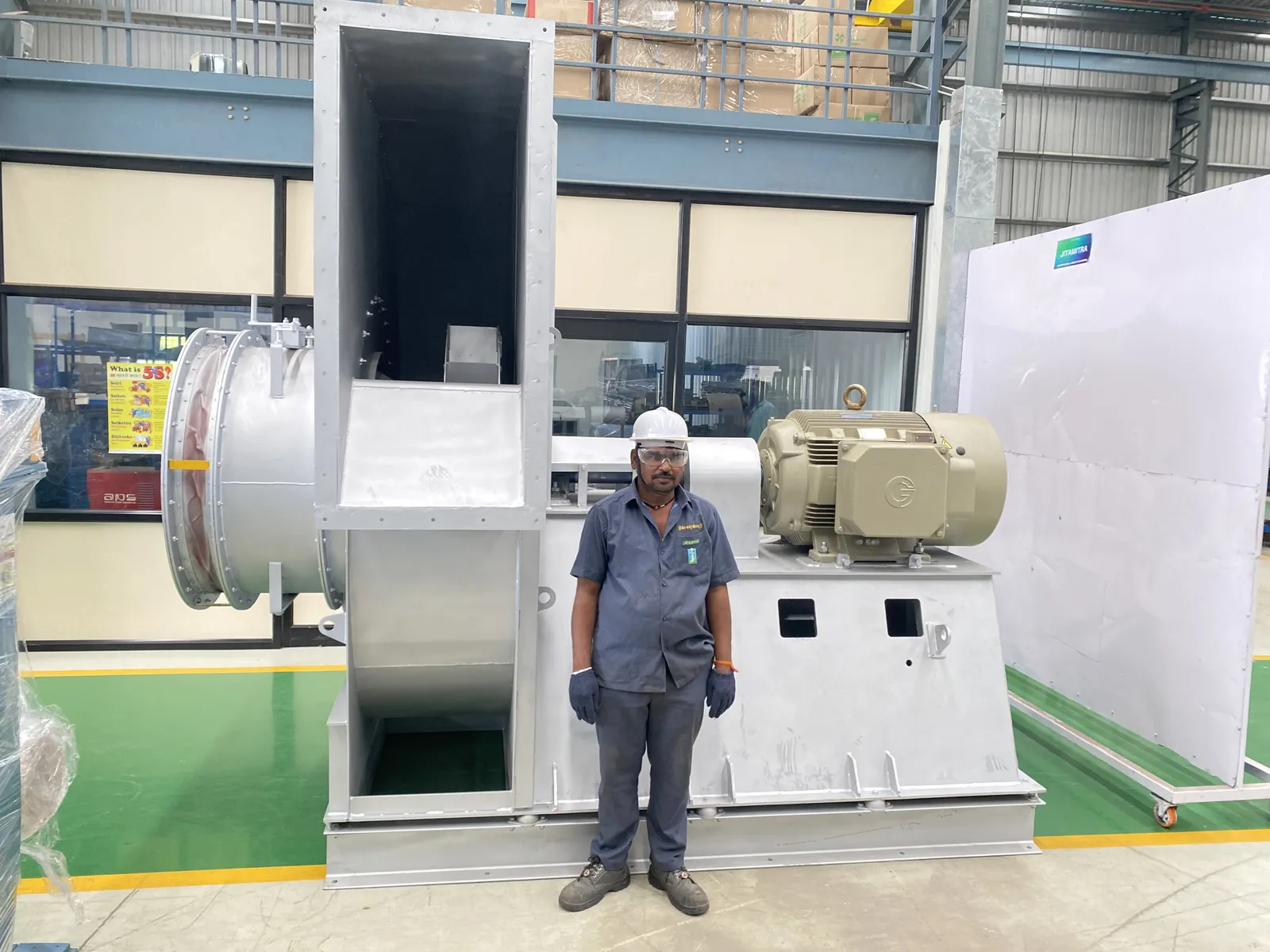
Yes. We supply bag-filter draught fans separately to pulse-jet baghouse and cartridge-collector manufacturers as a sub-package. You specify the duty and the integration interface, flange dimensions, mounting orientation, clean and loaded filter dP, position relative to the collector, ATEX scope if any, electrical interface and control protocol, and we document it up front and deliver the fan ready to mate. The engineering is identical to a direct-buyer fan; only the interface and who buys it differ. We have 17 customer duties on this application across cement, iron and steel, foundry and pollution-control OEMs.
What performance and certification claims actually apply to these fans?
Every fan is performance-tested in-house to the IS 4894 / ISO 5801 / AMCA 210 method on our 200 HP VFD test rig, and dynamically balanced to ISO 21940 G6.3 as standard, with G2.5 or G1.0 on application. Bearing life is a design target of L10h at least 40,000 hours continuous. To be precise about the claims: that is testing to the AMCA 210 method in-house, not an AMCA certification, and we are not an AMCA member. CE is self-declared per 2006/42/EC and 2014/35/EU, and ATEX Zone 2/22 is self-declared per 2014/34/EU, Category 3, where the area classification calls for it. Those are self-declarations of conformity, not third-party certifications; our only third-party certification is ISO 9001:2015.