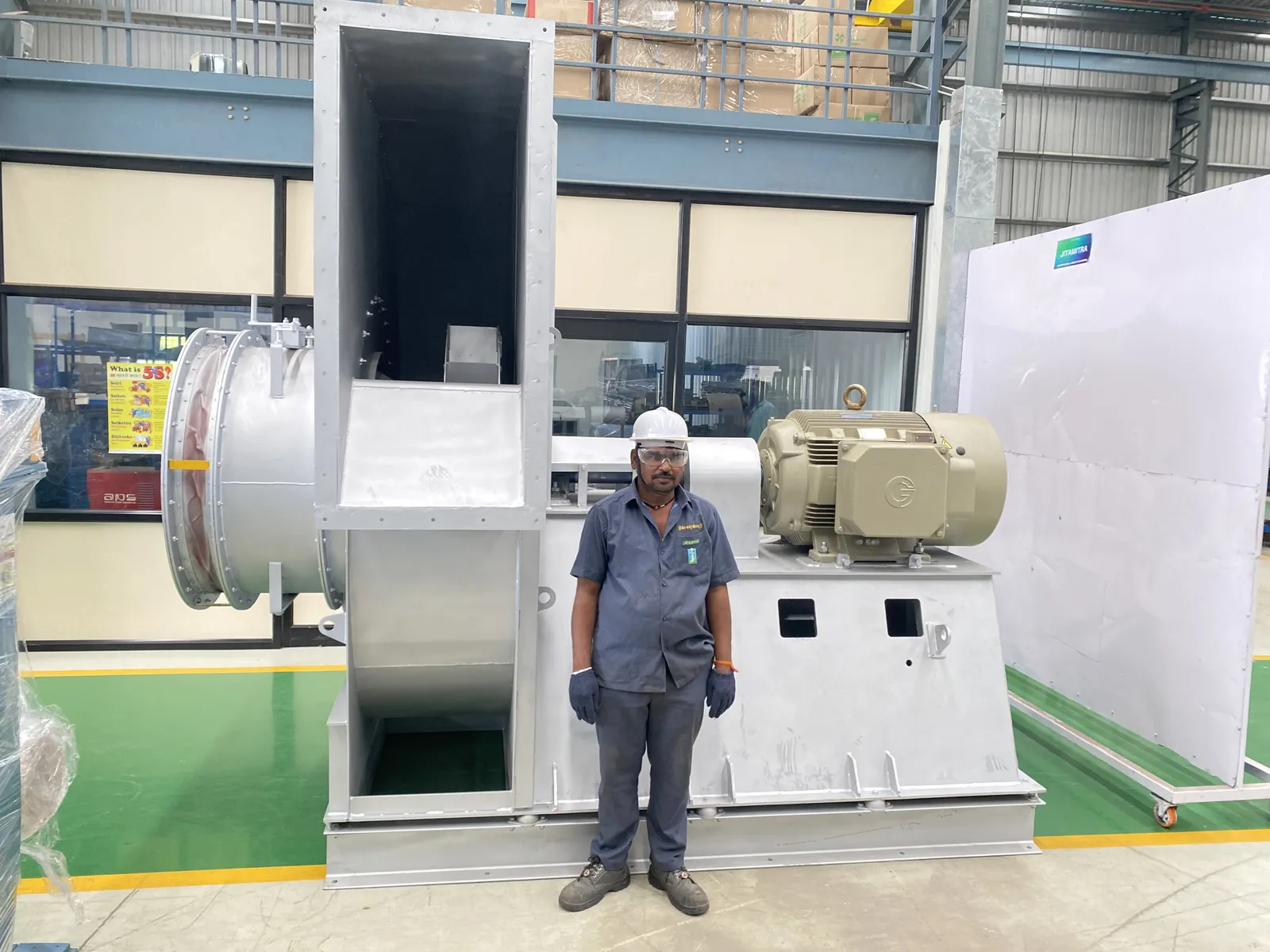
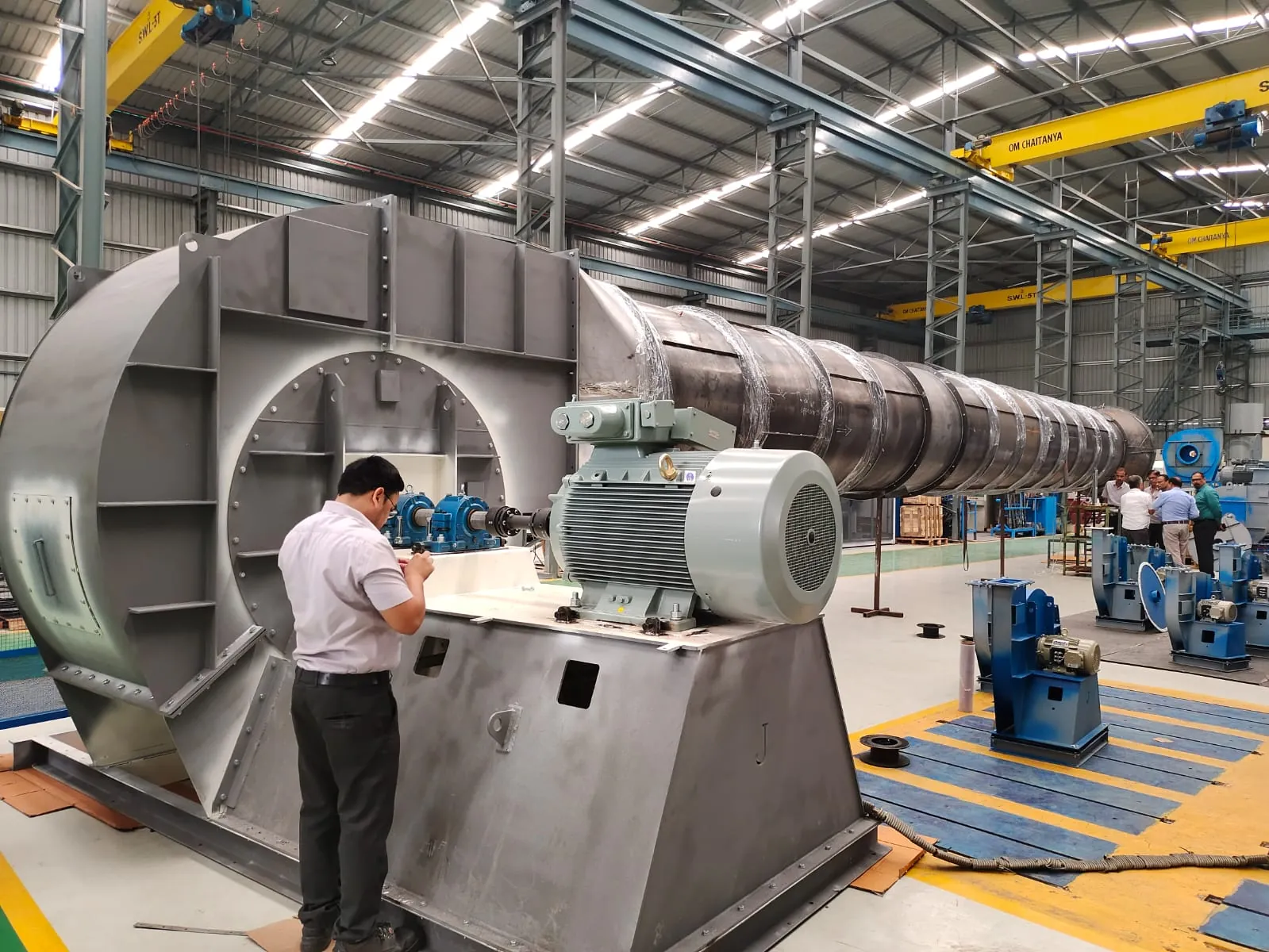
Centrifugal forced-draught cooling-tower fan on the Jitamitra shop floor
Home  /  Applications  /  Cooling tower
Applications

Cooling-tower fans — move the air, waste no power, stay quiet.

A cooling-tower fan moves a large volume of ambient air across the fill against very little resistance — the whole duty is high flow at low static. Most towers use large-diameter axial fans; where a cell is space- or pressure-constrained, or the tower is forced-draught, a centrifugal fan earns its place. That is the duty we build: high flow, low pressure, saturated wet air, and a fan that runs continuously — so efficiency and noise, not survival, decide whether it is a good fan. We engineer to the full envelope below — up to 2,00,000 CMH, 2,000 mmWC and 400 HP — with the typical cooling-tower point sitting at high flow and low static.

2,00,000CMH max flow
25–150mmWC typical static
100% RHsaturated air
400 HPdrive power
15,000+
fans built since 2011
200 HP
VFD test rig · IS 4894 / AMCA 210
99%
on-time delivery
3
working days to quote — always
AMBIENT AIR IN · ACROSS THE FILL · HIGH FLOW · LOW STATIC · SATURATED AIR OUT
What it does

The whole duty is high flow at low static — and the fan is pure parasitic load.

A cooling-tower fan moves ambient air across the fill so evaporation carries heat out of the circulating water. On a forced-draught tower the centrifugal fan sits at the air inlet and pushes air through the pack; the resistance is low, the volume is large, and the fan runs whenever the tower runs — so every point of efficiency and every dB(A) is on the operating bill, not on a survival list.

  • 01
    Move air

    A large volume across the fill — the flow sets the tower's cooling range and approach. Cooling-tower duty is high flow at low static, typically 25–150 mmWC, far down the pressure end of our envelope.

  • 02
    Waste no power

    The fan is parasitic load and runs continuously. On a forced-draught cell the centrifugal fan trades a little more pressure capability for a compact footprint — so we size onto the best-efficiency region to keep the kW down at the design flow.

  • 03
    Handle wet air

    The airstream leaving the fill is saturated — 100% RH — and carries drift plus treatment chemicals. Materials, coating and drainage are chosen for standing condensate, not clean dry air.

INDUCED-DRAFT CENTRIFUGAL FAN Single-width single-inlet — scroll cut away to reveal the impeller inlet expansion joint MOTOR IE3 / VFD GAS IN GAS OUT n 1 2 3 4 5 6 7 8 9 10 1 Inlet cone (bell-mouth) 2 Backward-curved / radial-tipped impeller 3 Spiral volute casing 4 Replaceable AR wear plates (volute throat) 5 Shaft 6 Plummer-block bearings (L10 ≥ 40,000 h) 7 Shaft cooling disc (>400 °C duty) 8 Pedestal / base frame 9 Drive — motor + coupling 10 Outlet flange + duct take-off
Fig. 1Centrifugal forced-draught cooling-tower fan — single-width single-inlet, scroll cut away to reveal the backward-inclined impeller. Numbered components keyed below the drawing.
Why it is hard

Low resistance makes it look easy — efficiency, wet air and noise decide the fan.

A cooling-tower fan does not fight heat or abrasion, so it looks like an easy duty. It is not. The fan runs continuously as pure parasitic load, so a few points of efficiency set the tower's lifetime power bill; the air is saturated and chemically aggressive, so the wrong metallurgy corrodes; and the fan usually sits outdoors near a site boundary, so noise carries. A 150 HP tower fan run several points below its best static efficiency wastes tens of MWh a year — over the tower's life the efficiency choice can outweigh the original CAPEX.

01 — EFFICIENCY

Parasitic power over the tower life

The fan runs whenever the tower runs — often 8,000+ h/yr — and its power is pure parasitic load on the plant. A tower fan held a few points below its achievable efficiency burns money every hour, and at low static the margin between a good and a poor selection is large.

How we engineer it out

Backward-inclined / backward-curved wheels sized onto the best-efficiency region for the high-flow, low-static point — high static efficiency on standard duty, airfoil-bladed for higher efficiency where the operating hours justify the CAPEX. VFD default so the fan tracks the cooling load instead of throttling.

02 — WET AIR

Saturated air, drift and treatment chemicals

Air leaving the fill is at 100% RH, carries drift droplets, and holds whatever biocide, acid or scale-inhibitor dosing the water treatment uses. On a forced-draught fan the wheel and casing see standing condensate for the fan's whole life — mild steel rusts through from the inside.

How we engineer it out

Stainless (304 / 316L) or hot-dip-galvanised construction, or FRP where the water chemistry is aggressive; epoxy / special coating on the wetted path; sealed bearings with a slinger and a cased drain, and casing drainage so condensate does not pool.

03 — NOISE

Sound at the site boundary

Cooling towers sit outdoors, often near a plant boundary, a data-hall or occupied buildings, and run through the night. Low-frequency blade-pass content carries, and the tower is frequently the loudest single item on the site's noise map.

How we engineer it out

Designed to <85 dB(A) @ 1 m as standard; <80 dB(A) with an inlet silencer and acoustic-treated casing; <75 dB(A) with a custom acoustic enclosure or sound hood — with the low tip speed a centrifugal wheel allows at low static working in our favour.

How we design for it

Every choice is documented on the GA drawing you sign off — before we cut metal.

We don't sell a catalogue near-fit. The fan is engineered to your air flow, cell static, water chemistry and sound limit — made to order, not off a shelf.

  • Impeller geometry — Backward-inclined or backward-curved for the highest static efficiency on the high-flow, low-static cooling-tower point; airfoil-bladed on the highest-efficiency builds where the duty is large and the continuous hours justify the CAPEX. Low tip speed keeps the noise down.
  • Materials for saturated air — Stainless steel (304 / 316L) or hot-dip galvanising for the wetted path; FRP / FRP-rubber-ebonite lining where the treated water is corrosive; epoxy or special coating on carbon-steel builds; shaft seal and cased drain to keep condensate off the bearings.
  • Control — VFD as default — Cooling demand swings with ambient wet-bulb and plant load; a tower cell rarely runs at design flow. VFD speed control tracks the load and is far more efficient than throttling or cycling — and by fan-affinity the power falls with the cube of speed, so part-load running is where the savings are. Inlet vane dampers remain available for legacy retrofit.
  • Drainage & bearing protection — Casing drain points so condensate does not pool; a heat slinger / cooling disc where a warm return-air recirculation raises inlet temperature; sealed, regreasable bearings selected for a wet outdoor environment; drive and motor rated for the humidity and the outdoor duty.
Engineered to your duty point

We size the fan onto its best-efficiency region at your low-static point — then prove it on the rig.

No catalogue fan forced onto your spec. Your high-flow, low-static operating point is engineered onto the best-efficiency region of the selected wheel — where a small change in cell resistance does not swing the flow — and verified on the 200 HP VFD test rig before dispatch.

avoid: unstable 0 40,000 80,000 1,20,000 1,60,000 2,00,000 VOLUME FLOW RATE  [ CMH ] 0 500 1000 1500 2000 STATIC PRESSURE  [ mmWC ] 0 25 50 75 100 STATIC EFFICIENCY  [ % ] Fan static pressure System resistance Static efficiency BEP 82% DUTY POINT 1,20,000 CMH · 450 mmWC Fan static pressure System resistance Static efficiency
Fig. 2Representative cooling-tower-fan characteristic — fan static pressure, cell system resistance and static efficiency vs. flow, with the duty point engineered onto the best-efficiency region at low static. Illustrative; every fan is sized to its own duty.
Capability envelope — cooling-tower service

What we can supply, and where it stretches on application.

ParameterStandardOn application
Volume flowup to 2,00,000 CMHhigher on enquiry
Static pressure25–150 mmWC typical cooling-tower pointup to 2,000 mmWC across the envelope
Inlet air conditionambient to saturated (100% RH), with drift and treatment chemicalswarm return-air recirculation on application
Static efficiencyhigh static efficiencyhigher on high-efficiency builds
Sound level<85 dB(A) @ 1 m<75 dB(A) with acoustic enclosure
Drive powerup to 400 HPhigher with custom motor sourcing
Speed600–1,800 RPM typicalper duty + sound limits
Balance qualityISO 21940 G6.3G2.5 / G1.0 on application

The envelope above covers the great majority of centrifugal cooling-tower duty. The cooling-tower point itself sits at high flow and low static — typically 25–150 mmWC — so the design focus is efficiency, wet-air construction and noise, not the high pressure the envelope can reach. The wetted path is engineered for saturated air (100% RH), drift and treatment chemistry: stainless, galvanised or FRP construction with drainage. Bearing life is a design target of L10h ≥ 40,000 h continuous, with longer L10 on application. For duty beyond the envelope we engineer to spec and quote on enquiry.

How a Jitamitra CTWR fan is specified

Specified, not picked from a shelf.

The same engineering language carries from your enquiry to the GA drawing to the nameplate — expressed in the standard AMCA conventions.

Specification fieldOptions
Arrangement (AMCA 99)Arr. 1 (overhung, fan bearings) / Arr. 4 (direct, motor on base) / Arr. 8 (overhung on common base) / Arr. 9 (overhung, motor side) / Arr. 10 (overhung, motor inside base) — selected by drive, access and the wet outdoor environment.
Width / inletSWSI (single width, single inlet) default for a forced-draught cell; DWDI (double width, double inlet) for high flow at low static where the cell geometry allows.
Wheel typeBackward-inclined or backward-curved (default, best efficiency at high flow and low static) / airfoil-bladed (highest-efficiency, large continuous-duty builds).
Class (by pressure / outlet velocity)Class I typical for the low-static cooling-tower point; Class II / III only where the cell resistance is unusually high — selected from the duty point on the pressure-vs-outlet-velocity limits.
Materials of constructionStainless steel (304 / 316L) or hot-dip galvanised for saturated air (default) / carbon steel + epoxy or special coating on milder chemistry / FRP or FRP-rubber-ebonite lining where the treated water is corrosive.
DriveDirect-coupled / V-belt / VFD (default for load tracking). Drive up to 400 HP across the envelope; speed typically 600–1,800 RPM, kept low for noise where the duty allows.
Discharge & rotation (AMCA orientation)Rotation CW or CCW (viewed from drive side) with discharge angle per AMCA — e.g. TH/BH/UB/DB — set to match the cell air inlet and installed footprint.
Accessories & acoustic scopeVFD or inlet vane damper control; shaft seal and cased drain for standing condensate; heat slinger / cooling disc on warm-recirculation duty; inlet silencer and casing acoustic lagging; acoustic enclosure / sound hood for <75 dB(A); flexible connection / expansion joint; drain and inspection doors.
The proof, not the promise

We test before we ship — and you're welcome to witness it.

Every job's performance is verified at our works on the 200 HP VFD test rig, to the AMCA 210 / ISO 5801 method, before dispatch.

  • Customer-witnessed FAT on request — at no extra cost
  • Rotors balanced to ISO 21940 G6.3 as standard (G2.5 / G1.0 on application) before they leave the floor
  • Full NDT in-house — DP, MPI, UT, RT — to what the duty demands
30+ INDUSTRIES · 45 APPLICATION / DUTY TYPES
Where cooling-tower fans run

Wherever a process rejects heat to a tower.

Power Generation

Condenser cooling-tower cells, auxiliary-cooling and closed-circuit tower fans.

Chemicals & Petrochem

Process cooling-water towers, forced-draught cells on space-constrained plots.

Data Centres

Cooling-tower and closed-circuit cells for chiller and heat-rejection loops.

Oil & Gas

Refinery and gas-plant cooling-water towers, often to a tight noise limit.

Iron & Steel / Metals

Cooling-tower cells on caster, mill and furnace-cooling water loops.

HVAC & Buildings

Condenser-water and closed-circuit cooling towers on large chiller plants.

Pharmaceuticals

Utility and process cooling towers on space- and noise-constrained sites.

Your process

45 application/duty types engineered. Tell us yours.

Standards & conformity

Stated precisely — because procurement checks.

What our marks mean, in the words that survive an audit.

Performance

Tested to the AMCA 210 / ISO 5801 method, in-house on our 200 HP VFD rig. Tested-to-method — not AMCA-certified.

Quality system

ISO 9001:2015 — third-party certified. Our only third-party certification.

CE conformity

Self-declared per 2006/42/EC + 2014/35/EU (Module A). A self-declaration, not a notified-body certificate.

ATEX conformity

Self-declared, Zone 2/22, Category 3, per 2014/34/EU, where the area classification calls for it.

Oil & gas duty

Designed and built to API 673 as project-specific scope.

Welding

ASME Sec IX qualified welders + WPS for every joint.

Balance

ISO 21940 — G6.3 minimum, G2.5 / G1.0 on application.

Vibration

ISO 20816 evaluation; ISO 14694 for fan-specific limits.

Lead time & process

From enquiry to a tested fan on your dock.

StageStandard dutyAPI-673 / engineered
Offer / quotation3 working days — always7–10 working days
GA drawing for approval2–3 weeks from PO3–4 weeks from PO
Manufacture + balance + paint6–10 weeks10–14 weeks
Performance test + witnessed FAT~1 week1–2 weeks
Order-to-dispatch (total)9–14 weeks14–20 weeks

Shutdown-driven replacements: we have shipped fans within 6 weeks of a clean PO. Tell us your shutdown window and we commit to a dated plan.

Questions engineers ask

The eight we hear most before a PO.

Do you make the axial fan or the centrifugal fan for a cooling tower?
We build the centrifugal fan. Most large cooling towers use a big-diameter axial fan pulling air out of the top of the cell, and that is a different machine. A centrifugal fan earns its place on a forced-draught tower, where the fan sits at the air inlet and pushes air through the fill, and on space- or pressure-constrained cells that cannot take a large axial rotor or need a little more static capability. If your tower is induced-draught with a top-mounted axial fan, tell us and we will say so plainly rather than fit the wrong machine.
The static pressure is tiny. Why does the fan selection still matter?
Because the fan is pure parasitic load and it runs continuously. At high flow and low static the difference between a good selection and a poor one is large in absolute kW, and the fan often runs 8,000 or more hours a year. A 150 HP tower fan held several points below its best static efficiency wastes tens of MWh a year, and over the tower's life that efficiency choice can outweigh the original purchase price. We size onto the best-efficiency region at your low-static point and tell you the offered efficiency on the quote, not a generic catalogue figure.
The air is saturated and the water is treated. What materials do you use?
Air leaving the fill is at 100 percent relative humidity, carries drift droplets, and holds whatever biocide, acid or scale-inhibitor the water treatment doses, so the wetted path sees standing condensate for the fan's whole life. We build the wheel and casing in stainless steel (304 or 316L) or hot-dip galvanised as default, in FRP or FRP-rubber-ebonite lining where the treated water is aggressive, and add epoxy or a special coating on milder carbon-steel builds. We size the material to your actual water chemistry and drift condition, not a default, and add casing drainage and a shaft seal so condensate does not reach the bearings.
How do you keep the tower fan within our site noise limit?
As standard we design to below 85 dB(A) at 1 m. Below 80 dB(A) is achievable with an inlet silencer and an acoustic-treated casing, and below 75 dB(A) with a custom acoustic enclosure or sound hood. A centrifugal wheel at the low static a cooling tower needs can run at a modest tip speed, which works in our favour on low-frequency content. Tell us the boundary noise limit and where the tower sits relative to occupied buildings, and we predict and engineer to it rather than fit a silencer after the complaint.
Should I specify VFD or an inlet vane damper for control?
VFD is our default. Cooling demand swings with the ambient wet-bulb and the plant load, so a tower cell rarely sits at design flow, and by fan-affinity the power falls with the cube of speed — part-load running on a drive is where the energy saving is. VFD also lets several cells share the load smoothly instead of cycling motors on and off. Inlet vane dampers remain available for legacy retrofit where the existing motor and starter cannot take a drive. We quote whichever your installation calls for.
Have you built cooling-tower fans before?
This is an engineered-capability page. We publish it because centrifugal forced-draught cooling-tower duty is squarely within what we design and build — high flow, low static, saturated wet air, continuous running — and shares its engineering with our air-supply, general-ventilation and data-centre cooling fans. Rather than claim a cooling-tower reference we do not have, we would rather be straight: tell us your cell flow, static, water chemistry and noise limit, and we will engineer the fan to it and prove the curve on the 200 HP VFD test rig before dispatch.
What is the lead time for a cooling-tower fan?
A standard engineered cooling-tower fan runs roughly 8 to 13 weeks order-to-dispatch: offer in 3 to 5 working days, GA drawing 2 to 3 weeks from PO, manufacture, balance and paint 5 to 9 weeks, and performance test plus FAT about a week. Stainless or FRP construction for aggressive water chemistry, or a full acoustic enclosure, adds material lead time — we confirm a dated commitment against your requirement rather than a placeholder.
Do you build to CE and ATEX, and are your efficiency claims independently certified?
CE is self-declared per 2006/42/EC and 2014/35/EU, and ATEX Zone 2/22 is self-declared per 2014/34/EU (Category 3) where an area classification calls for it — those are self-declarations of conformity, not third-party certifications. Performance is tested in-house to the AMCA 210 / ISO 5801 method on our 200 HP VFD test rig; that is testing to the AMCA 210 method, not an AMCA certification, and we are not an AMCA member. Balance is to ISO 21940 G6.3 as standard, with G2.5 or G1.0 on application, and bearing life is a design target of L10h at or above 40,000 hours. Our only third-party certification is ISO 9001:2015.

Across the range

Where cooling tower fans fit — the fans that run them, related duties, and the industries served.

The same engineering, viewed three ways — by fan family, by duty, and by industry. Follow the cross-references.

Take it further

Specs an engineer can use — not a brochure.

Engineer to engineer

Send us the duty point.
We'll quote in 3 working days — always.

No model numbers needed. Give us the operating conditions — flow, static, gas temperature, composition, particulate, and any tender standard — and our application engineers size the fan and quote it. Attach a spec or GA if you have one.

+91 90110 09155  ·  mihir.jitamitra@gmail.com