Have you supplied fans for data centers before?
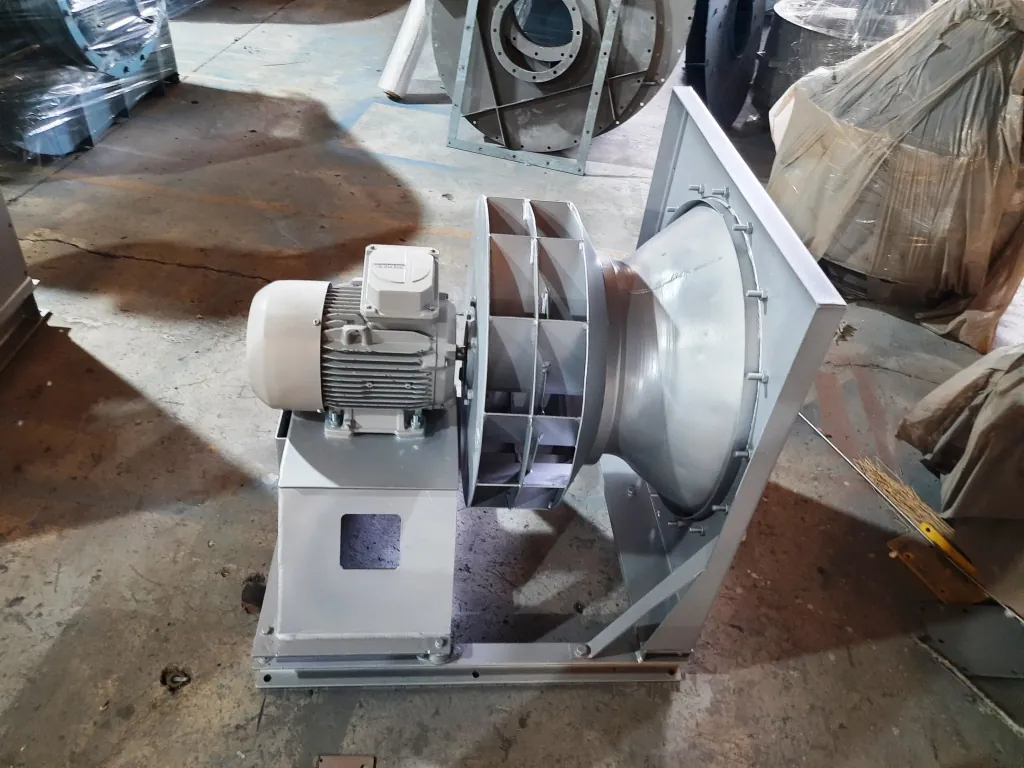
We have executed a small number of data-center duties, and the underlying fan engineering is proven across our range in far harder service than clean cooling air. A data-center fan is a clean-air, high-reliability, low-noise duty; the same aerofoil and backward-curved wheels we run there, and the same continuous-duty rotor and bearing engineering, are proven across cleanroom, HVAC and process work. We engineer each fan to your duty point and prove it on the test rig before it ships, whether it is your first unit from us or your fiftieth.
How do you engineer the fans for 24x7 uptime and N+1 fan duty?
Three ways. The rotor is dynamically balanced to ISO 21940 G6.3 as standard, tighter on application, and the bearings are sized for a long continuous L10h life rather than intermittent duty. The wheel is a non-overloading backward-curved or aerofoil type, so in an N+1 set sized to your redundancy scheme a failed unit's share of the flow is carried by the remaining fans without overloading their motors, and the fan itself is not a single point of failure. And every fan is performance-tested in-house before dispatch, so the unit that goes into a live facility is a proven curve, not a catalogue promise. Tell us your redundancy scheme and the duty split and we size the set to it.
Fan energy lands straight in our PUE. How do you keep it efficient?
The cooling fans run every hour of the year, so we treat efficiency as the primary design driver, not an afterthought. We engineer your duty point onto the best-efficiency region of a high-efficiency aerofoil or backward-curved wheel, size the fan where its own curve crosses your system rather than forcing a catalogue point onto your spec, and default to VFD speed control so part-load flow follows the fan laws instead of burning energy across a throttling damper. Because the IT load swings, part-load efficiency matters as much as the design point, and we select for both. We prove the curve on the 200 HP VFD test rig before the fan leaves the floor. Fans above the rig's 200 HP are run at derated speed and scaled to the specified duty by the fan laws.
We have a hard sound-power limit near the boundary. Can you meet it?
Yes, but the sound target has to be a design input, not a site surprise. We hold the fan at a low tip speed on the quietest wheel geometry for the duty and keep the operating point in the best-efficiency region, which is also where the fan is quietest. Where the limit is tight we add matched inlet and outlet attenuators and acoustic lagging inside the battery limit. Give us the sound-power or sound-pressure limit and the location, and we engineer the selection and the attenuation scope to meet it rather than measuring a problem after installation.
Do the emergency smoke and pressurisation fans really run hot, and can you build them?
Yes. Smoke-extraction and stairwell-pressurisation fans sit idle until a fire, then must move smoke hot for the class and hold time the project's fire strategy specifies. We build these on the same high-temperature platform that runs our hot-gas duty across the range up to 500 °C, with high-temperature bearings and construction, engineered here for the unusual case of sitting unused for months and then running hot on demand. Tell us the temperature rating, the duration and the airflow the life-safety scheme calls for and we build to it.
Do you performance-test the fans, and what about AMCA, CE, ATEX and quality certification?
Every fan is performance-tested in-house to the IS 4894 / ISO 5801 / AMCA 210 method on our 200 HP VFD test rig, and dynamically balanced to ISO 21940 G6.3 as standard (G2.5 / G1.0 on application), so you get the proven curve and the balance report before dispatch. To be precise: that in-house testing is to the IS 4894 / ISO 5801 / AMCA 210 method, not AMCA-certified, and we are not an AMCA member; CE is self-declared per 2006/42/EC and 2014/35/EU, and ATEX Zone 2/22 is self-declared per 2014/34/EU (Category 3) where the area classification calls for it — those are self-declarations of conformity, not third-party certifications. Our only third-party certification is ISO 9001:2015.