How efficient are your data-center cooling fans, and why does it matter?
We design for high static efficiency on airfoil builds, and we size the wheel so the part-load band, not just the peak duty, sits on the efficiency island. It matters because a cooling fan runs 8,760 hours a year against a moving IT load, and every watt it wastes lands straight in the mechanical PUE. A fan held several points below its achievable efficiency wastes tens of MWh a year. We tell you the offered efficiency on the quote, and the part-load points, not a single generic catalogue figure.
Can the fan track a variable IT load without throttling?
Yes, and it should. IT load swings hour to hour, so a fan sized only for the peak spends most of its life at part-load. We fit VFD as default, or an EC-motor direct-drive on the smaller units, and control on cold-aisle differential pressure, typically +5 to +25 Pa, so the fan follows the servers by speed instead of throttling against a fixed damper. VFD speed control is more efficient than an inlet damper across the range because it avoids the part-load throttling loss.
How do you design for N+1 or 2N redundancy?
We size each fan to carry its share with the redundant unit held in reserve, so the loss of any one fan is invisible to the cold aisle. The design avoids hiding a single point of failure behind a shared shaft or drive, uses bearings with an L10h design target of at least 40,000 hours continuous, and provides for vibration monitoring so you can run condition-based maintenance between planned outages. On a fan-array layout the redundancy granularity is finer still — one plug fan out of many can drop without a meaningful loss of cooling.
What sound levels can you meet, and how?
As standard we design to below 85 dB(A) at 1 m. Below 80 dB(A) is achievable on application with inlet and outlet silencers plus an acoustic-treated casing, and below 75 dB(A) with an acoustic enclosure or sound hood. We start from a low-tip-speed airfoil selection for a broadband, tone-free signature, then add silencing and casing lagging to the measured limit. Tell us the sound target and where the fan sits relative to occupied and white space, and we predict and engineer to it.
Why a plug/plenum fan rather than a housed scroll fan?
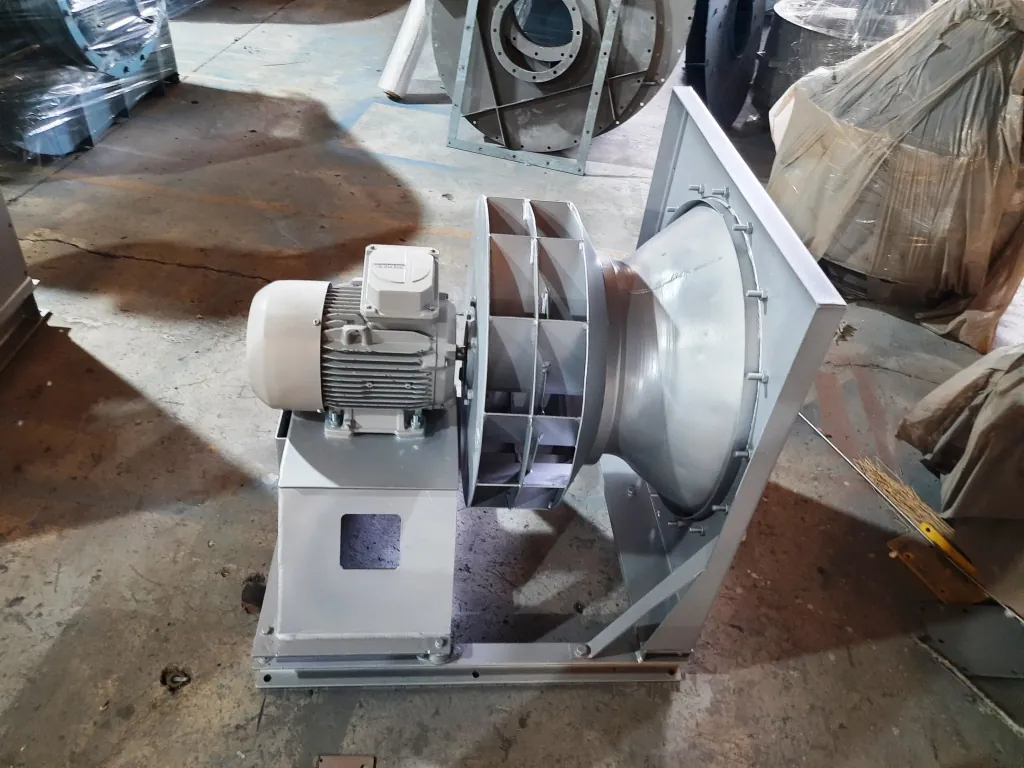
Inside a CRAH or AHU plenum a direct-driven plug/plenum fan has no scroll, a low installed footprint and an even discharge across the cooling coil, which suits the tight unit envelope and the plenum airflow. We use a housed SWSI fan where a ducted take-off is required, and a fan-array of several small plug fans where you want finer N+1 granularity and the ability to lose one unit without losing meaningful cooling. We build to your unit and containment scheme, not a fixed configuration.
Do you supply fans to CRAH, AHU and containment OEMs as a sub-package?
Yes. We supply cooling-air fans separately to CRAH manufacturers, AHU builders and containment integrators. You specify the air-side duty, the part-load band, the acoustic limit, the redundancy scheme and the integration interface — flange dimensions, mounting orientation, EC or VFD electrical interface and control protocol — and we document it up front and deliver the fan ready to mate. The engineering is identical to a direct-buyer fan; only the integration interface and who buys it differs. We have engineered to this duty and can size yours from your CRAH/AHU or containment data.
What is the lead time for a data-center cooling fan?
A standard engineered cooling fan runs roughly 8 to 13 weeks order-to-dispatch: offer in 3 to 5 working days, GA drawing 2 to 3 weeks from PO, manufacture, balance and paint 5 to 9 weeks (the materials are simple clean-air construction), and performance test plus FAT 1 week. A fan-array or a tightly acoustically-treated build adds file prep and runs a little longer. For a redundancy-deck expansion we confirm a dated commitment against your commissioning window, not a placeholder.
Do you performance-test these fans, and what standards actually apply?
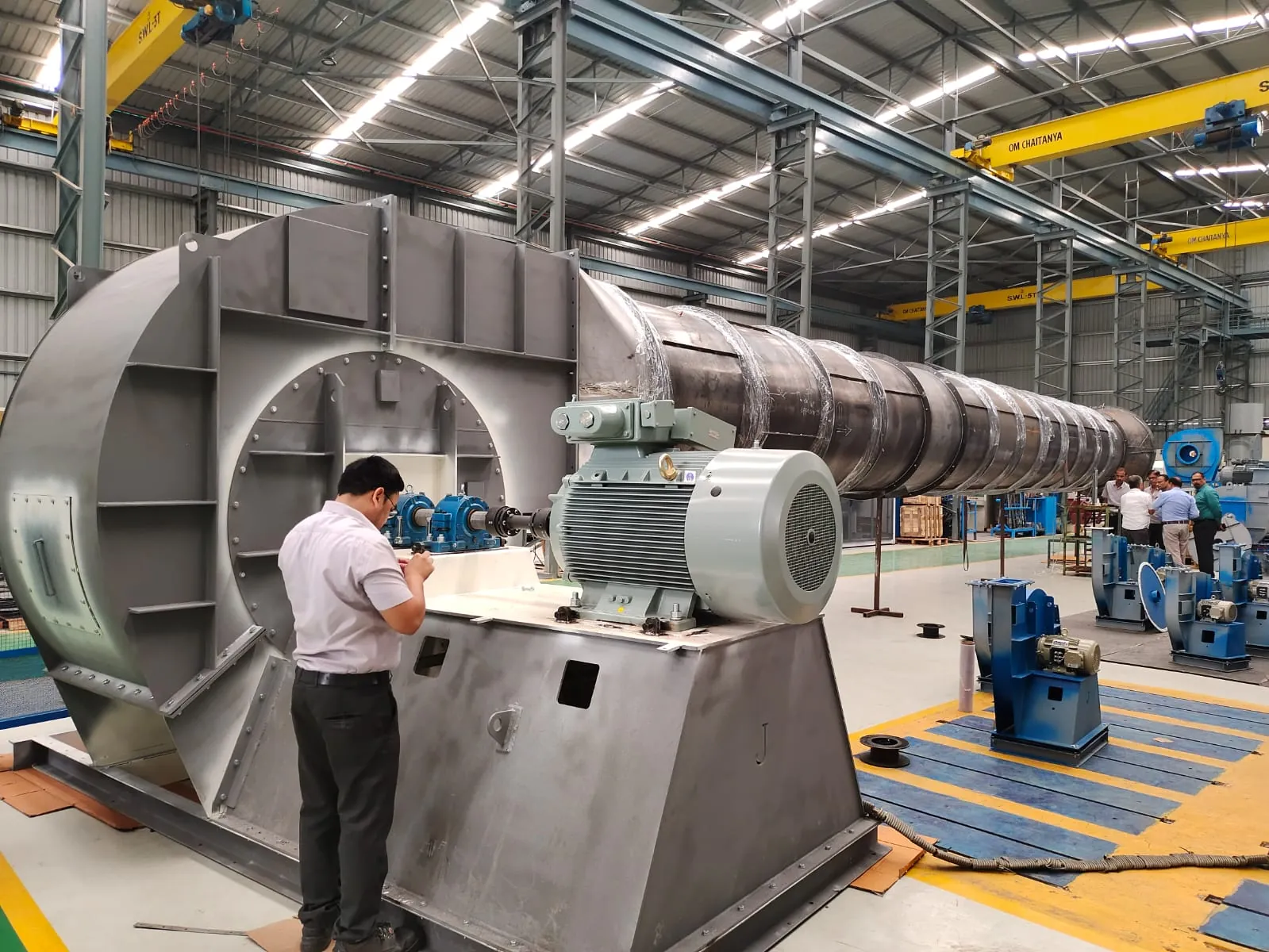
Yes. Every fan is performance-tested in-house to the IS 4894 / ISO 5801 / AMCA 210 method on our 200 HP VFD test rig, and dynamically balanced to ISO 21940 G6.3 as standard, with G2.5 or G1.0 on application. Fans above the rig's 200 HP are run at derated speed and scaled to the specified duty by the fan laws. To be precise about the claims: that is testing to the AMCA 210 method in-house, not an AMCA certification, and Jitamitra is not an AMCA member. CE is self-declared per the relevant EU directives, and ATEX Zone 2/22 (Category 3) is self-declared per 2014/34/EU only where an area classification calls for it — those are self-declarations of conformity, not third-party certifications. Our only third-party certification is ISO 9001:2015. The test and FAT take about a week and are customer-witnessed on request.