Why doesn't Jitamitra build the deep-tank aeration blower itself?
The discharge static is set by the diffuser submergence, roughly 100 mmWC for every metre of water column, plus header, drop-leg and diffuser losses — which puts a typical 4 to 8 m tank at 4,000 to 8,000 mmWC before any correction for site altitude or inlet temperature. That is multistage-centrifugal or positive-displacement territory, a different machine class from the single-stage centrifugal fans we build to 2,000 mmWC. We match the machine class to the duty, so every fan runs inside its envelope. Talk to us instead about the digester, odour-control and sludge-drying duties on the same plant.
Aeration is our biggest power bill. Does that change what I should look for in a deep-tank blower?
It should be the first thing you check, whoever supplies it. Aeration commonly runs 50 to 60 percent of a treatment plant's total energy and the machine runs continuously, so a duty point placed even a few percentage points off the wheel's best-efficiency region compounds into real money over a 20-year asset life. Because deep-tank static sits outside a single-stage centrifugal's envelope, this isn't a duty we quote — but the same discipline, duty point at best-efficiency rather than a catalogue near-fit, and VFD turndown instead of throttling loss, is exactly what we apply to the digester, odour-control and sludge-drying duties we do build on your plant.
Does a deep-tank aeration blower need to follow dissolved-oxygen demand through the day?
Yes. Oxygen demand swings diurnally, at weekends and seasonally, so whatever supplies the aeration air should turn down against the DO setpoint rather than throttling the surplus, typically across a wide turndown band verified clear of surge. On the digester, odour-control and sludge-drying air we do supply for the same plant, VFD speed control is our default for exactly this reason, tracking demand rather than wasting power against a fixed speed.
The aeration blower has to run 24×7. Does Jitamitra build for that kind of continuous duty?
Yes, for the fans we build around it. On the digester and biogas boosters, odour-control and biofilter exhaust, and sludge-drying air we build for the same plant, continuous running is the default assumption: bearing life is a design target of L10h at or above 40,000 hours, the lubrication and thermal scheme is sized for sustained running, and we run a lateral-critical check so the speed sits clear of resonance across the VFD band. Where the plant needs it we configure duty-and-standby so a machine can be taken out for service without stopping the process.
The atmosphere around the tanks is humid and can carry H₂S. What materials do you use on the fans you do build there?
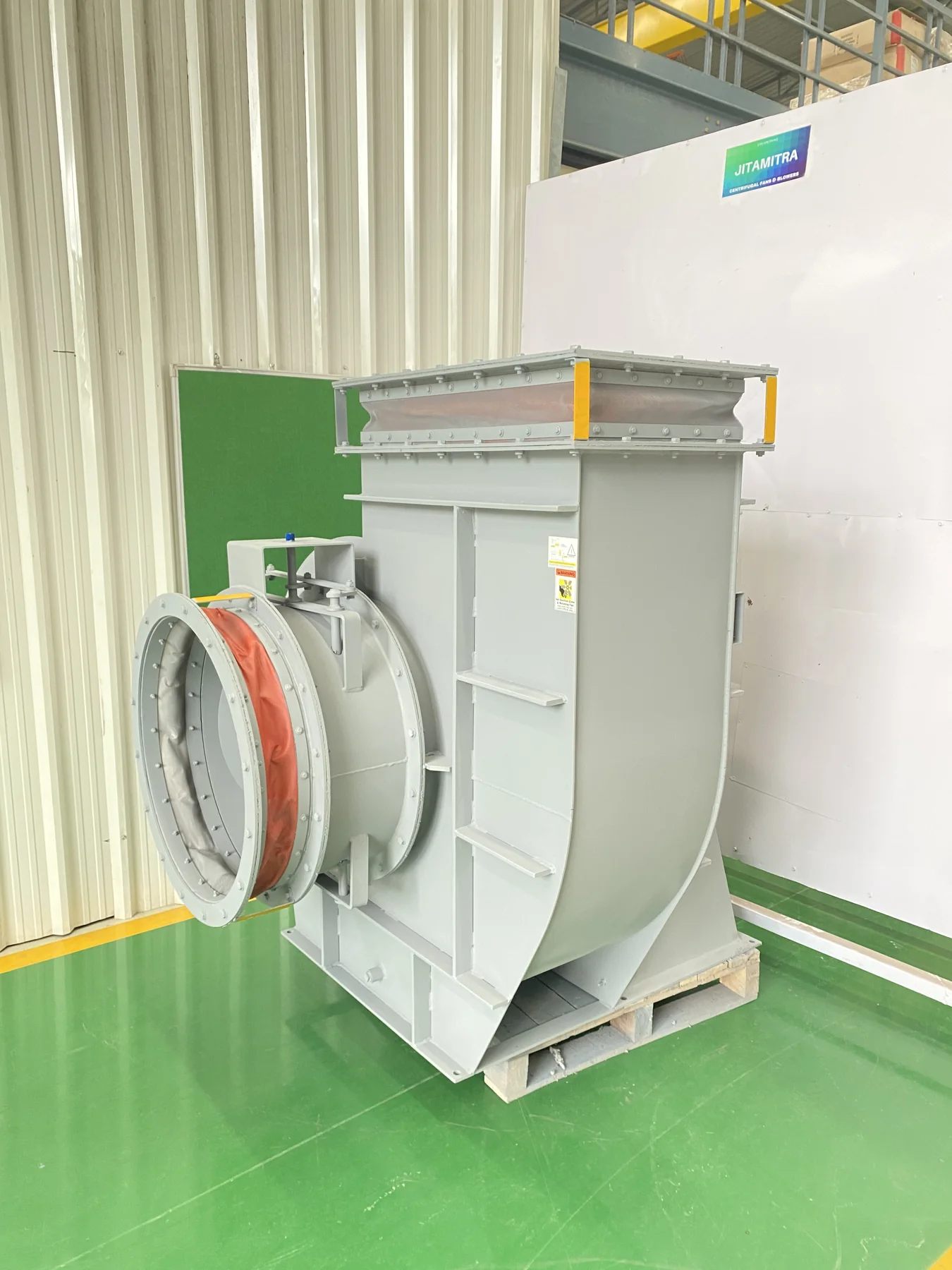
On the digester, odour-control, sludge-drying and ventilation fans we build for that atmosphere, the corrosion concern is the plant ambient rather than the process airstream. Standard build is mild steel with an epoxy coating, which suits most enclosed blower rooms. Where the surroundings are humid, coastal, or carry hydrogen sulphide from the sewage stream, we move to stainless steel construction or a special protective coating on the exposed surfaces, selected to your site atmosphere. We size the material to the actual ambient you describe, not a default.
Can you match or replace an existing aeration blower on our plant?
The deep-tank aeration blower itself, at 4,000 to 8,000 mmWC, is a multistage or positive-displacement machine. What we reverse-engineer is everything else around that tank: a digester or biogas booster, an odour-control or biofilter fan, or a sludge-drying and ventilation unit, matched to the existing duty point, bearing centres, inlet and discharge orientation and foundation bolt pattern, so the replacement drops onto the existing base and ducting. Send us the old GA drawing and nameplate for any of those and we will match it.
What is the lead time on the fans you do build for a wastewater plant, and how are they tested?
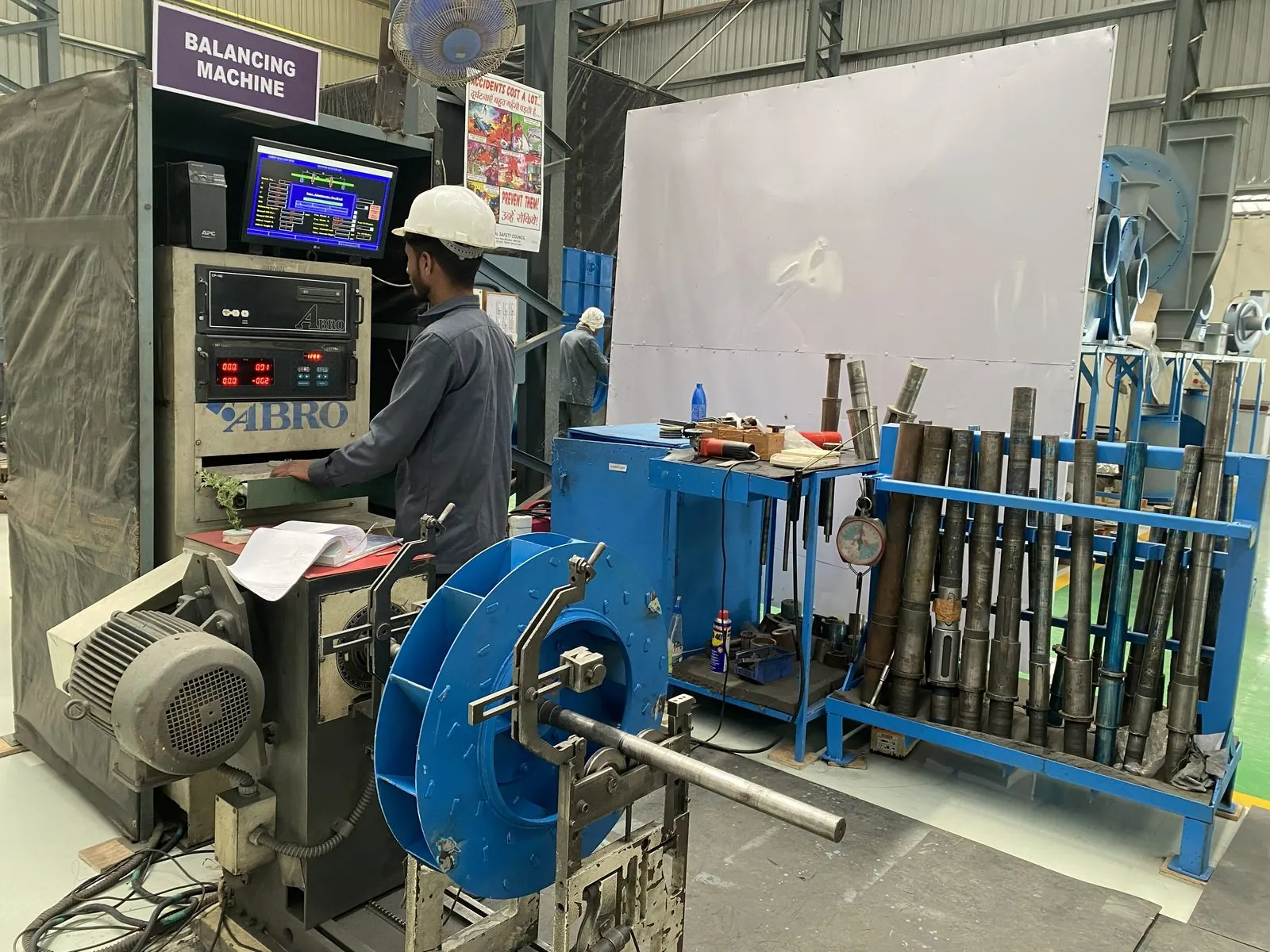
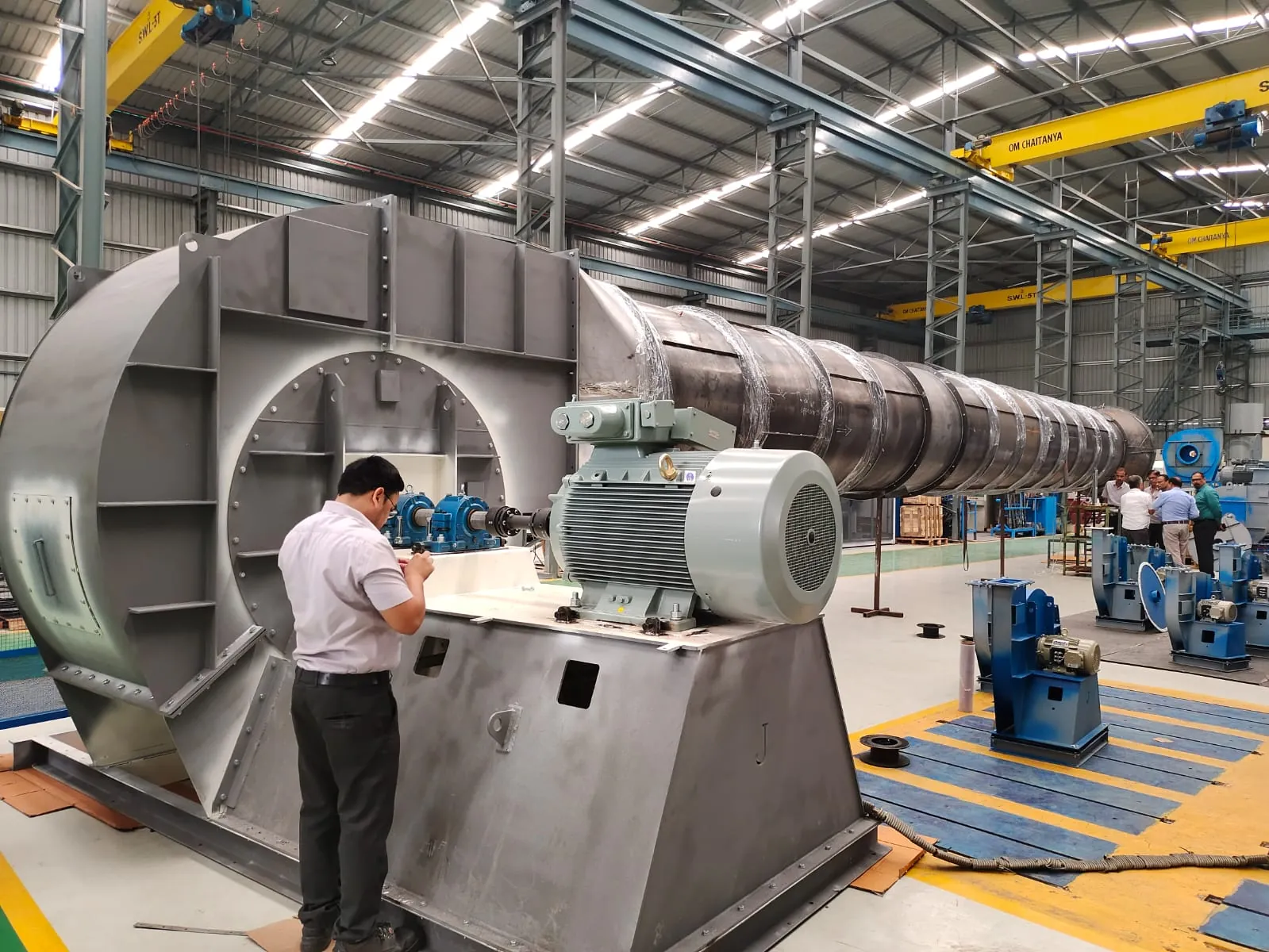
For the digester and biogas boosters, odour-control and biofilter exhaust, and sludge-drying air we build around the tank, a standard job runs roughly 9 to 14 weeks order-to-dispatch: offer in 3 to 5 working days, GA drawing 2 to 3 weeks from PO, manufacture, balance and paint 6 to 10 weeks, and performance test plus FAT about a week. Every machine is performance-tested in-house to the IS 4894 / ISO 5801 / AMCA 210 method on our 200 HP VFD test rig and dynamically balanced to ISO 21940 G6.3 as standard. Fans above the rig's 200 HP are run at derated speed and scaled to the specified duty by the fan laws. The test and FAT are customer-witnessed on request. The deep-tank aeration blower itself is not part of this — it is not a machine we build.
What do your AMCA, CE, ATEX and ISO claims actually mean?
We are precise about this. Performance is tested in-house to the IS 4894 / ISO 5801 / AMCA 210 method on our 200 HP VFD rig; that is testing to the method, not an AMCA certification, and we are not an AMCA member. CE is self-declared per 2006/42/EC and 2014/35/EU, and ATEX Zone 2/22 is self-declared per 2014/34/EU, Category 3, where an area classification calls for it; those are self-declarations of conformity, not third-party certifications. Balance is to ISO 21940, G6.3 as standard and G2.5 or G1.0 on application, and bearing life is a design target of L10h at or above 40,000 hours. Our only third-party certification is ISO 9001:2015.