Can you engineer for airport duty?
Yes. Terminal, apron and tunnel ventilation sits inside the 45 duty types we engineer, and the underlying fan engineering is proven across our range. The large clean-air AHU and ventilation fans, the exhaust fans, and the high-temperature rated construction that a smoke or tunnel fan needs are all duties we build across our range and across 45 engineered application and duty types. We engineer each fan to your building's flow, pressure, noise and fire-rating case. Tell us your duty and we will show you the selection.
How do you keep a large fan quiet enough for a concourse or public area?
Noise is designed in, not silenced afterwards. We select an aerofoil or backward-curved wheel for low sound power, place the operating point on the best-efficiency region of the wheel where it is quietest, hold the tip speed down, and specify matched inlet and outlet attenuators into the scope. We size the fan to your stated dB(A) limit at the point that matters, so the installed sound is engineered to the specification rather than discovered on commissioning, which is the expensive way to find out.
What temperature and duration can your smoke and fire fans handle?
We build and in-house test hot-gas construction to the temperature and time class your fire strategy calls for, commonly 300 °C or 400 °C for a stated period, and up to 500 °C at the top of our envelope for the most demanding case. Where the arrangement allows we keep the motor and bearings outside the hot airstream and add high-temperature cabling and drive scope. The fan is built to your stated smoke case, not a generic rating.
These fans run almost continuously. What do you do about energy?
We size the fan where its curve crosses your system so it runs on its best-efficiency region rather than throttled there, select a high-efficiency aerofoil or backward-curved wheel, and make VFD speed control our default for the large flow turndown between peak and off-peak occupancy. Speed control avoids the throttling loss of a damper at part load, which matters on a fan that runs most hours of the year. The energy-saving figure is worked out on your system and your load profile, and we engineer it rather than advertise a generic percentage.
Can you supply the whole fan scope for a terminal or hub from one source?
Yes. We can engineer and supply the comfort-air side (terminal and concourse AHU, general and dilution ventilation, roof and wall exhaust) and the life-safety side (car-park and basement CO exhaust, smoke and fire emergency fans, tunnel and metro jet and supply fans) from one partner. Each duty is a different machine, but they come on one engineering convention, with one set of drives, controls and documentation across the project, which is easier to specify, install and maintain than a mixed bag of suppliers.
Do you performance-test the fans, and what about AMCA, CE, ATEX and quality certification?
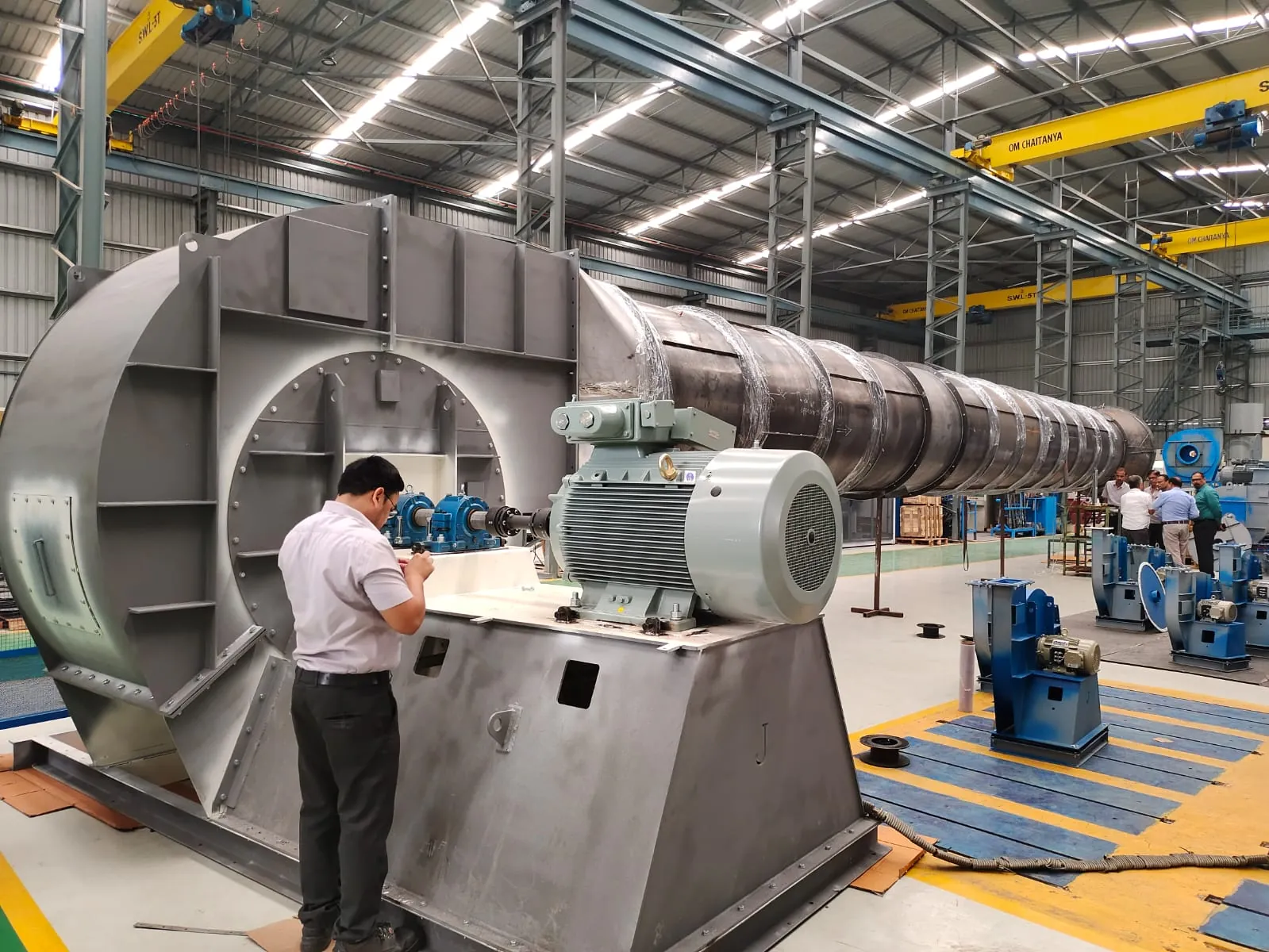
Every fan is performance-tested in-house to the IS 4894 / ISO 5801 / AMCA 210 method on our 200 HP VFD test rig, and dynamically balanced to ISO 21940 G6.3 as standard (G2.5 / G1.0 on application), which matters on quiet occupied-space duty. Fans above the rig's 200 HP are run at derated speed and scaled to the specified duty by the fan laws. To be precise: that in-house testing is to the IS 4894 / ISO 5801 / AMCA 210 method, not AMCA-certified, and we are not an AMCA member; CE is self-declared per 2006/42/EC and 2014/35/EU, and ATEX Zone 2/22 is self-declared per 2014/34/EU (Category 3) where an area classification calls for it. Those are self-declarations of conformity, not third-party certifications. Our only third-party certification is ISO 9001:2015.