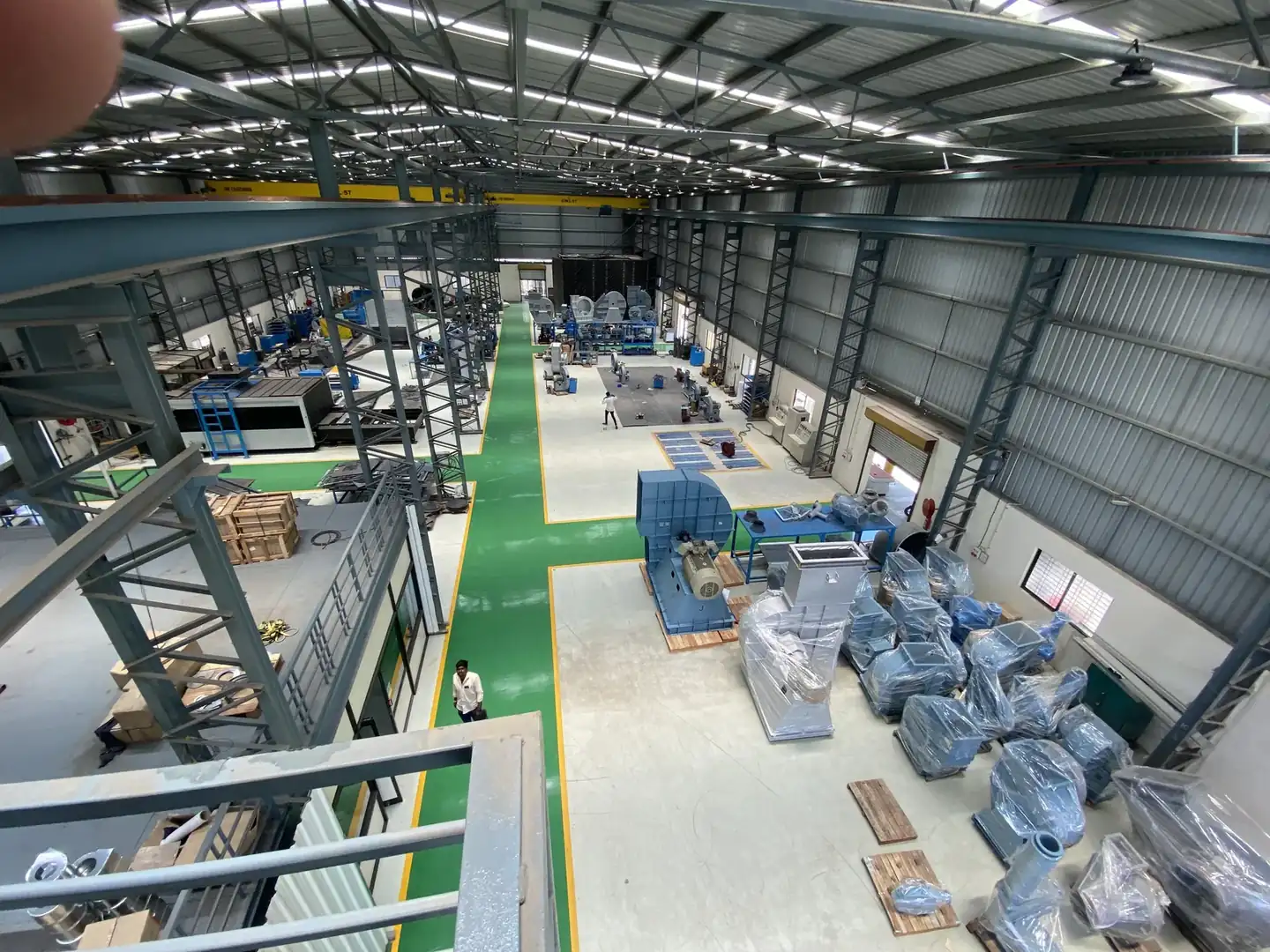
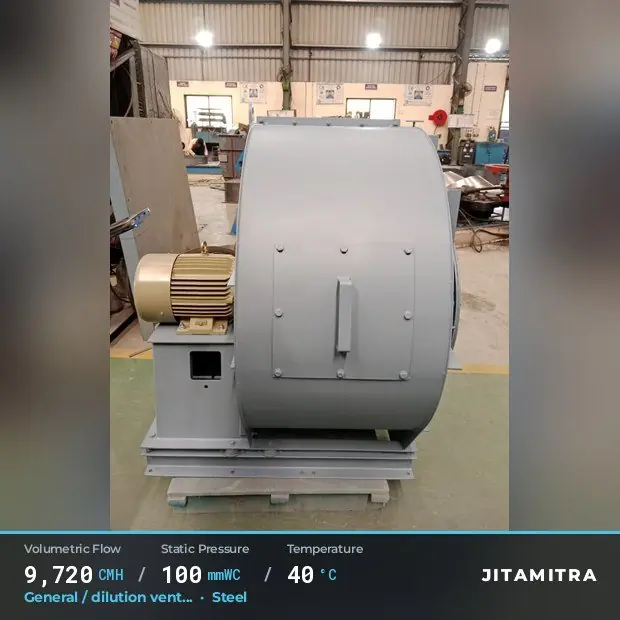
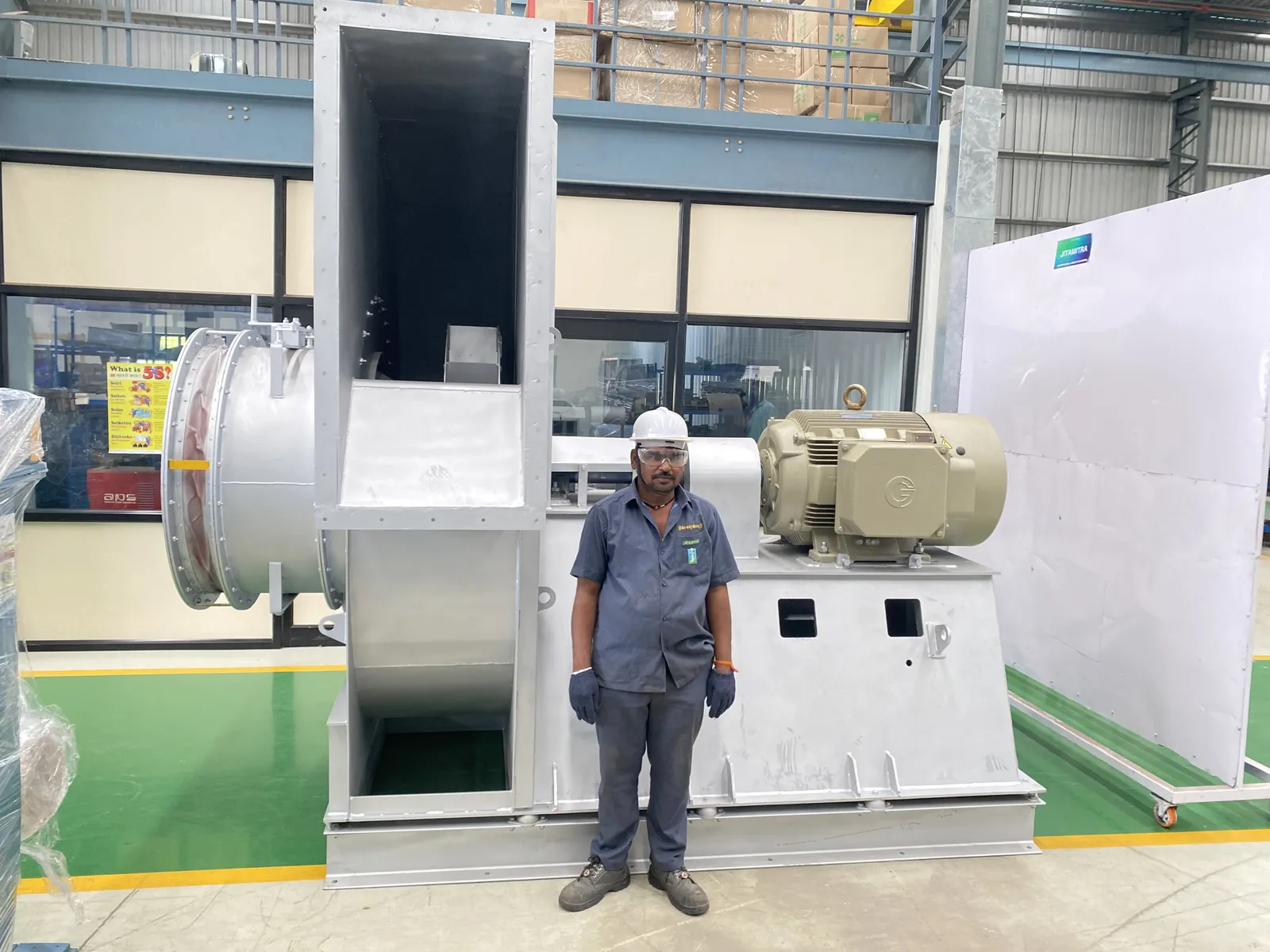
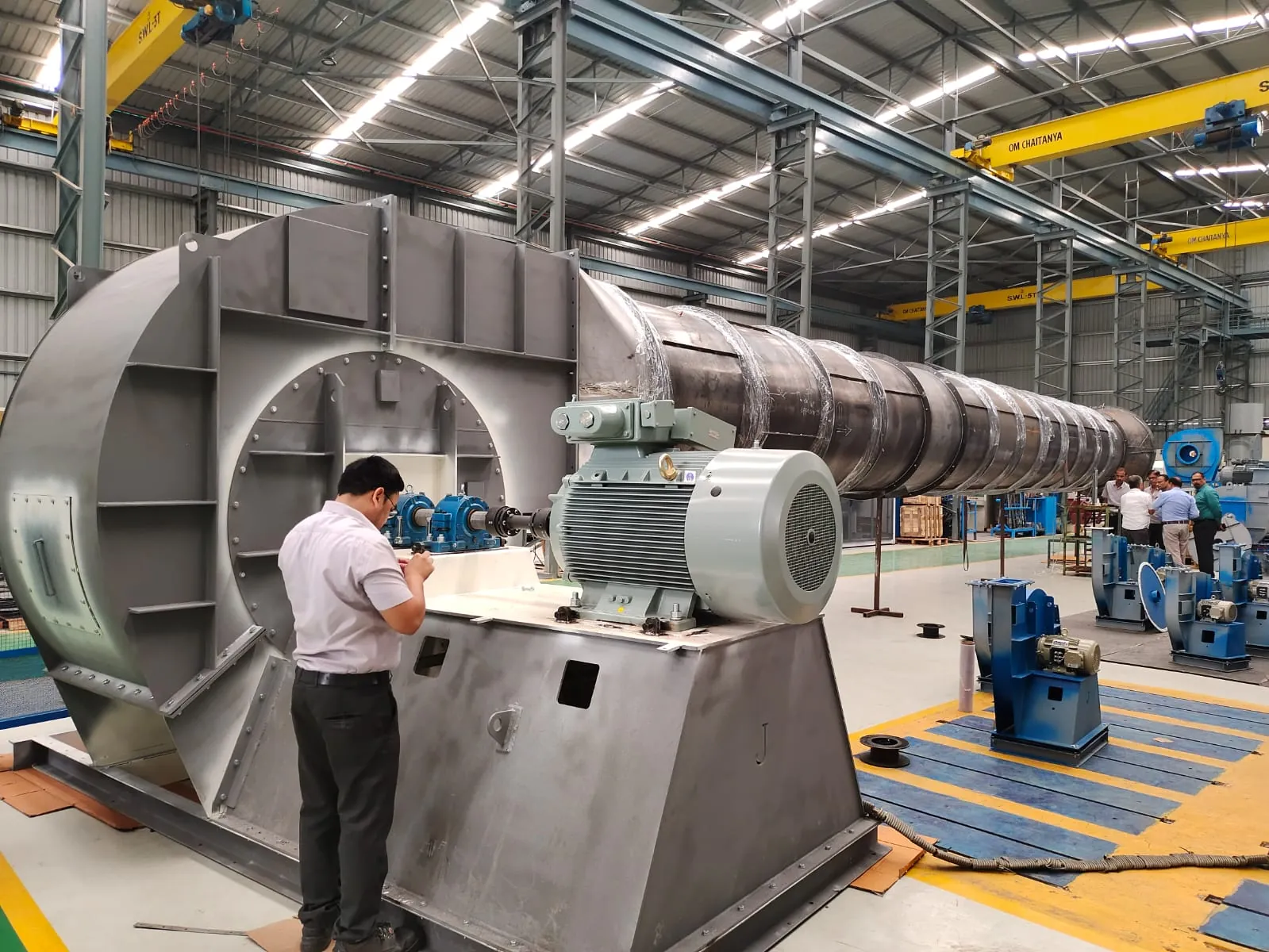
Centrifugal upblast roof-mounted power ventilator on the Jitamitra shop floor
Home  /  Applications  /  Roof / wall exhaust (PRV)
Applications

Roof / wall exhaust fans — weatherproof, quiet, built for the roofline.

A powered roof or wall ventilator (PRV) sits on the building envelope: pulling stale, warm, fume- or grease-laden air out of the space below and discharging it clear of the roof, in weather, day and night. The duty is low-static and high-flow, but the engineering is not trivial — the fan must shed rain and wind, stay quiet above occupied rooms, and be spark-resistant where the extract carries process fume. We build PRVs across the low-static end of the full envelope below, up to 2,00,000 CMH, 2,000 mmWC and 400 HP.

2,00,000CMH max flow
250mmWC typical static
IP55weatherproof motor
400 HPdrive power
15,000+
fans built since 2011
200 HP
VFD test rig · IS 4894 / AMCA 210
99%
on-time delivery
3
working days to quote — always
ON THE BUILDING ENVELOPE · LOW STATIC · WEATHERPROOF · UPBLAST OR DOWNBLAST TO ATMOSPHERE
What it does

A PRV moves the air out and keeps the weather out — both at once.

A powered roof or wall ventilator sits on the building envelope: extracting warm, stale, fume- or grease-laden air from the space below, discharging it clear of the roof or wall, and doing it in rain, wind and snow without letting weather back in. Where a duct fan lives indoors, a PRV is a weather-exposed machine first.

  • 01
    Extract

    General building and process air out of the space below — typically 2,000–2,00,000 CMH against low static, 10–250 mmWC for most roof and wall duty, higher where a filter or long stub duct adds resistance.

  • 02
    Discharge clear

    Upblast to throw the exhaust up and away from the roof and fresh-air intakes, or downblast where the discharge must hug the roof — the configuration set to your re-entrainment and plume requirement, not a default.

  • 03
    Keep weather out

    A spun or fabricated weather hood, drain trough, bird / vermin screen and IP55 weatherproof motor hold rain, wind-driven water and pests out — with an internal backdraught damper against reverse flow when the fan is off.

INDUCED-DRAFT CENTRIFUGAL FAN Single-width single-inlet — scroll cut away to reveal the impeller inlet expansion joint MOTOR IE3 / VFD GAS IN GAS OUT n 1 2 3 4 5 6 7 8 9 10 1 Inlet cone (bell-mouth) 2 Backward-curved / radial-tipped impeller 3 Spiral volute casing 4 Replaceable AR wear plates (volute throat) 5 Shaft 6 Plummer-block bearings (L10 ≥ 40,000 h) 7 Shaft cooling disc (>400 °C duty) 8 Pedestal / base frame 9 Drive — motor + coupling 10 Outlet flange + duct take-off
Fig. 1Roof-mounted upblast PRV — spun weather hood cut away to reveal the backward-curved centrifugal impeller, curb, drain trough and bird screen. Numbered components keyed below the drawing.
Why it is hard

Low static does not mean low engineering — weather, noise and ignition decide the build.

The air-moving duty on a PRV is easy; the operating environment is not. The fan lives outdoors on the roofline above people, so it has to shed weather for years, stay quiet over occupied space, and — where the extract carries solvent fume, kitchen grease or combustible dust — never become the ignition source. Get those three right and a PRV runs a decade weatherproof; get them wrong and you get water in the motor, complaints from the floor below, or a roof-level fire on process duty.

01 — WEATHER

Rain, wind and pest ingress

A roof fan sits exposed. Wind-driven rain, standing water on the curb, snow and birds all try to get past the discharge — and when the fan stops, warm building air escaping through an open ventilator invites reverse flow and condensation.

How we engineer it out

Spun or fabricated weather hood with an overlapping drip edge, a drain trough that sheds water clear of the motor, a bird / vermin screen, an IP55 (IP66 on application) motor out of the airstream, and a gravity or motorised backdraught damper against reverse flow.

02 — NOISE

Sound over occupied space

A PRV usually sits directly above offices, kitchens, retail or process floors, and both the fan noise and the discharge plume carry into the space below and to the neighbours across the boundary.

How we engineer it out

Backward-curved and airfoil wheels for low blade-pass energy, sized well left of peak sound; discharge and inlet silencers and an acoustic-lined curb where the limit is tight — designed to <80 dB(A) @ 3 m as standard, lower on application.

03 — IGNITION

Process discharge that carries fume, grease or dust

A roof fan pulling solvent fume off a coating line, grease off a commercial kitchen, or fine dust off a process is not moving clean air — a spark at the roof, above the building, with grease or solvent in the stream, is a real fire and re-entrainment risk.

How we engineer it out

Spark-resistant construction per AMCA 99 (Type A / B / C to the risk), bonded earthing, cleanable grease-duty construction with a drain, and ATEX Zone 2/22 self-declaration per 2014/34/EU (Category 3) where the area classification calls for it.

How we design for it

Every choice is documented on the GA drawing you sign off — before we cut metal.

We don't sell a catalogue near-fit. The fan is engineered to your flow, discharge configuration, sound limit, extract type and exposure — made to order, not off a shelf.

  • Configuration — upblast or downblast — Upblast (discharge thrown up and away from intakes) is the default for fume, grease and process extract; downblast where the plume must hug the roof or the discharge is clean building air. Wall-mounted centrifugal ventilators where roof access or structure rules out a roof unit — the configuration set to your re-entrainment and layout, not a default.
  • Impeller & efficiency — Backward-curved or backward-inclined wheels for the best efficiency and low sound on clean building extract; airfoil-bladed where the flow is large and continuous; radial-tipped self-cleaning where the process extract carries grease or grit that would pack a curved wheel.
  • Weatherproofing & materials — Spun aluminium or fabricated mild-steel weather hood with epoxy or polyester powder coat for the roofline; stainless steel on coastal, corrosive or wash-down duty; FRP construction for aggressive process fume; drain trough, bird screen and IP55 (IP66 on application) weatherproof motor throughout.
  • Control & acoustics — VFD default where the extract demand varies through the day (occupancy or process load); backdraught damper against reverse flow. Discharge and inlet silencers and an acoustic-lined curb where the fan sits over occupied or boundary-sensitive space — sound engineered to the stated limit before dispatch.
Engineered to your duty point

We size the fan onto the efficient, quiet part of its curve — then prove it on the rig.

No catalogue fan forced onto your spec. Your operating point — low static, high flow — is engineered onto the efficient, low-sound region of the selected wheel, well left of the peak-noise zone, and verified on the 200 HP VFD test rig before dispatch. Weather hood and screen losses are carried in the system resistance, not ignored.

avoid: unstable 0 40,000 80,000 1,20,000 1,60,000 2,00,000 VOLUME FLOW RATE  [ CMH ] 0 500 1000 1500 2000 STATIC PRESSURE  [ mmWC ] 0 25 50 75 100 STATIC EFFICIENCY  [ % ] Fan static pressure System resistance Static efficiency BEP 82% DUTY POINT 1,20,000 CMH · 450 mmWC Fan static pressure System resistance Static efficiency
Fig. 2Representative PRV characteristic — fan static pressure, system resistance (including hood and screen loss) and static efficiency vs. flow, with the duty point engineered onto the efficient, low-sound region. Illustrative; every fan is sized to its own duty.
Capability envelope — roof / wall exhaust service

What we can supply, and where it stretches on application.

ParameterStandardOn application
Volume flowup to 2,00,000 CMHhigher on enquiry
Static pressure10–250 mmWC typical PRV dutyup to 2,000 mmWC for filtered or long-stub-duct extract
Configurationupblast / downblast roof, or wall-mounted centrifugalgooseneck, high-plume or dilution discharge on application
Weatherproofingweather hood + drain + bird screen; IP55 motorIP66 motor / stainless / FRP for coastal or corrosive duty
Sound level<80 dB(A) @ 3 mlower with silencers + acoustic-lined curb
Construction (process duty)AMCA 99 spark-resistant Type B on fume / grease serviceType A / C + ATEX Zone 2/22 (Cat 3) self-declared
Drive powerup to 400 HPhigher with custom motor sourcing
Balance qualityISO 21940 G6.3G2.5 / G1.0 on application

Most roof and wall exhaust duty is low-static and high-flow — typically 10–250 mmWC against flows up to 2,00,000 CMH — and sits comfortably inside the full envelope of 2,00,000 CMH / 2,000 mmWC / 400 HP. Static rises to 2,000 mmWC only where a filter, scrubber or long stub duct is in the path. On clean building extract wear protection is not needed and the focus is efficiency, weatherproofing and noise; on process extract carrying grease, solvent or combustible dust the build adds spark-resistant construction and, where classified, ATEX Zone 2/22 (Cat 3) self-declared per 2014/34/EU. Bearing life is a design target of L10h ≥ 40,000 h continuous, longer on application. For duty beyond the envelope we engineer to spec and quote on enquiry.

How a Jitamitra RWE fan is specified

Specified, not picked from a shelf.

The same engineering language carries from your enquiry to the GA drawing to the nameplate — expressed in the standard AMCA conventions, with the weatherproofing and spark-resistant scope alongside.

Specification fieldOptions
Arrangement (AMCA 99)Arr. 4 (direct, motor on base) and Arr. 9 (overhung, motor side) are the common PRV forms; Arr. 1 (overhung, fan bearings) / Arr. 8 (overhung on common base) / Arr. 10 (overhung, motor inside base) selected by drive, access and whether the motor sits in or out of the airstream.
Width / inletSWSI (single width, single inlet) default for PRV duty; DWDI (double width, double inlet) for high flow at moderate pressure on large roof units.
Configuration & dischargeUpblast roof (discharge up and away from intakes) / downblast roof (discharge along the roof) / wall-mounted centrifugal — set to the re-entrainment, plume and structure requirement.
Wheel typeBackward-curved or backward-inclined (default, best efficiency and low sound on clean building extract) / airfoil-bladed (large continuous-duty flow) / radial-tipped self-cleaning (grease- or grit-laden process extract).
Spark-resistant construction (AMCA 99)Type A (all non-ferrous parts in the airstream) / Type B (non-ferrous rub ring and shaft-opening parts) / Type C (aligned construction preventing ferrous contact) — selected to the ignition risk on fume, grease and combustible-dust discharge; not required on clean building extract.
Materials & weatherproofingSpun aluminium or fabricated MS weather hood + epoxy / polyester powder coat (standard) / stainless steel for coastal, corrosive or wash-down duty / FRP for aggressive process fume; drain trough, bird / vermin screen, backdraught damper and IP55 (IP66 on application) motor throughout.
DriveDirect-coupled / V-belt / VFD (default where extract demand varies with occupancy or process load). Drive up to 400 HP across the envelope; speed typically 600–1,800 RPM.
Accessories & acoustic scopeWeather hood, drain trough, bird screen and mounting curb; gravity or motorised backdraught damper; isolation / shut-off damper; grease trough and cleanable construction on kitchen duty; spark arrestor on ember-carrying process discharge; discharge and inlet silencers with acoustic-lined curb (down to the stated sound limit); inspection door.
The proof, not the promise

We test before we ship — and you're welcome to witness it.

Every job's performance is verified at our works on the 200 HP VFD test rig, to the AMCA 210 / ISO 5801 method, before dispatch.

  • Customer-witnessed FAT on request — at no extra cost
  • Rotors balanced to ISO 21940 G6.3 as standard (G2.5 / G1.0 on application) before they leave the floor
  • Full NDT in-house — DP, MPI, UT, RT — to what the duty demands
30+ INDUSTRIES · 45 APPLICATION / DUTY TYPES
Where our roof / wall exhaust fans run

Engineered for the roofline — building, kitchen and process extract.

HVAC & Commercial Buildings

General building extract, toilet and car-park exhaust, plant-room and boiler-room ventilation on roof and wall.

Food & Beverage

Process-hall extract, cooking and drying-line exhaust, grease-duty roof fans on cleanable construction.

Automotive & Paint

Roof extract off paint and coating lines — spark-resistant on solvent fume, ATEX where the area is classified.

Textile

Process-hall and dye-house extract, humid and lint-laden air moved off the roof at high volume.

Warehousing & Logistics

High-volume roof extract and heat relief over large-span sheds and distribution centres.

Light Manufacturing & Assembly

General workshop and process extract to atmosphere through roof and wall ventilators.

Pharmaceuticals & Chemicals

Process and utility extract to atmosphere — corrosion-resistant or FRP construction where the discharge is aggressive.

Your process

45 application/duty types engineered. Tell us yours.

Standards & conformity

Stated precisely — because procurement checks.

What our marks mean, in the words that survive an audit.

Performance

Tested to the AMCA 210 / ISO 5801 method, in-house on our 200 HP VFD rig. Tested-to-method — not AMCA-certified.

Quality system

ISO 9001:2015 — third-party certified. Our only third-party certification.

CE conformity

Self-declared per 2006/42/EC + 2014/35/EU (Module A). A self-declaration, not a notified-body certificate.

ATEX conformity

Self-declared, Zone 2/22, Category 3, per 2014/34/EU, where the area classification calls for it.

Oil & gas duty

Designed and built to API 673 as project-specific scope.

Welding

ASME Sec IX qualified welders + WPS for every joint.

Balance

ISO 21940 — G6.3 minimum, G2.5 / G1.0 on application.

Vibration

ISO 20816 evaluation; ISO 14694 for fan-specific limits.

Lead time & process

From enquiry to a tested fan on your dock.

StageStandard dutyAPI-673 / engineered
Offer / quotation3 working days — always7–10 working days
GA drawing for approval2–3 weeks from PO3–4 weeks from PO
Manufacture + balance + paint6–10 weeks10–14 weeks
Performance test + witnessed FAT~1 week1–2 weeks
Order-to-dispatch (total)9–14 weeks14–20 weeks

Shutdown-driven replacements: we have shipped fans within 6 weeks of a clean PO. Tell us your shutdown window and we commit to a dated plan.

Questions engineers ask

The eight we hear most before a PO.

Do you build upblast or downblast roof ventilators, and how do I choose?
Both, and the choice is driven by re-entrainment. Upblast throws the exhaust up and away from the roof and from fresh-air intakes, so it is the default for fume, grease and process extract where you must not draw the discharge back into the building. Downblast discharges along the roof and suits clean building air where there is no contaminant to keep clear of intakes and a low plume is preferred. We also build wall-mounted centrifugal ventilators where roof access or structure rules out a roof unit. Tell us the extract type and where your intakes and the property boundary sit, and we set the configuration to that, not a default.
How do you keep weather and birds out of a roof fan?
A PRV is a weather-exposed machine first. We fit a spun or fabricated weather hood with an overlapping drip edge, a drain trough that sheds water clear of the motor, and a bird and vermin screen across the discharge. The motor is IP55 as standard, out of the airstream, with IP66 available on coastal or wash-down duty. A gravity or motorised backdraught damper closes the ventilator when the fan is off, so warm building air does not escape and reverse flow does not draw weather back in. The whole weatherproofing scope is shown on the GA drawing you approve.
The fan sits directly over offices. How quiet can you make it?
Roof and wall fans usually sit above occupied space, so both the fan noise and the discharge plume matter. We select backward-curved or airfoil wheels that run quiet and size the duty well left of the peak-noise zone, then design to below 80 dB(A) at 3 m as standard. Where the limit is tighter — an office, a hospital, or a boundary condition — we add discharge and inlet silencers and an acoustic-lined curb and engineer to the stated number. Tell us the sound limit and the measurement position and we predict and build to it before dispatch.
My extract carries solvent fume and grease. Is that a spark or fire risk on the roof?
It can be, and it is worth taking seriously because the fan sits above the building. A roof fan pulling solvent fume off a coating line or grease off a commercial kitchen is not moving clean air. For that duty we build spark-resistant construction to AMCA 99 — Type A, B or C selected to the ignition risk — with bonded earthing throughout, and for kitchen duty a cleanable construction with a grease drain. Where the area is classified for flammable vapour or combustible dust we self-declare ATEX Zone 2/22 per 2014/34/EU, Category 3. On clean building extract none of this is needed, and we do not add cost that the duty does not call for.
Roof fans are usually low-pressure. Why engineer them at all — can't I buy a standard unit?
You can buy a standard unit, and for a plain low-static building extract it may be fine. We add value where the standard unit stops: a specific flow and discharge configuration set to your re-entrainment case; a real sound target over occupied space; corrosion-resistant, FRP or stainless construction for coastal or process air; spark-resistant or ATEX build on fume and grease; and a documented weatherproofing scope. The duty is low static, but the environment — weather, noise, ignition and corrosion — is where a fan fails. We engineer for that and put every choice on a GA drawing you sign, made to order rather than pulled off a shelf.
What size and pressure range do your roof / wall exhaust fans cover?
Most roof and wall exhaust duty is low-static and high-flow — typically 10 to 250 mmWC against flows up to 2,00,000 CMH — and sits comfortably inside our full envelope of 2,00,000 CMH, 2,000 mmWC, 400 HP and 600 °C. Static rises toward 2,000 mmWC only where a filter, scrubber or a long stub duct is in the path. If your duty is beyond the envelope we engineer to spec and quote on enquiry. Every fan is sized to your exact operating point on our fan-selection software, not picked from a size table.
What construction do you use for coastal or corrosive process air?
The material follows the air and the exposure. For a normal roofline we use a spun aluminium or fabricated mild-steel weather hood with an epoxy or polyester powder coat. On a coastal site, a wash-down area or mildly corrosive extract we move to stainless steel and an IP66 motor. For aggressive process fume — acid, solvent or chemical-plant extract — we build in FRP or add a corrosion-resistant lining. We size the material and the coating to your air analysis and site exposure, not a default, and state it on the GA drawing so there is no ambiguity at the roofline.
Are your fans AMCA certified, and what about CE and ATEX?
To be precise about the claims: our fans are performance-tested in-house to the AMCA 210 / ISO 5801 method on our 200 HP VFD test rig — that is testing to the AMCA 210 method, not an AMCA certification, and we are not an AMCA member. Spark-resistant construction is built to AMCA 99. CE is self-declared per the relevant EU directives, and ATEX Zone 2/22 is self-declared per 2014/34/EU, Category 3, where the area classification calls for it — those are self-declarations of conformity, not third-party certifications. Our only third-party certification is ISO 9001:2015. Every fan is dynamically balanced to ISO 21940 G6.3 as standard, G2.5 or G1.0 on application, and bearing life is a design target of L10h at least 40,000 hours continuous.

Across the range

Where roof / wall exhaust fans fit — the fans that run them, related duties, and the industries served.

The same engineering, viewed three ways — by fan family, by duty, and by industry. Follow the cross-references.

Take it further

Specs an engineer can use — not a brochure.

Engineer to engineer

Send us the duty point.
We'll quote in 3 working days — always.

No model numbers needed. Give us the operating conditions — flow, static, gas temperature, composition, particulate, and any tender standard — and our application engineers size the fan and quote it. Attach a spec or GA if you have one.

+91 90110 09155  ·  mihir.jitamitra@gmail.com