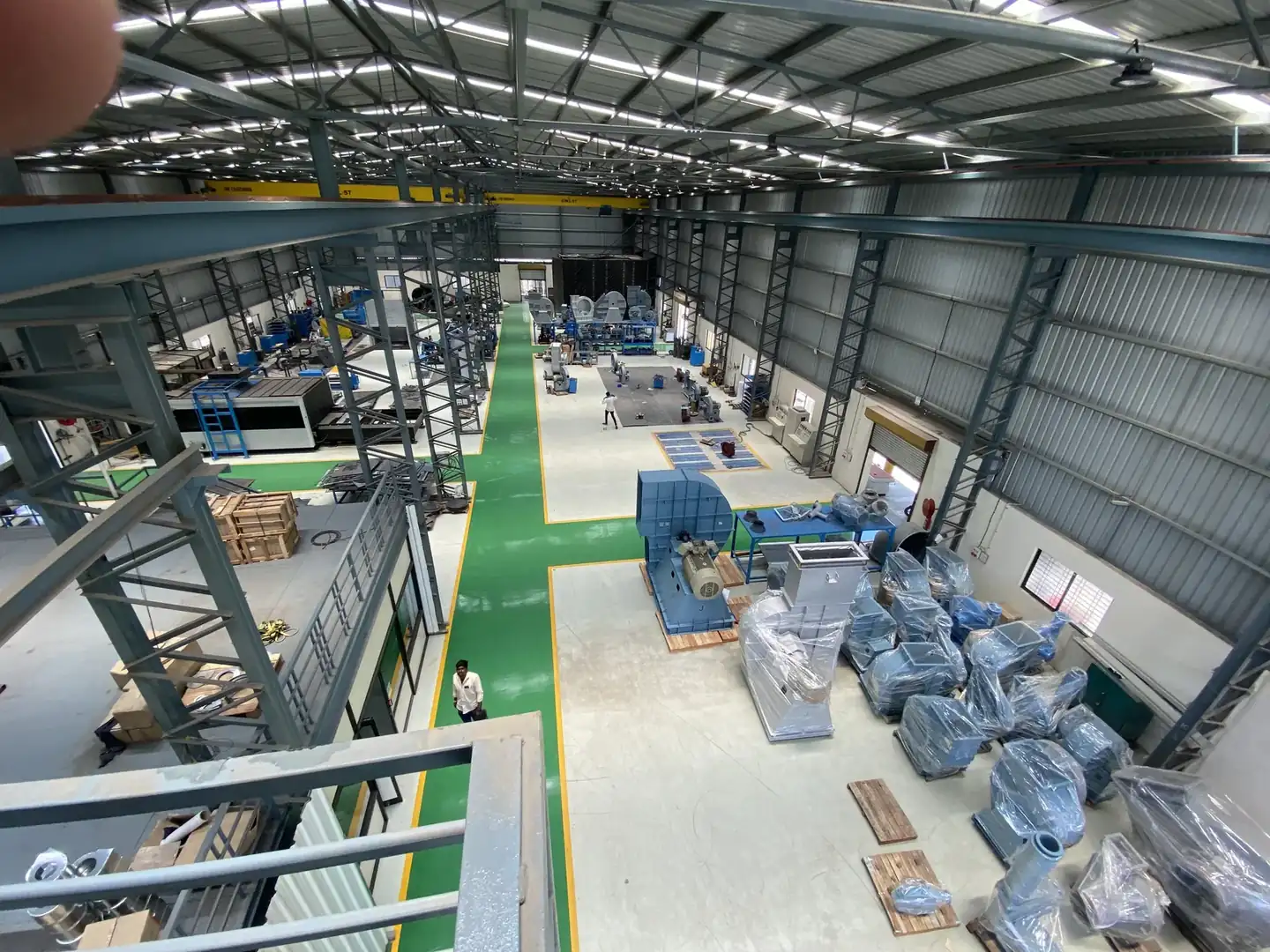
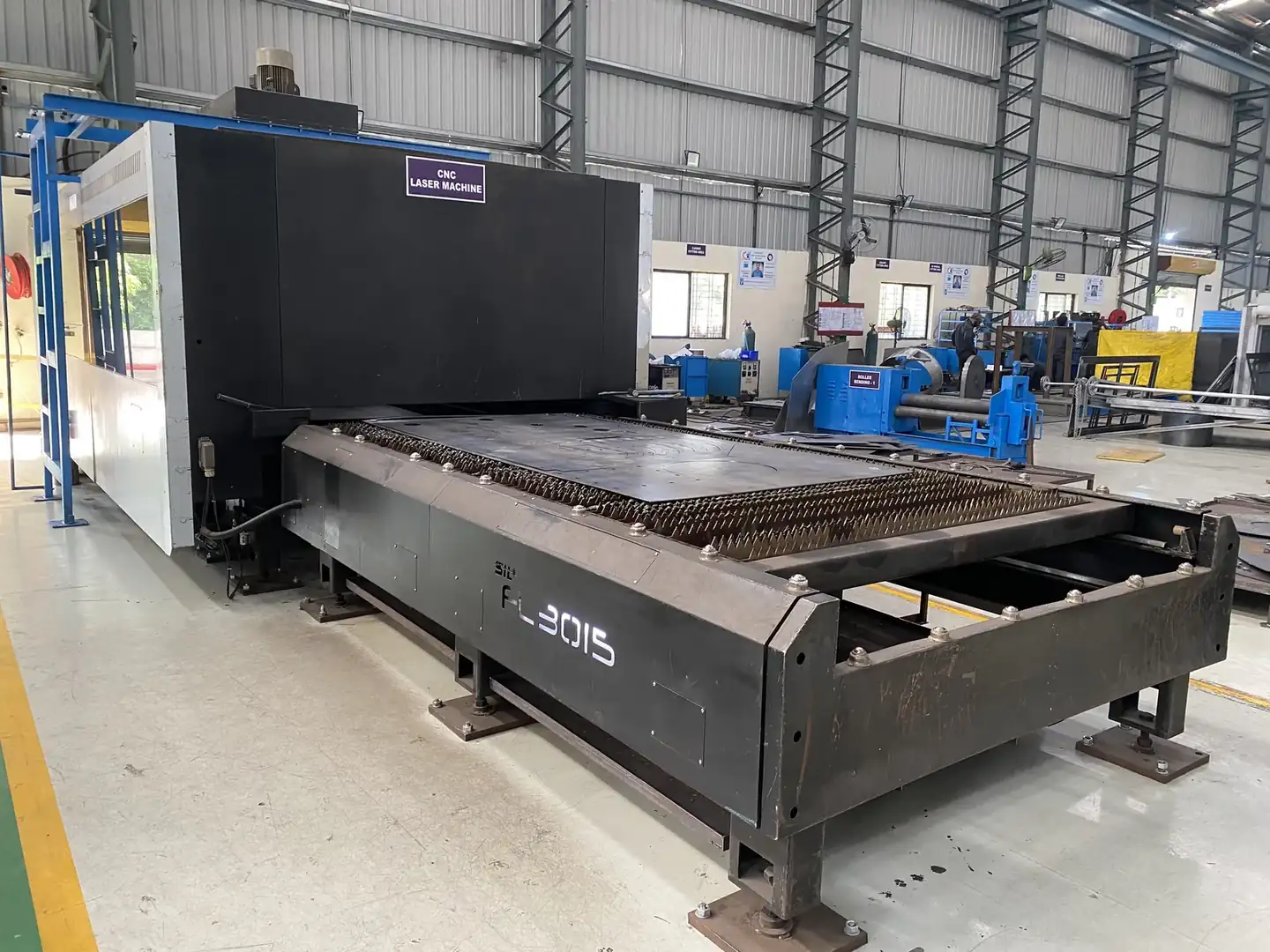
Can you supply the fans across the whole rubber or tyre plant, or only one duty?
Across the whole plant. We engineer the fume extraction off the mixing rooms, mills and curing presses; the spark-resistant solvent, rubber-cement and dip-line exhaust in the ATEX-classified areas; the carbon-black and buffing dust collection; the process and cure-oven drying air; and the general and local ventilation that keeps the halls breathable. Each fan is engineered to its own fume, dust, temperature and area classification — the tacky curing-fume fan and the spark-safe solvent fan are different machines — but they come from one partner, on one engineering convention across the plant.
Our mixing and curing fume is hot and tacky and keeps fouling our old fans. What do you do?
Rubber curing and mixing fume carries hot oil mist, plasticiser and volatiles that condense a sticky film and then trap dust, so the wheel loads up and drifts out of balance. We fight it three ways. A rugged radial or flat-bladed wheel geometry that sheds the deposit rather than trapping it; smooth, cleanable internal surfaces; and full-size access, drain and cleanout doors on the scroll and inlet so the wheel and casing wash down in place on a scheduled clean, without dismantling the fan. The fan is built to hold balance and airflow through your maintenance interval, on fume running 60 to 180 °C.
Parts of our line are ATEX-classified for solvent and rubber cement. Can your fans run there?
Yes, where the area classification calls for it. We build spark-resistant construction and self-declare it to ATEX Zone 2/22, Category 3, per 2014/34/EU: non-sparking wheel and inlet material pairings to the AMCA 99 spark-resistant construction types, generous running clearances so no rotating part can strike the casing, full earthing and bonding continuity across the assembly, and bearings kept outside the airstream. Tell us your zone, gas or vapour group and temperature class and we build the fan to it. To be precise, that ATEX marking is a self-declaration of conformity, not a third-party certification.
Is carbon-black dust a special problem for the dust-collection fan?
It is. Carbon-black weigh-up, buffing and grinding release an extremely fine, tacky and staining dust that packs into the wheel roots and abrades the leading edges, and suspended in the extract stream it is itself a combustible dust — a Zone 22 risk. We use a self-cleaning radial wheel that resists packing, chrome-carbide hard-facing on the leading edges where the fine dust wears, and where the dust is classified combustible we carry the same spark-resistant, earthed ATEX Zone 22 construction through the dust-collection fan and confirm the area classification with you first.
Can you build a replacement to match our existing rubber-plant fan's duty and footprint?
Yes. We reverse-engineer to the existing duty point (flow, static pressure, gas temperature, density and dust or fume load), bearing centres, inlet/outlet orientation and foundation bolt pattern so the unit drops onto the existing base and ducting, whether it is a curing-fume fan, a solvent exhaust fan, a carbon-black dust fan or a hall-ventilation fan. Made to your installation, not a nearest-catalogue substitute. Send the old GA, the nameplate and a curve if you have one, and we match it, including the ATEX scope where the area is classified.
Do you performance-test the fans, and what about AMCA, CE, ATEX and quality certification?
Every fan is performance-tested in-house to the IS 4894 / ISO 5801 / AMCA 210 method on our 200 HP VFD test rig, and dynamically balanced to ISO 21940 G6.3 as standard (G2.5 / G1.0 on application). Fans above the rig's 200 HP are run at derated speed and scaled to the specified duty by the fan laws. To be precise: that in-house testing is to the IS 4894 / ISO 5801 / AMCA 210 method, not AMCA-certified, and we are not an AMCA member; CE is self-declared per 2006/42/EC and 2014/35/EU, and ATEX Zone 2/22 is self-declared per 2014/34/EU (Category 3) where the area classification calls for it — those are self-declarations of conformity, not third-party certifications. Our only third-party certification is ISO 9001:2015.