Duty from the customer's GA drawing. Nothing rounded, nothing added.
A Maharashtra-based industrial-oven and furnace builder puts our fans inside the machines it ships. Oven-exhaust air movement is not a bolt-on for them — it is core to how their ovens work. When they design a build, the exhaust fan is part of the thermal answer, not an afterthought bought at the end.
Moving 57,200 CMH is one problem. Moving 57,200 CMH of hot oven-exhaust air, and holding both flow and 250 mmWC of static pressure while the fan sits in a heat stream, is a harder one. Heat changes air density, and density is what a fan trades in — so a fan that hits the numbers cold can fall short hot. The impeller and shaft have to keep their geometry and balance at temperature, run after run, without drifting off the curve.
Oven-exhaust and process centrifugal fans, engineered to this duty — made to order, not pulled off a shelf. Each fan is engineered and computed to its exact duty point, then built to the geometry that duty demands.
Before it ships, every fan is performance-tested in-house on our 200 HP VFD test rig, to the IS 4894 / AMCA 210 method. Fans above the rig's 200 HP are run at derated speed and scaled to the specified duty by the fan laws. We measure flow and pressure on the rig, not on a datasheet. That is the difference between proof and promises — you get a fan that has already run to its duty before it reaches your floor. Fans above the rig's 200 HP are run at derated speed and scaled to the specified duty by the fan laws.
This is not a single order. It is a multi-year, repeat-supply line — build after build, oven after oven, the exhaust fans keep coming back to us. A fan you have to re-argue every time is a fan you do not trust; they stopped re-arguing ours a long time ago.
If you build ovens, furnaces, or any process that moves hot air, tell us the duty — airflow, static pressure, temperature, the medium — and we will tell you honestly whether we are the right fan for it. Our envelope runs to 2,25,000 CMH, 2,000 mmWC, 425 HP and 500 °C; your point sits somewhere inside it. Send us the GA drawing and let's work the numbers.
— Mihir Kulkarni, Director, Jitamitra Electro Engineering
Engineered for Every Application.
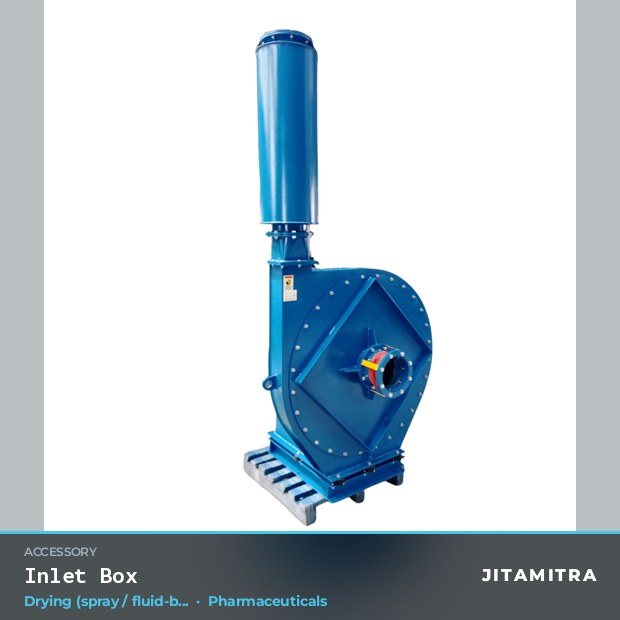
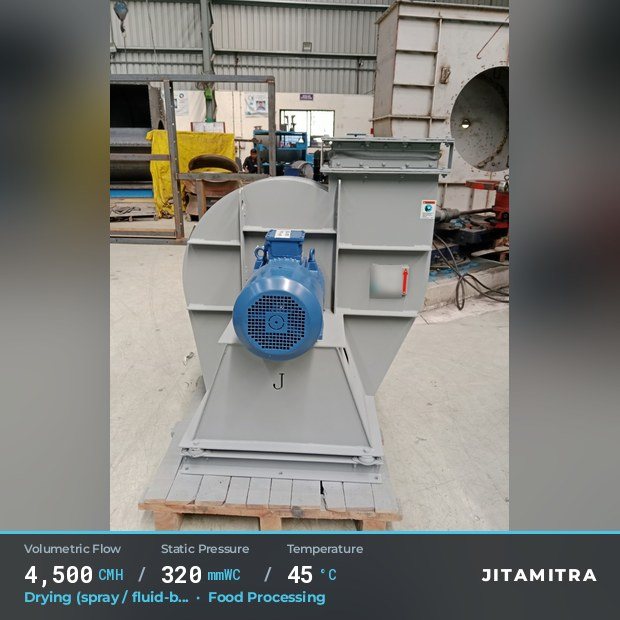
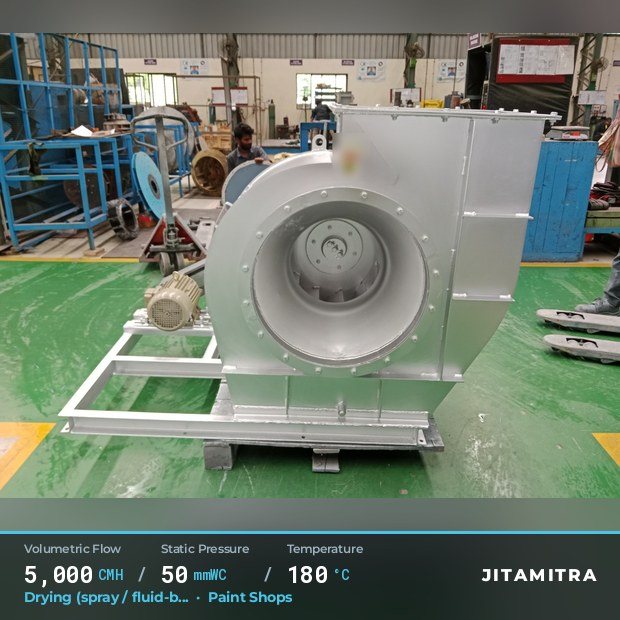
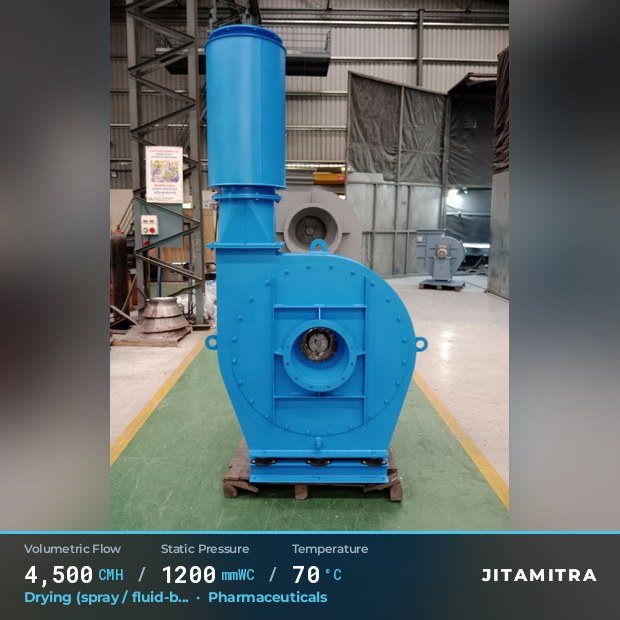
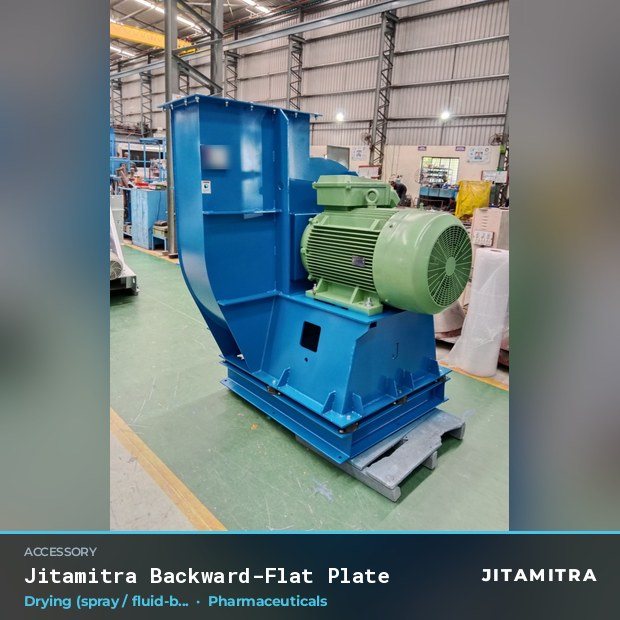
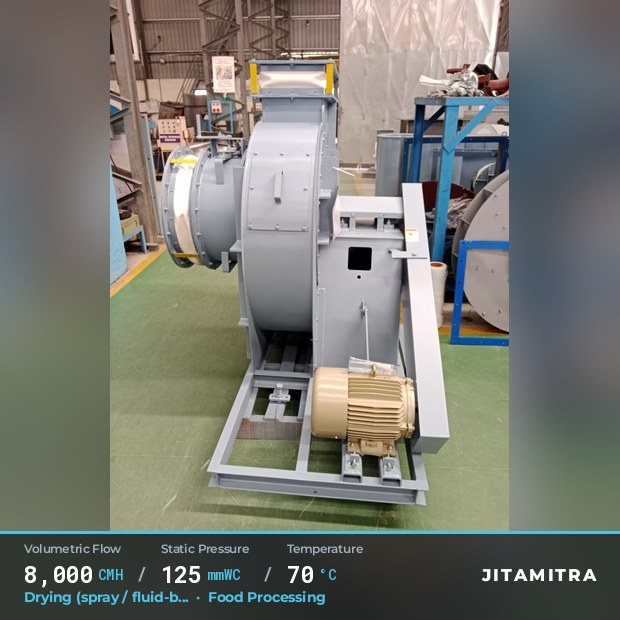
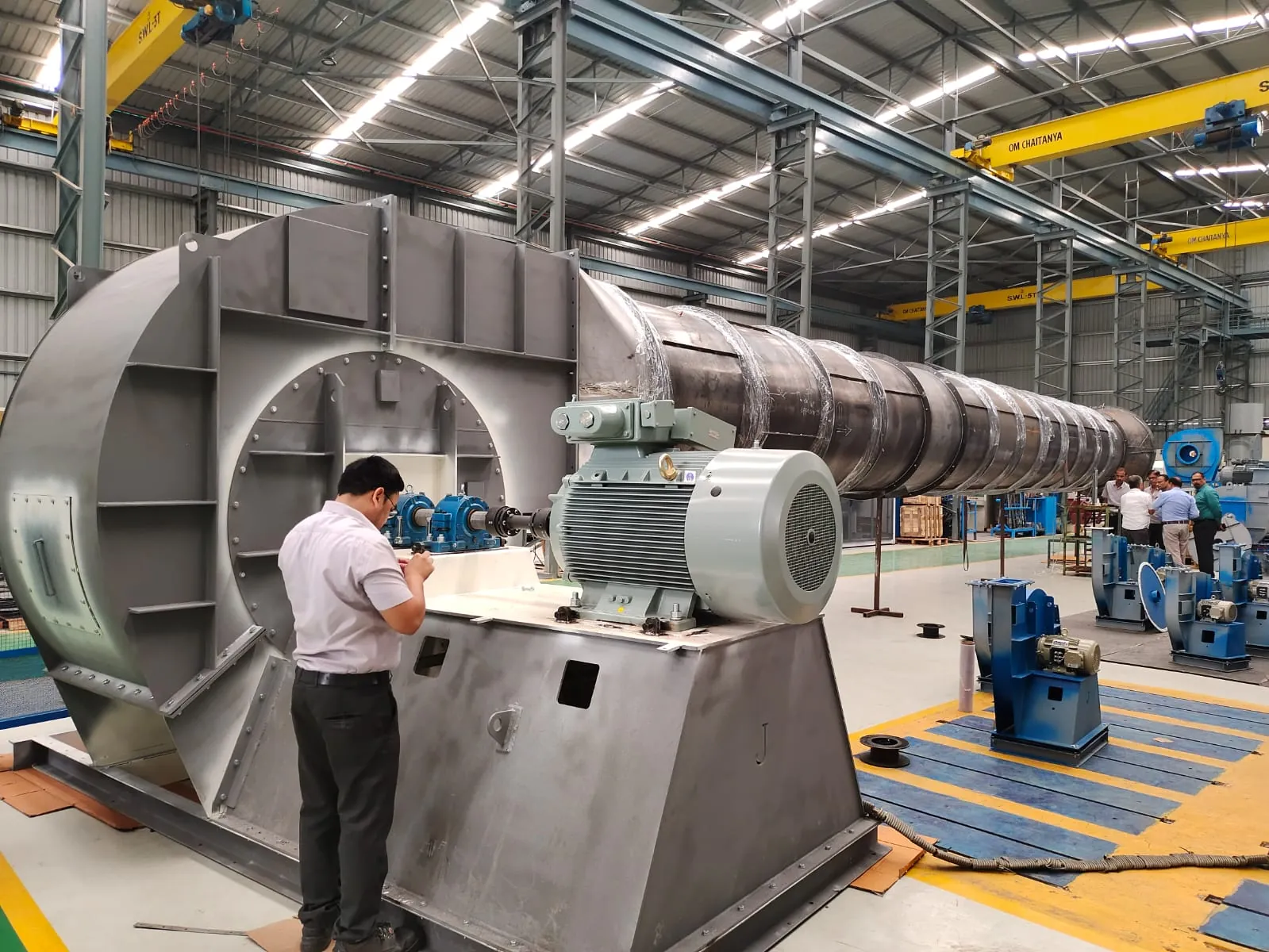
Real dispatched fans from this duty class — nameplate-scrubbed. Representative of the work; not the customer's own unit.
Heat changes air density, and density is what a fan trades in — so a fan that hits the numbers cold can fall short hot. Moving 57,200 CMH is one problem; moving it as hot oven-exhaust air while holding both flow and 250 mmWC of static pressure is a harder one. Impeller and shaft have to keep their geometry and balance at temperature.
Before it ships, every fan is performance-tested in-house on our 200 HP VFD test rig, to the IS 4894 / AMCA 210 method. Fans above the rig's 200 HP are run at derated speed and scaled to the specified duty by the fan laws. We measure flow and pressure on the rig, not on a datasheet. That is the difference between proof and promises — the fan has already run to its duty before it reaches your floor.
Our envelope runs to 2,25,000 CMH, 2,000 mmWC, 425 HP and 500 °C, so a point like 57,200 CMH at 250 mmWC on 100 HP sits well inside it. Send the GA drawing with airflow, static pressure, temperature and the medium, and we will tell you honestly whether we are the right fan for it.
Neither. The duty comes from the customer's GA drawing — nothing rounded, nothing added: 57,200 CMH, 250 mmWC, 100 HP as specified. The photographs are a separate matter and we say so on the page — real dispatched fans from this duty class, nameplate-scrubbed, representative of the work rather than the customer's own unit.
Made to order, not pulled off a shelf. Each fan is engineered and computed to its exact duty point, then built to the geometry that duty demands. For this Maharashtra-based oven and furnace builder the exhaust fan is part of the thermal answer, not an afterthought bought at the end of a build.
This is not a single order. It is a multi-year, repeat-supply line — build after build, oven after oven. Each fan is engineered to its own duty point and rig-tested to the IS 4894 / AMCA 210 method before dispatch, which is what makes the repeat possible: a fan you have to re-argue every time is a fan you do not trust.
Flow, static, gas temperature, application — or attach a spec, GA drawing or a multi-fan schedule. Engineer to engineer.
ISO 9001:2015 quality system · performance-tested to IS 4894 / ISO 5801 / AMCA 210 method · witnessed FAT on request.
*For our standard range. ATEX and special projects need 5 to 7 working days.
This site sets no cookies of its own. Google Analytics loads only if you accept. It sets two cookies, so we can see which fan topics people actually read. Decline and no analytics loads — the site works exactly the same. What we collect →