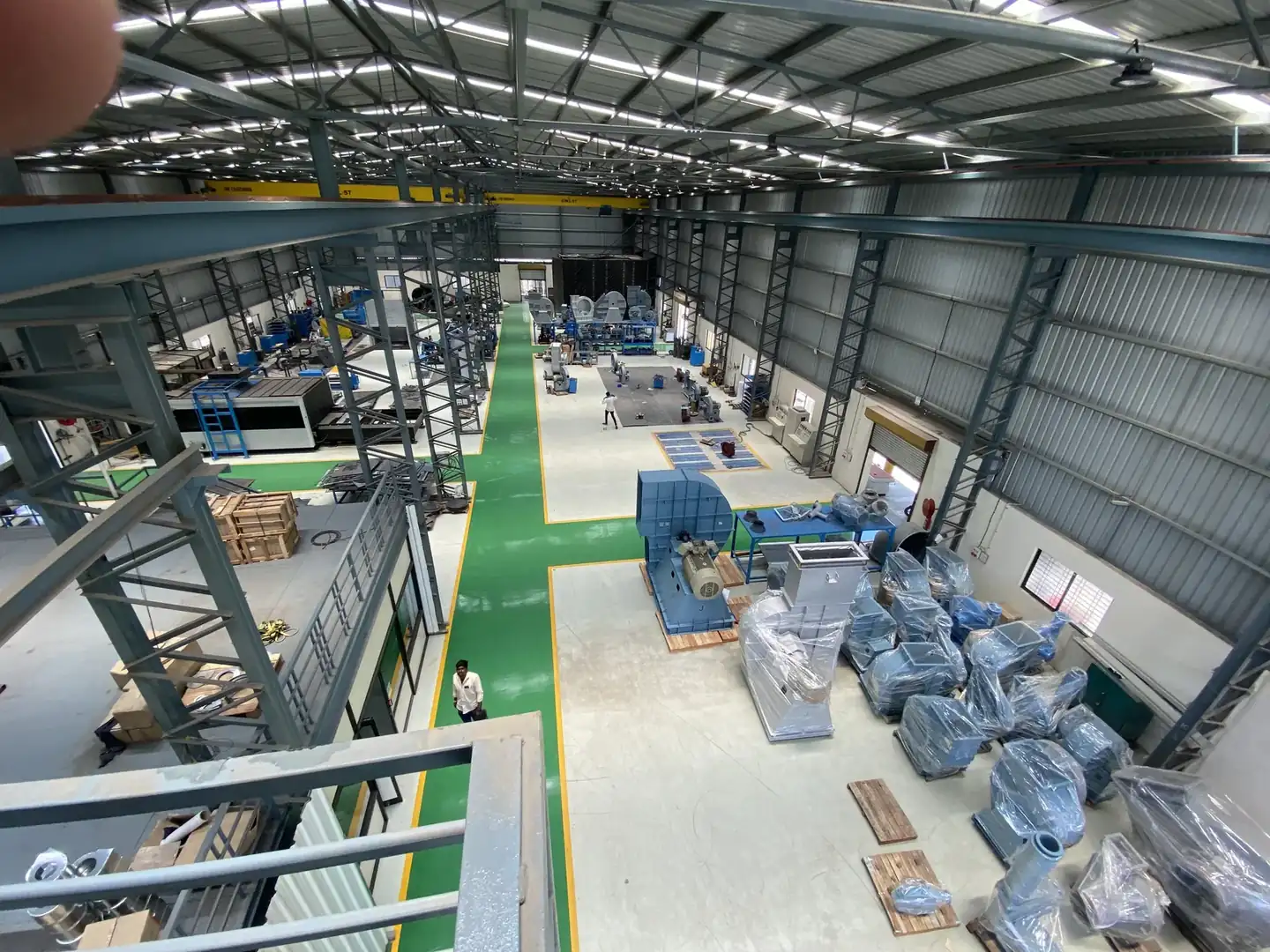
Backward-curved process-air fan for a textile stenter on the Jitamitra shop floor
Home  /  Industries  /  Textile
Industries

Fans for the textile plant — stenter, dryer, humidity and lint.

A textile mill runs a quiet but relentless fan duty: stenter and dryer process air that has to hold an even temperature across the fabric, humidification and dilution ventilation that keeps the spinning and weaving halls at controlled RH, and lint and dust extraction that carries away the fine fibre the process sheds. The gas is hot, wet and full of flammable lint — and even air distribution, not brute pressure, is what decides fabric quality. We build fans across the whole plant: a handful of duty types, engineered rather than pulled off a shelf, backed by 17 executed textile duties, across the full envelope below — up to 2,00,000 CMH, 2,000 mmWC, 400 HP and 600 °C.

17executed textile duties
180–220 °Cstenter process air
fine lintflammable, fouling
high RHhumid, condensing air
15,000+
fans built since 2011
200 HP
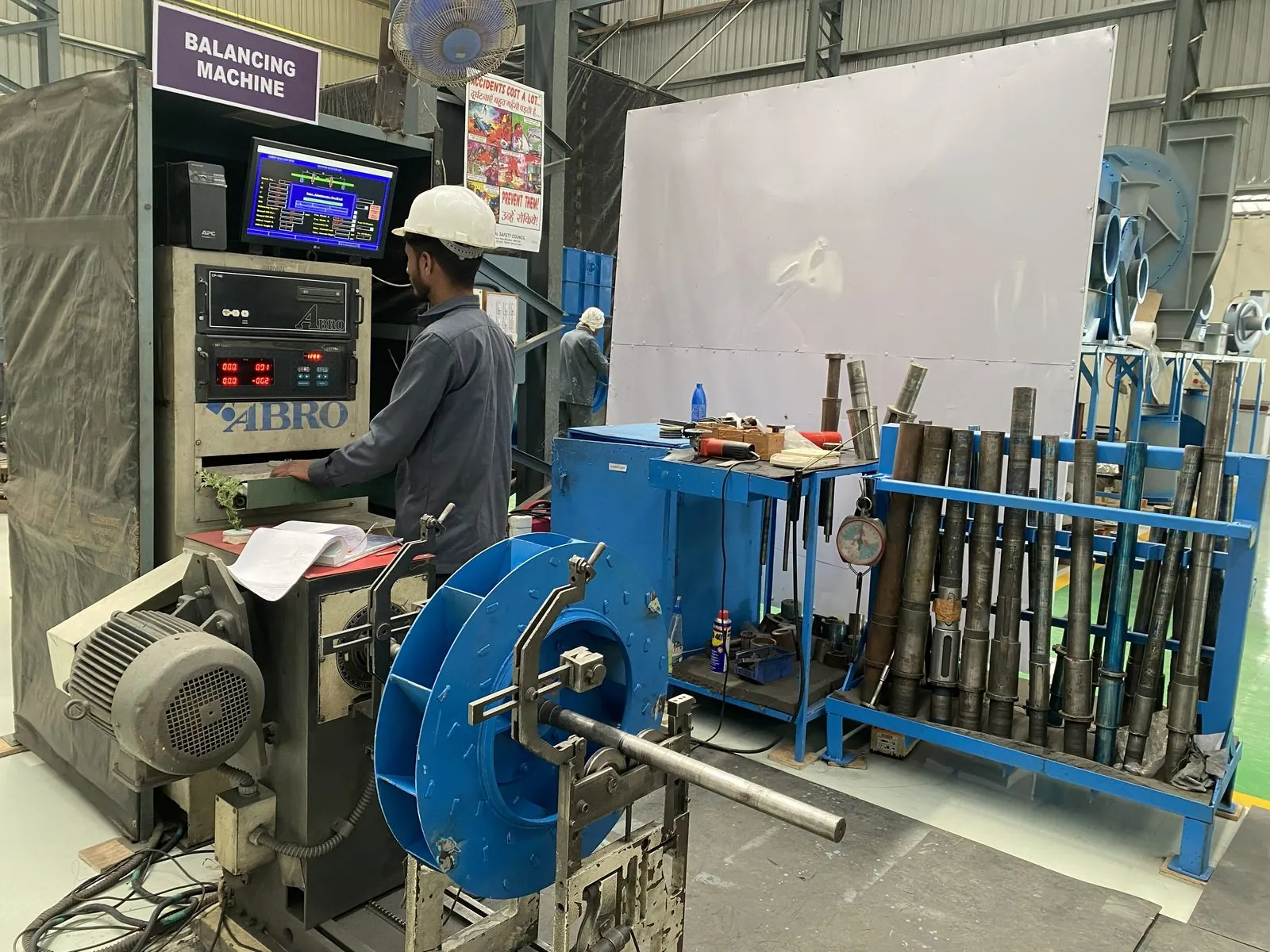
VFD test rig · IS 4894 / AMCA 210
99%
on-time delivery
3
working days to quote — always
STENTER PROCESS AIR · DRYER · HUMIDIFICATION · LINT EXTRACTION · ROOF EXHAUST
Where the fans sit

One plant, three jobs the fans have to do — and even airflow decides the cloth.

Across a textile mill the fans do three distinct jobs: they move the hot process air through the stenter and dryer that sets and cures the fabric, they hold the mill halls at controlled temperature and humidity, and they extract the fine lint the process sheds before it fouls or catches. None of it is high pressure — but the air has to be evenly distributed, clean of fibre and tolerant of humidity, or the fabric shade, hand and shrinkage drift off spec.

The duties we run on a textile plant

The fan duties across a textile mill — and the role each one plays.

A mill needs a family of fan duties, from the hot stenter process air down to the low-pressure humidification and roof exhaust. We have executed 17 textile duties across this list — each engineered to its own air temperature, humidity and lint load, not adapted from a catalogue near-fit.

The fans we deploy here

Three fan types cover the textile plant — matched to the air, the lint and the pressure.

The wheel is chosen by how clean the air is and how much it has to move: an aerofoil for the large, clean humidification and ventilation volumes, a backward-curved wheel for stenter and dryer process air, and a backward-curved plate wheel for the lint-laden extraction where the fibre has to shed off the blades. All three build across the same envelope — to 2,00,000 CMH, 2,000 mmWC, 400 HP and 600 °C.

Why textile fan duty is hard

Three things in a textile mill decide whether the fan runs clean or fouls, corrodes and burns.

Textile air is not high pressure, but it attacks a fan in three quieter ways — fine flammable lint that packs onto the wheel, humid air that condenses and corrodes, and stenter process air that has to arrive even and hot across the full fabric width. Engineer for all three and the fan runs clean and balanced for years. Engineer for the duty point alone and it fouls, rusts or drifts the cloth off spec within 12–24 months.

01 — LINT

Lint fouling & fire risk

Fine cotton and synthetic lint packs onto the blades and casing, builds up unevenly and throws the wheel out of balance — and a dry lint layer on a hot stenter or extraction fan is a genuine ignition and fire load, not a housekeeping nuisance.

How we engineer it out

A backward-curved plate wheel with flat, self-shedding blades and generous tip clearance; smooth, cleanable internals with large access and cleanout doors; and, on the extraction duty, spark-resistant construction per AMCA 99 Type A/B where the fibre load calls for it.

02 — HUMIDITY

Humid, condensing air

Humidification and dryer-exhaust air runs at high relative humidity and swings through the dew point as it cools, so moisture condenses on the wheel and casing and corrodes plain mild steel — and wet lint cakes far harder than dry.

How we engineer it out

Corrosion-resistant metallurgy on the wetted duty — hot-dip galvanised, epoxy-coated or 304/316 stainless where condensation is continuous — with cased drains, a self-draining scroll and casing insulation to hold the wall above dew point.

03 — UNIFORMITY

Even hot air across the width

Stenter and heat-setting quality depends on delivering the same air temperature and velocity edge to edge; an uneven or unstable fan characteristic leaves shade bands, uneven shrinkage and off-spec hand across the fabric width at 180–220 °C.

How we engineer it out

A backward-curved wheel with a stable, non-overloading curve selected onto its best-efficiency point at the true duty; balanced to ISO 21940 G6.3 for low vibration; and a shaft cooling disc with bearings outside the airstream where the range runs hot.

How we design for the mill

Every lint, humidity and metallurgy choice is documented on the GA drawing you sign off — before we cut metal.

We don't sell a catalogue near-fit onto a textile line. Each fan is engineered to its own duty — the stenter fan to its hot even air, the humidification fan to its clean volume, the lint extractor to its fibre load — at your operating point.

  • Lint-shedding & fire-safe build — A backward-curved plate wheel with flat, self-shedding blades on the lint-laden duty; smooth cleanable internals with large access and cleanout doors so fibre build-up clears fast; and spark-resistant construction per AMCA 99 Type A/B on extraction where the fibre load warrants it.
  • Humidity-tolerant metallurgy — Hot-dip galvanised, epoxy-coated or 304/316 stainless on the humidification and dryer-exhaust duty where the air condenses; a self-draining scroll with cased drains and casing insulation to hold the wall above dew point so wet lint does not cake.
  • Stenter & dryer construction — A stable, non-overloading backward-curved wheel selected onto its best-efficiency point for even air across the fabric width; shaft cooling disc standard above ~350 °C with bearings outside the airstream; casing and metallurgy stepped up to 600 °C for gas-fired and thermic-fluid ranges, with expansion joints for the growth.
  • Single source across the plant — One engineering partner for the whole plant — stenter and dryer air, humidification, lint extraction, local exhaust and roof exhaust — with 17 executed textile duties, so the fans, wear parts and drives carry one convention across the mill.
Standards & conformity

Stated precisely — because procurement checks.

What our marks mean, in the words that survive an audit.

Performance

Tested to the AMCA 210 / ISO 5801 method, in-house on our 200 HP VFD rig. Tested-to-method — not AMCA-certified.

Quality system

ISO 9001:2015 — third-party certified. Our only third-party certification.

CE conformity

Self-declared per 2006/42/EC + 2014/35/EU (Module A). A self-declaration, not a notified-body certificate.

ATEX conformity

Self-declared, Zone 2/22, Category 3, per 2014/34/EU, where the area classification calls for it.

Oil & gas duty

Designed and built to API 673 as project-specific scope.

Welding

ASME Sec IX qualified welders + WPS for every joint.

Balance

ISO 21940 — G6.3 minimum, G2.5 / G1.0 on application.

Vibration

ISO 20816 evaluation; ISO 14694 for fan-specific limits.

Questions engineers ask

Textile fan questions, answered straight.

Can you supply the fans across the whole textile plant, or only one duty?
Across the whole plant. We have executed 17 textile duties spanning stenter and drying-range process air, humidification-plant supply and hall dilution ventilation, lint and fibre-dust extraction, local exhaust at singeing and process points, combustion and process air for the heaters, and roof or wall exhaust. Each fan is engineered to its own air temperature, humidity and lint load — the hot stenter fan and the clean humidification fan are different machines — but they come from one partner, on one engineering convention across the mill.
Lint fouls and unbalances a fan, and it is a fire load. How do you handle it?
Two ways, sized to your fibre load. On the extraction and dirty stenter-exhaust duty we use a backward-curved plate wheel with flat, self-shedding blades and generous tip clearance so lint does not pack on, plus smooth cleanable internals with large access and cleanout doors so what does build up clears quickly and does not throw the wheel out of balance. Where a dry lint layer is an ignition risk we build the fan spark-resistant per AMCA 99 (Type A or B construction) so there is no ferrous rubbing contact in the airstream. The wear and cleanout scope is built in, not an afterthought.
Our humidification and dryer-exhaust air is humid and condenses. What materials do you use?
We size the metallurgy to where the air condenses. On continuously wet duty we select corrosion-resistant construction — hot-dip galvanised, epoxy-coated, or 304 / 316 stainless on the wetted surfaces — with a self-draining scroll, cased drains and casing insulation to hold the wall above dew point so moisture does not sit on the metal or cake the lint. The right answer depends on your temperature, RH and any chemical carry-over from the process, so we engineer it to your air, not a default.
How do you keep the air even across the fabric width on a stenter or drying range?
Uniform drying and heat-setting depend on delivering the same temperature and velocity edge to edge, so we select a backward-curved wheel with a stable, non-overloading characteristic onto its best-efficiency point at your true duty, rather than forcing a catalogue fan near the point. The wheel is balanced to ISO 21940 G6.3 as standard for low vibration, and above about 350 °C we fit a shaft cooling disc with the bearings outside the airstream. Even, stable airflow is what keeps shade, shrinkage and hand consistent across the width.
What is the maximum air temperature you handle on a stenter or dryer fan?
Continuous duty up to 600 °C across the envelope, with most stenter and drying-range fans running 180 to 220 °C and gas-fired or thermic-fluid ranges going higher. Above about 350 °C we fit a shaft cooling disc to keep heat off the bearings, keep the bearings outside the airstream, and add expansion joints for the thermal growth. The fan is built for your stated air temperature and excursion case, not a generic rating.
Do you performance-test the fans, and what about AMCA, CE, ATEX and quality certification?
Every fan is performance-tested in-house to the AMCA 210 / ISO 5801 method on our 200 HP VFD test rig, and dynamically balanced to ISO 21940 G6.3 as standard (G2.5 / G1.0 on application). To be precise: that in-house testing is to the AMCA 210 / ISO 5801 method, not AMCA-certified; CE is self-declared per 2006/42/EC and 2014/35/EU, and ATEX Zone 2/22 is self-declared per 2014/34/EU (Category 3) where the fibre load or area classification calls for it — those are self-declarations of conformity, not third-party certifications. Our only third-party certification is ISO 9001:2015.

Across the range

Where Textile fits — the fans we deploy, the duties we run, and adjacent industries.

The same engineering, viewed three ways — by fan family, by duty, and by industry. Follow the cross-references.

Take it further

Specs an engineer can use — not a brochure.

Engineer to engineer

Send us the duty point.
We'll quote in 3 working days — always.

No model numbers needed. Give us the operating conditions — flow, static, gas temperature, composition, particulate, and any tender standard — and our application engineers size the fan and quote it. Attach a spec or GA if you have one.

+91 90110 09155  ·  mihir.jitamitra@gmail.com