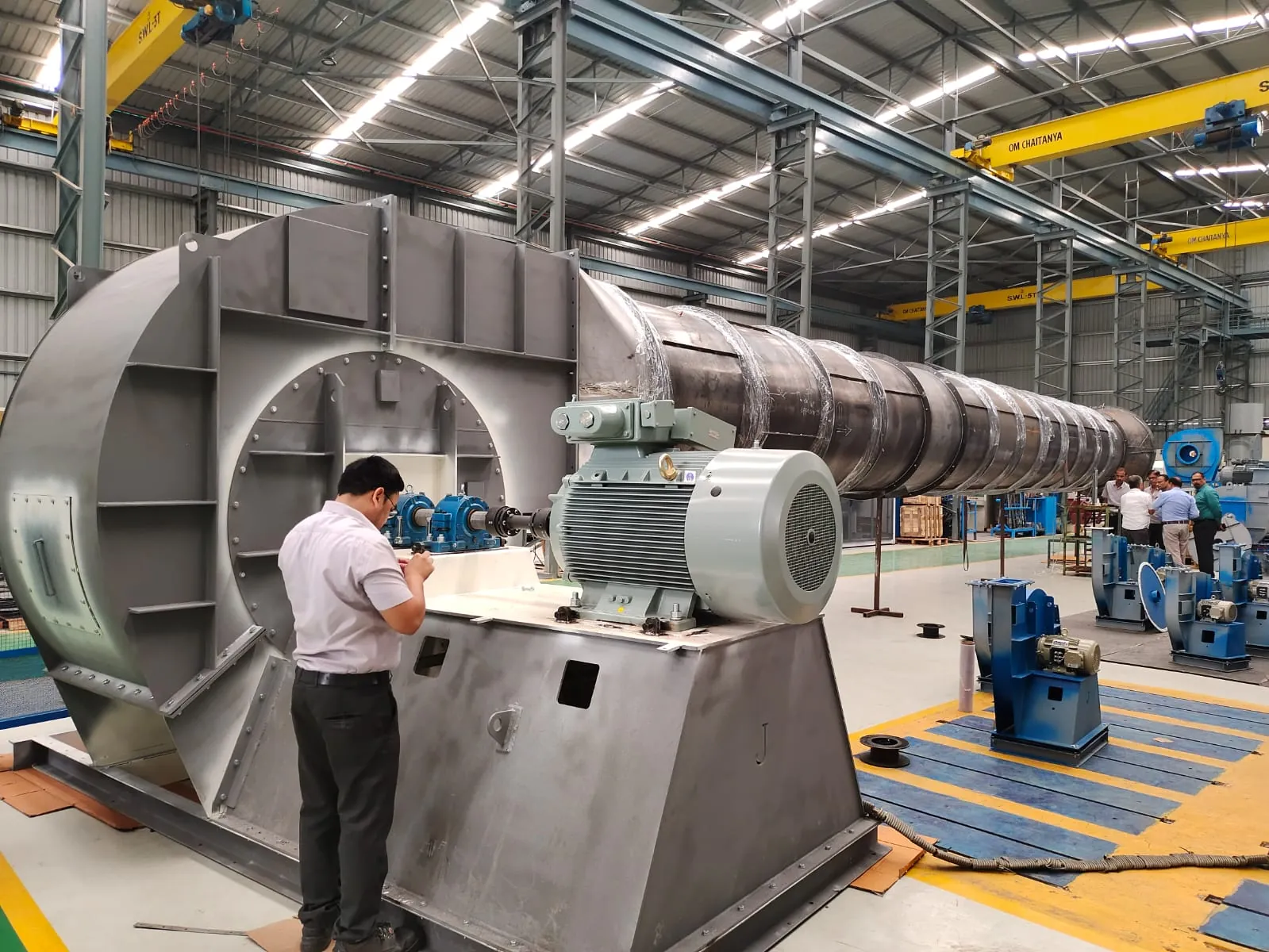
How do you keep the fan on duty as the heading advances and the duct gets longer?
That is the defining problem of an auxiliary fan. As the heading advances, the duct lengthens, joints leak, and the system resistance climbs, so a fan sized onto the flat or rising part of its curve loses face quantity and can stall. We engineer the duty point onto the falling, stable portion of the pressure-flow curve, typically 5 to 15 percent to the right of the peak, and we build in headroom for the planned duct extension so the fan holds face air across the whole advance. On very deep headings we engineer a series booster, a second fan down the duct, rather than overspeeding one fan into instability. Give us the final duct length, diameter, leakage class and target face quantity and we size to the deepest case, not the collar.
Our ground is gassy. Is the fan safe to run in a methane atmosphere?
For gassy strata we build flameproof-ready construction. The fan itself is self-declared to ATEX Zone 2/22 per 2014/34/EU, Category 3: non-sparking impeller, non-ferrous rub ring, bonded earthing throughout, anti-static surfaces and T-class bearing-temperature control. The motor, starter and any local control are specified as flameproof (Ex d) equipment to your mine's statutory electrical regime and area classification. Because an auxiliary fan stops and restarts where gas can accumulate behind it, we also engineer the restart and isolation scheme with your ventilation officer. To be precise, the fan ATEX marking is a self-declaration of conformity, not a third-party certification; our only third-party certification is ISO 9001:2015.
Should the fan force air in or exhaust it out?
Both are standard, and the choice is a ventilation decision we build to. A forcing system pushes fresh air down the duct to the face and returns along the drive, which clears the face quickly and is common where gas or fume must be diluted right at the source. An exhausting system pulls fume and dust back through the duct and keeps the drive itself on fresh air, which suits heavy blasting and diesel fume. Some headings run an overlap or a combination. Tell us the method your ventilation plan uses and we set the fan direction, the duct coupling and the dust and moisture protection to match; on an exhausting duty we assume the worst of your dust and fume loading, not the average.
How robust is the fan for repeated re-siting and the wet, dusty airway?
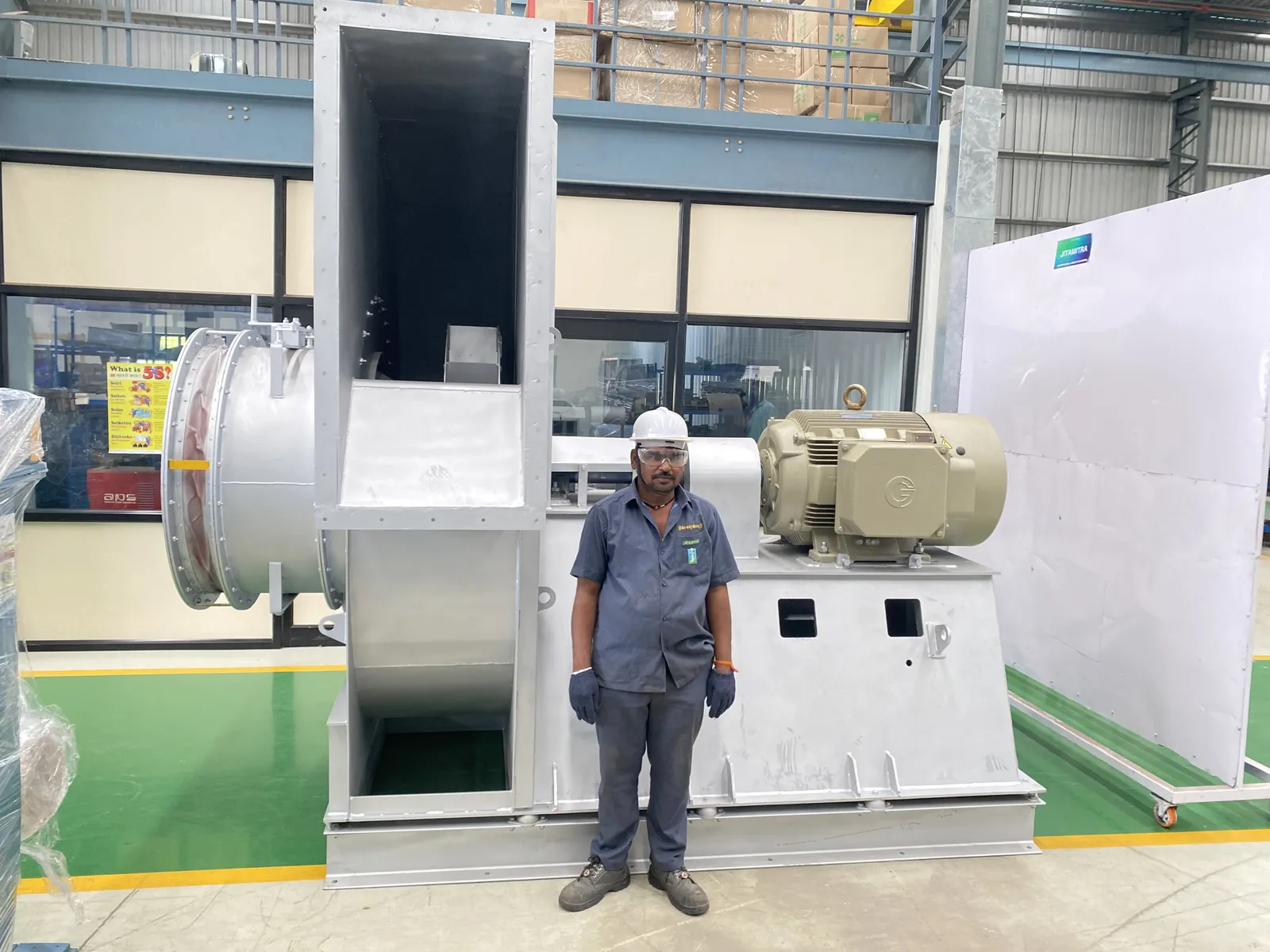
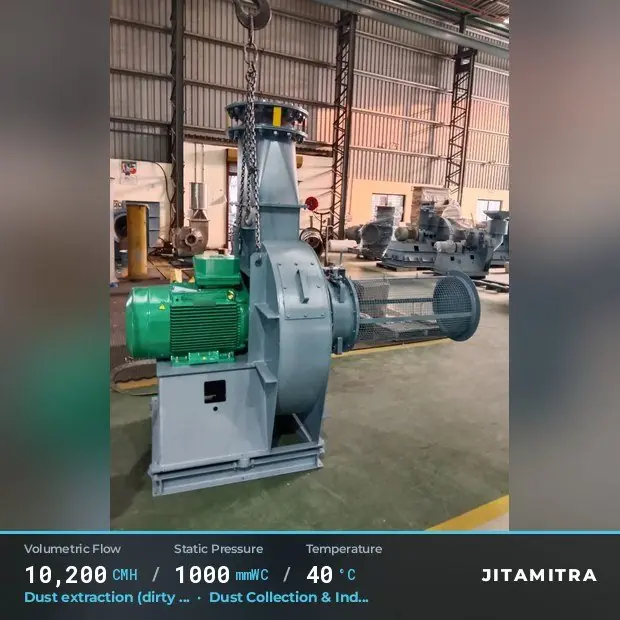
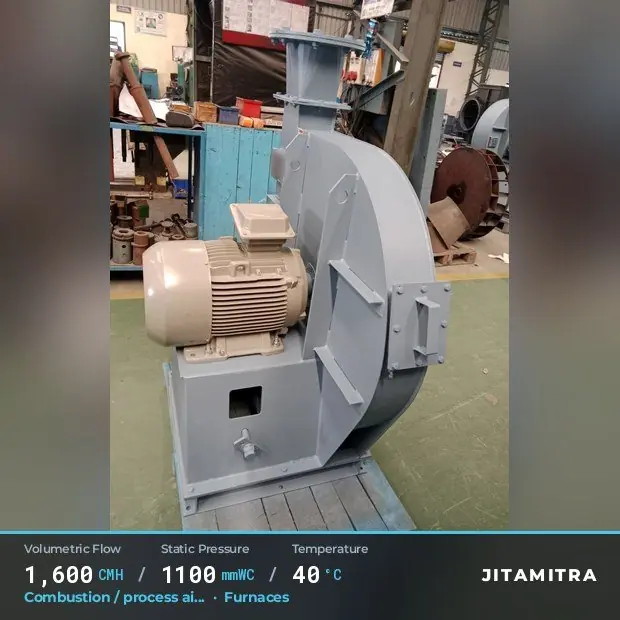
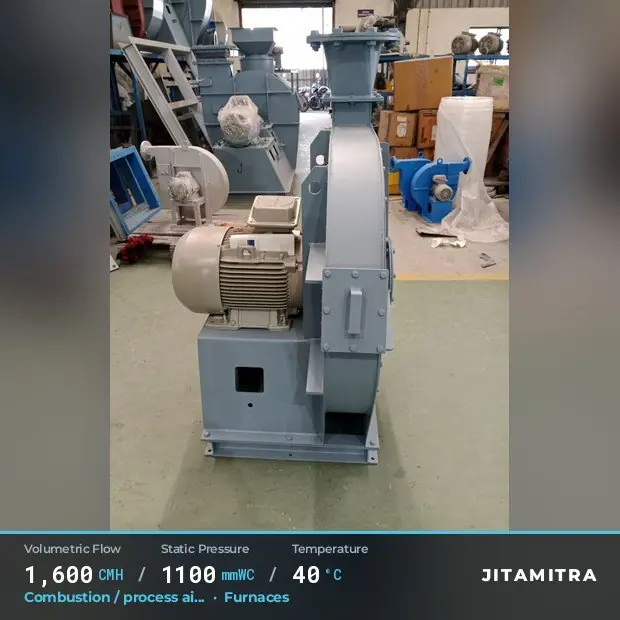
It is built for underground handling, not HVAC service. The casing is heavy plate on a stiffened pedestal that takes repeated lifting and re-siting as the heading moves, the bearings are sealed or regreasable with labyrinth and lip seals against mine water and rock dust, and the finish is epoxy or hot-dip galvanised for the wet airway. We add lifting lugs and skid points designed for the way the fan is actually moved underground. A light-build fan cracks a seal or loses balance fast in that environment, so we specify the robustness to the handling it will take, and you sign it off on the GA drawing before we cut metal.
Can two fans run in series down a long duct, and will you engineer that?
Yes. On a long or deep heading the pressure needed can exceed what one fan should be pushed to deliver, and the right answer is a booster fan partway down the duct rather than overspeeding a single fan into an unstable region. We engineer the series arrangement so the two fans share the resistance on the stable side of their curves, size the spacing and the duct so neither one starves or surges, and match the controls so they start and trip together. It is designed, not improvised on site. Give us the duct profile and the face quantity and we tell you whether one fan or a boosted pair is the sound arrangement.
What control do you recommend, VFD or a damper?
VFD is our default. Face air demand changes as the heading advances and the duct extends, and a variable-frequency drive holds the target face quantity across that range while trimming power on the shorter early runs, which is more efficient than throttling because it avoids the part-load throttling loss. A discharge or isolation damper remains available for a simple fixed-duty installation or where the electrical regime cannot take a drive underground. On gassy ground the drive is specified as flameproof (Ex d) equipment either way. We quote whichever your installation and electrical regime call for.
What sound level can you meet where the fan sits near the crew?
Auxiliary fans often sit close to the working place, so we design to below 85 dB(A) at 1 m as standard and lower on application. Below 80 dB(A) is achievable with inlet and outlet silencers and an acoustic-lagged casing, and below 75 dB(A) with a custom acoustic enclosure where the fan is very near crews for a full shift. We use cylindrical or splitter-type silencers to attenuate the low-frequency content that carries down a drive. Tell us the sound limit and where the fan sits relative to the working place and we predict and engineer to it, alongside the duty and the gassy-area scope.
Do you performance-test before dispatch, and what standards actually apply?
Yes. Every fan is performance-tested in-house to the IS 4894 / ISO 5801 / AMCA 210 method on our 200 HP VFD test rig, and dynamically balanced to ISO 21940 G6.3 as standard, with G2.5 or G1.0 on application. Fans above the rig's 200 HP are run at derated speed and scaled to the specified duty by the fan laws. To be precise about the claims: that is testing to the AMCA 210 method in-house, not an AMCA certification, and we are not an AMCA member; spark-resistant construction is built to AMCA 99; and CE and ATEX are self-declared per the relevant EU directives (ATEX Zone 2/22, Category 3, per 2014/34/EU), not third-party certified. Our only third-party certification is ISO 9001:2015. Bearing life is a design target of L10h at or above 40,000 hours continuous. The test and FAT take about a week and are customer-witnessed on request.