What decides the performance of a quench or tempering-air fan?
Velocity uniformity, not just flow. The nozzle-exit velocity sets the heat-transfer coefficient on the part, so it is the velocity landing on the metal or glass that decides hardness, distortion and residual stress. If plenum pressure is uneven, velocity varies across the part and you get soft spots on steel or uneven temper stress on glass. We size the fan to feed the plenum with a clean, even outlet profile and work back from your target nozzle velocity to the fan static and flow, rather than picking a nearest-catalogue duty point.
How is this different from a normal supply or combustion-air fan?
The air is clean, like a supply fan, so there is no erosion or corrosion to design against. But two things make it harder. First, uniformity: the whole point is an even velocity map across the nozzle bank, so the fan and plenum are engineered together, not separately. Second, the cycle: quench is a duty-cycle where dampers and the load swing the system resistance within seconds, so the fan has to ride that swing without stalling. A combustion-air fan holds a near-steady duty; a quench fan tracks a moving one.
Our tempering furnace recirculates hot air. Can the fan handle that?
Yes. On a recirculating tempering furnace the air is reused rather than exhausted, so it returns to the fan hot, typically 200 to 400 °C. We size the fan on the hot-air density at your stated return temperature so it is not oversized on cold-air density, upgrade the casing to IS 2062 or SA 516 Gr 70, size the shaft for thermal growth, select bearings for a sustained 80 to 100 °C housing temperature, and fit a heat slinger or cooling disc where the return runs to the top of the band. The build is engineered to your stated return temperature and excursion case, not a generic rating.
How do you keep the fan stable through the quench cycle?
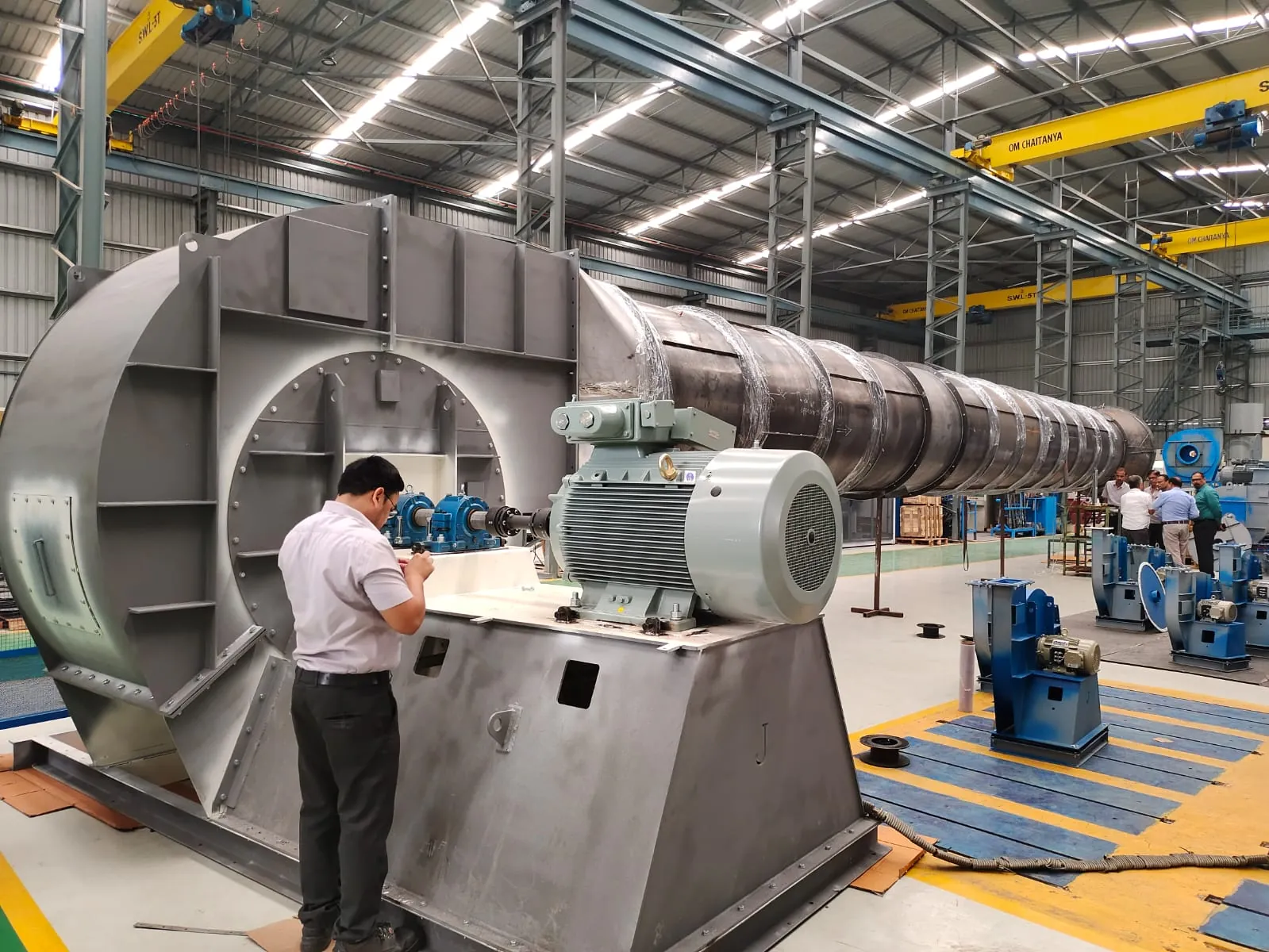
Quench is a duty-cycle: dampers, diverters and the load itself move the system resistance within seconds, and a fan sized onto the flat or rising part of its curve can stall or surge as the operating point moves, pulsing the velocity that has to stay constant. We engineer the duty point onto the falling portion of the pressure-flow curve, typically 5 to 15 percent to the right of the peak, so the fan rides the resistance swing and holds nozzle velocity. VFD is our default because it gives repeatable ramps and setpoint changes between soak, quench and hold. We verify the whole curve on the 200 HP VFD test rig before dispatch.
Glass tempering needs high plenum pressure. Do you cover that?
Yes. Glass-tempering nozzle banks drive high-velocity jets to quench the sheet uniformly, so the plenum runs hard, commonly 600 to 2,000 mmWC. That lands at the higher fan classes for pressure and tip speed, and it puts a premium on a stable outlet profile so every nozzle sees the same plenum pressure. Metal air-quench is usually the opposite balance, higher flow at more moderate static. We size to whichever end of that range your line sits at, across the full envelope up to 2,25,000 CMH and 2,000 mmWC.
Should I specify VFD or an inlet vane damper for control?
VFD is our default. Quench cycles need repeatable ramps and setpoint changes between soak, quench and hold, and VFD speed control gives that directly while avoiding the throttling loss of a damper at part-load. Inlet vane dampers remain available for retrofit into an existing control scheme where the motor and starter cannot accommodate a drive. We quote whichever your installation and control philosophy call for.
Do you have experience on heat-treatment and tempering lines?
Yes. We have engineered quench and tempering-air fans on heat-treatment and glass-tempering duties, sizing each to its own nozzle velocity, plenum resistance and return-air temperature. Every fan is engineered to the specific line rather than pulled from a catalogue, and where your duty sits outside anything we have run before we still engineer to it and quote on enquiry. Tell us the target nozzle velocity, the plenum resistance and whether the return air is fresh or recirculated, and we size to it.
Do you performance-test, and what standards actually apply?
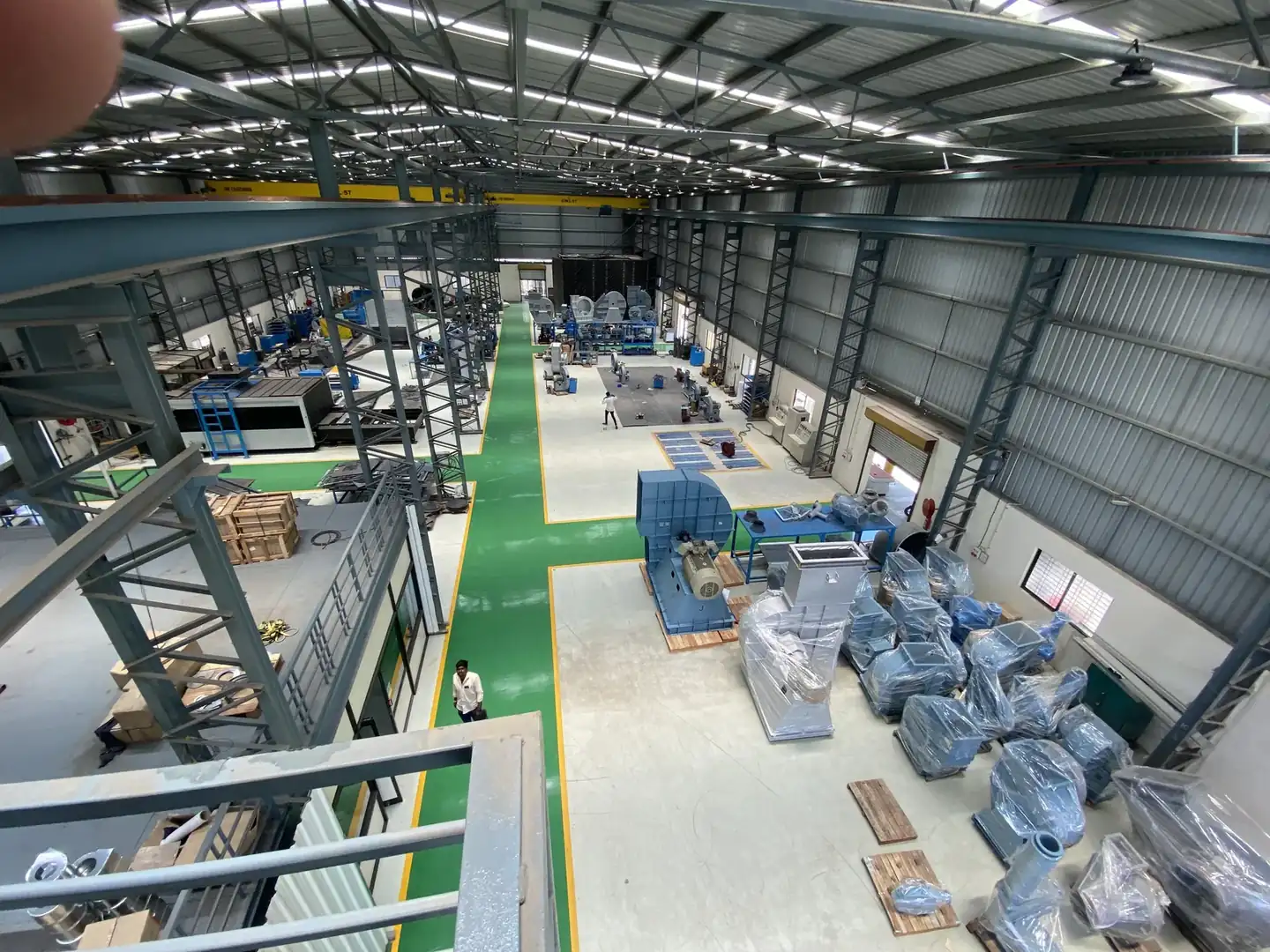
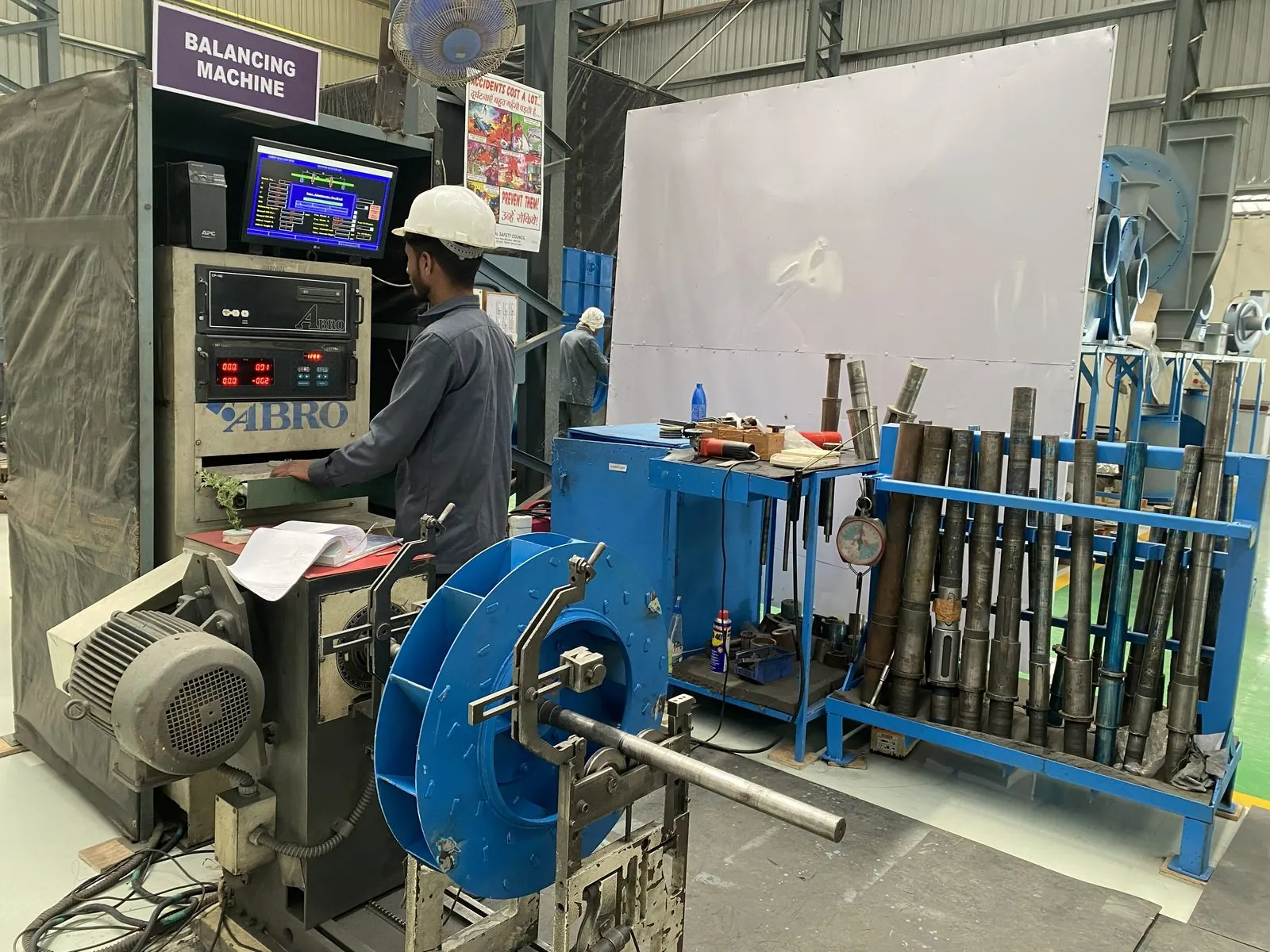
Yes. Every fan is performance-tested in-house to the IS 4894 / ISO 5801 / AMCA 210 method on our 200 HP VFD test rig, and dynamically balanced to ISO 21940 G6.3 as standard, with G2.5 or G1.0 on application. To be precise about the claims: that is testing to the AMCA 210 method in-house, not an AMCA certification, and we are not an AMCA member. CE is self-declared per 2006/42/EC and 2014/35/EU, and ATEX Zone 2/22 is self-declared per 2014/34/EU (Category 3) where an adjacent process calls for it — those are self-declarations of conformity, not third-party certifications. Our only third-party certification is ISO 9001:2015. The test and FAT take about a week and are customer-witnessed on request.