40,000 CMH · 100 mmWC · 25 HP · belt drive · VFD-driven · hot-start capable
A Maharashtra-based furnace and heat-treatment OEM builds furnaces and heat-treatment lines for a living. When they specify a fan, they are not buying air movement in the abstract — they are buying a component that has to behave inside a hot system, on their schedule, under their controls.
Forty thousand cubic metres an hour at 100 mmWC is high-volume, low-pressure work. That part is straightforward to state and unforgiving to get wrong: at low pressure the fan curve is flat, so small errors in the system resistance move the operating point a long way. Two things made this duty demanding, not routine.
First, the fan has to start against a hot system. Furnace air does not wait for a cold, quiescent start — the ductwork is already at temperature, the gas is already thin, and the motor has to break the impeller away and come up to speed under that condition without stalling or tripping. That is the hot-start requirement, and it is written on the drawing, not added by us.
Second, the fan has to turn down cleanly on a VFD. A furnace line does not run at one point; it ramps, holds, and backs off as the process demands. The fan has to follow the drive down through its speed range and stay in control the whole way — no surge, no hunting, no loss of the operating point.
Belt-drive centrifugal fans, VFD-compatible, hot-start capable — built to the 40,000 CMH / 100 mmWC / 25 HP duty on their fan curve, not to a nearest-catalogue-size approximation. Belt drive keeps the impeller speed independent of the motor, so the fan is selected to the duty rather than to whatever a direct-coupled pole count allows.
Every fan is performance-tested in-house on our 200 HP VFD test rig, to the IS 4894 / AMCA 210 method, before it leaves the works — the VFD turn-down is proven on the rig, not assumed from the curve.
This is not a one-fan story. The supply has run across furnace build after furnace build, multi-year and repeat — the kind of relationship that only holds when the fans keep doing on the line what the curve said they would do on the rig. They keep coming back because the duty keeps being met.
If you build furnaces or heat-treatment lines and you have a fan that has to start hot and turn down on a drive, send us the fan curve and the system resistance. We will select to your duty and prove it on the rig before it ships — proof, not promises.
— Mihir Kulkarni, Director, Jitamitra Electro Engineering
Engineered for Every Application.
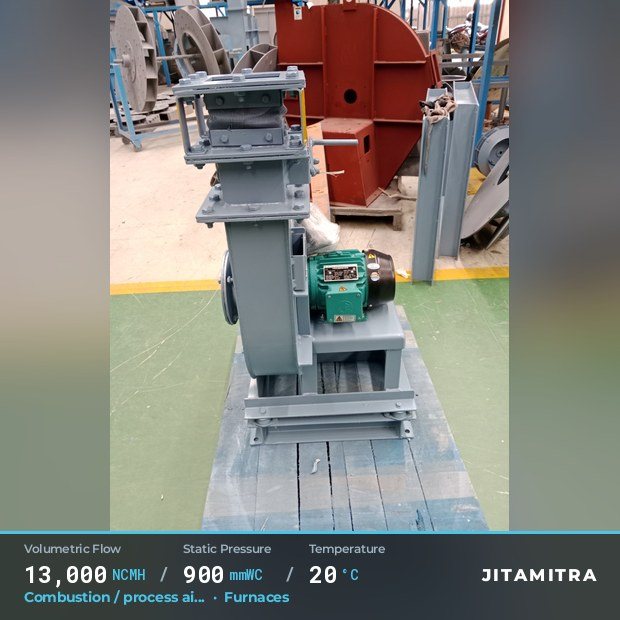
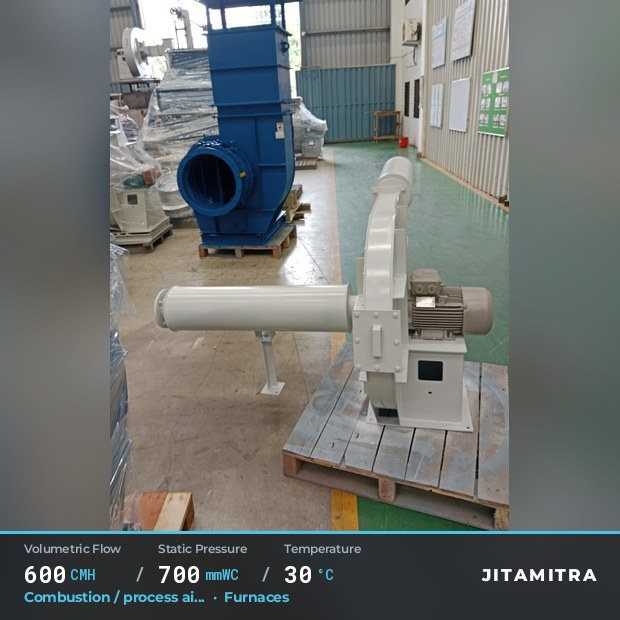
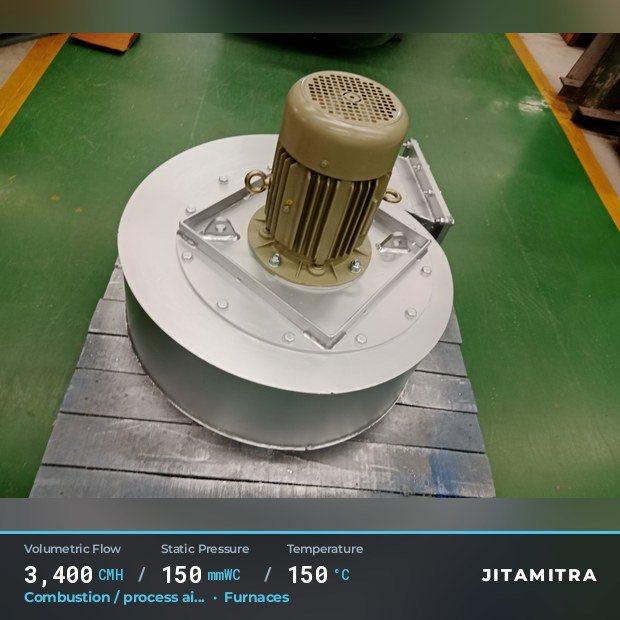
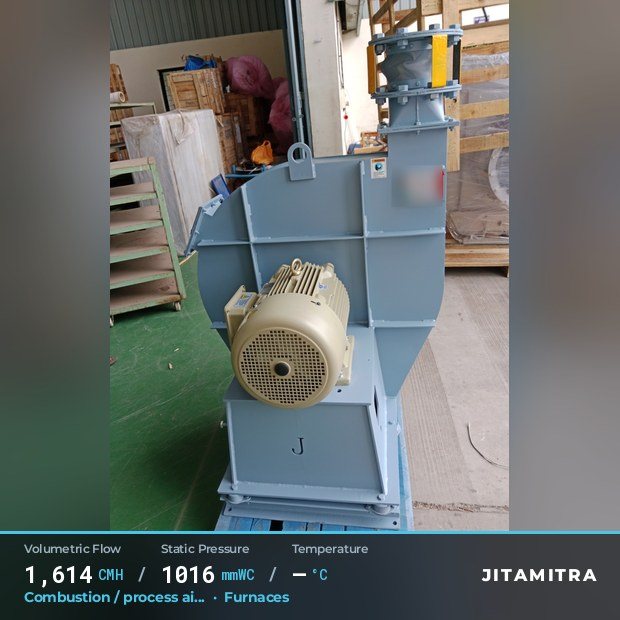
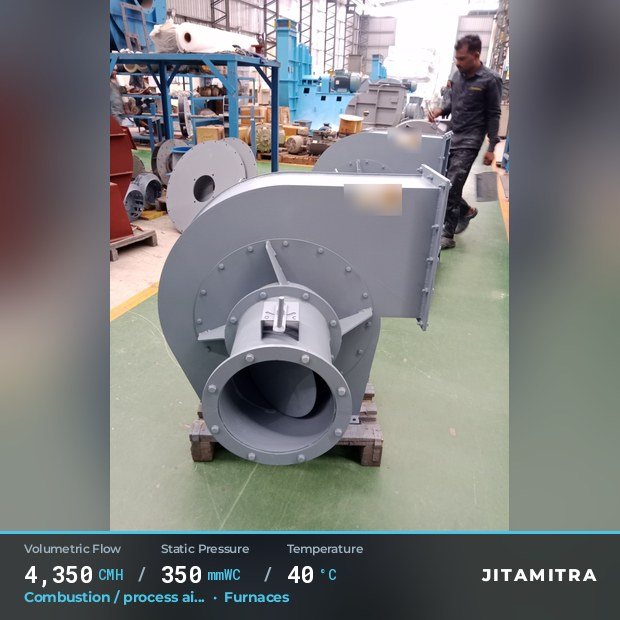
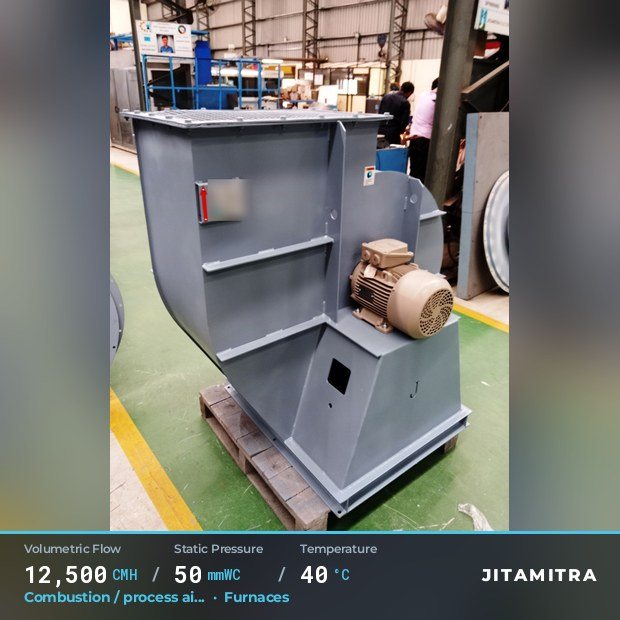
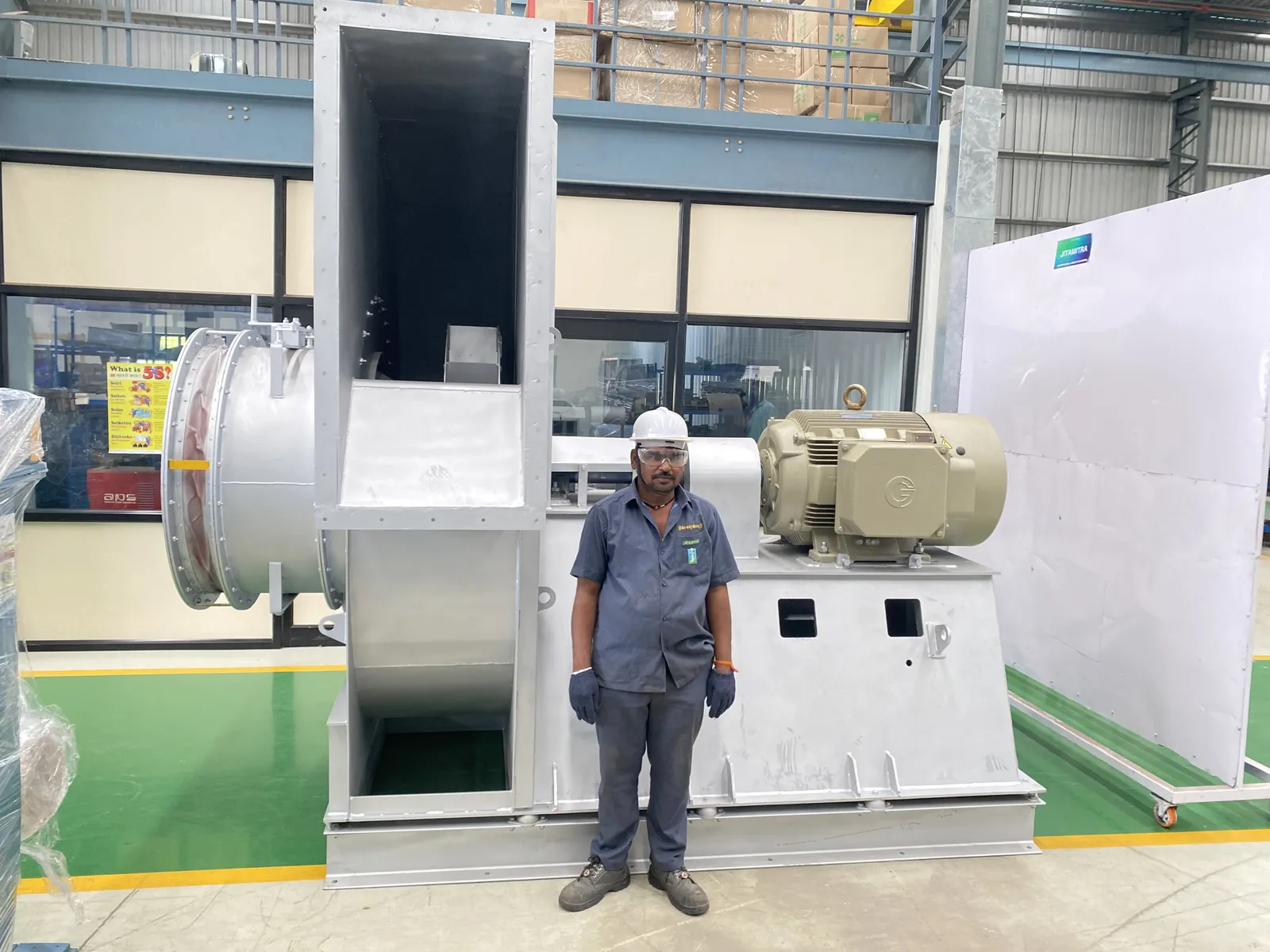
Real dispatched fans from this duty class — nameplate-scrubbed. Representative of the work; not the customer's own unit.
Furnace air does not wait for a cold, quiescent start. The ductwork is already at temperature, the gas is already thin, and the motor has to break the impeller away and come up to speed under that condition without stalling or tripping. On this duty it was written on the drawing, not added by us.
Forty thousand cubic metres an hour at 100 mmWC is high-volume, low-pressure work — straightforward to state and unforgiving to get wrong. At low pressure the fan curve is flat, so small errors in the system resistance move the operating point a long way. That is why we ask for your fan curve and your system resistance, not just a flow figure.
That was the second demanding part of this duty. A furnace line ramps, holds and backs off as the process demands, and the fan has to follow the drive down through its speed range and stay in control the whole way — no surge, no hunting, no loss of the operating point. The turn-down is proven on the rig, not assumed from the curve.
Belt drive keeps the impeller speed independent of the motor, so the fan is selected to the duty rather than to whatever a direct-coupled pole count allows. These were built to the 40,000 CMH / 100 mmWC / 25 HP duty on their fan curve, not to a nearest-catalogue-size approximation.
Every fan is performance-tested in-house on our 200 HP VFD test rig, to the IS 4894 / AMCA 210 method, before it leaves the works. Because the rig is VFD-driven, the turn-down is proven there rather than discovered on your line. Send the fan curve and the system resistance, and we will select to your duty and prove it before it ships.
No. They are real dispatched fans from this duty class, nameplate-scrubbed — representative of the work, not the customer's own unit. The supply itself is not a one-fan story: it has run across furnace build after furnace build, multi-year and repeat, and they keep coming back because the duty keeps being met.
Flow, static, gas temperature, application — or attach a spec, GA drawing or a multi-fan schedule. Engineer to engineer.
ISO 9001:2015 quality system · performance-tested to IS 4894 / ISO 5801 / AMCA 210 method · witnessed FAT on request.
*For our standard range. ATEX and special projects need 5 to 7 working days.
This site sets no cookies of its own. Google Analytics loads only if you accept. It sets two cookies, so we can see which fan topics people actually read. Decline and no analytics loads — the site works exactly the same. What we collect →