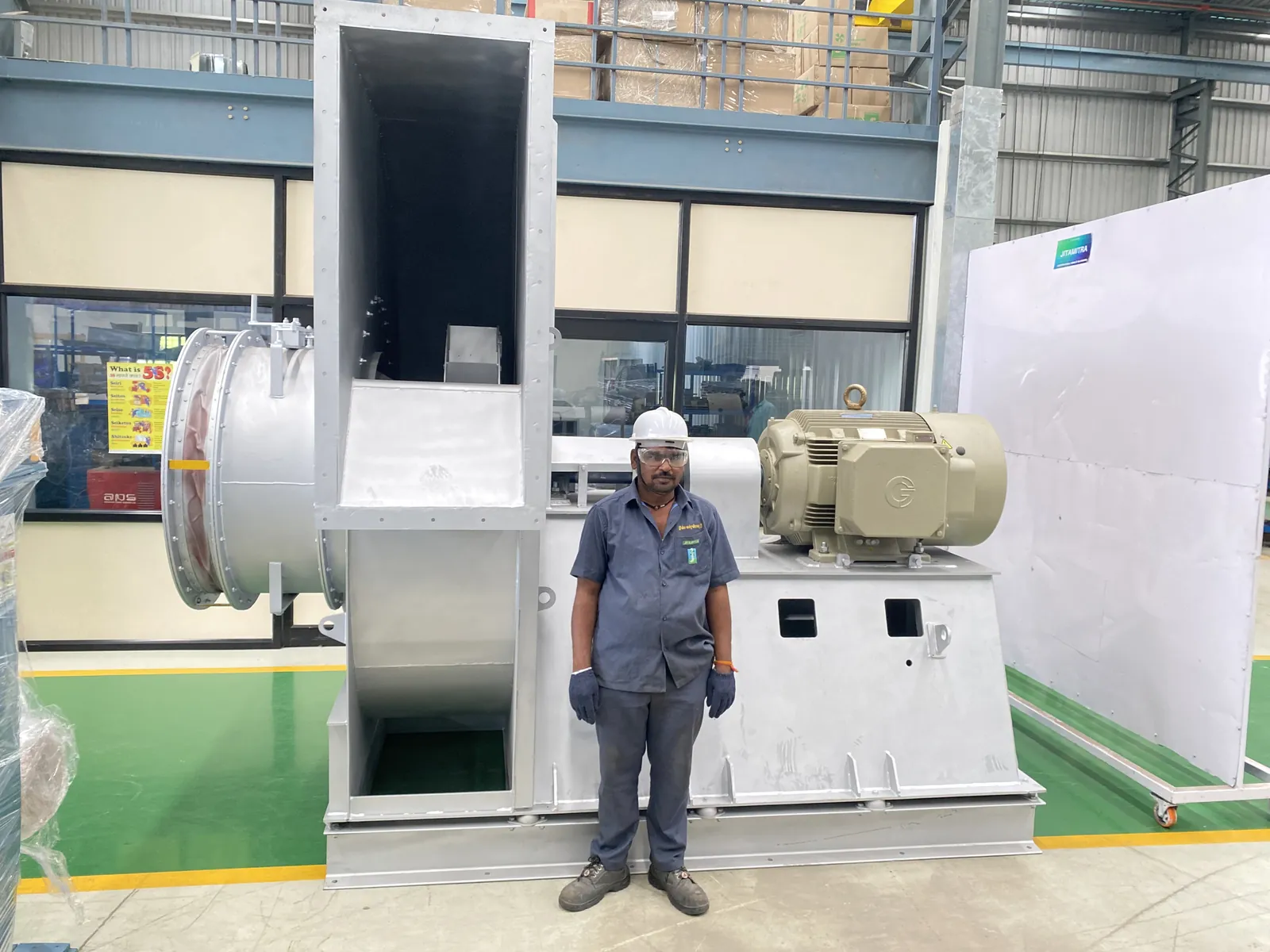
| Who | a plant running a Jitamitra centrifugal fan on oil-lubricated plummer blocks |
| Equipment | oil-bath plummer-block bearing housings, each with a loose oil ring riding on the shaft |
| Complaint | a noise from a bearing housing while the fan was running |
| Service | review of the site's details by our Technical Services team, October 2026 |
| Response | a written engineering view and a monitoring instruction |
| Result | The sound matches normal oil-ring behaviour. Instruction given: keep running, log bearing vibration and temperature, report any abnormality. The record closes at that guidance; the site's logged readings are not on file. |
Many fans run their bearings in oil-lubricated plummer blocks instead of grease. In an oil-ring housing, a loose ring hangs over the shaft and dips into the oil bath below it. As the shaft turns, the ring turns with it, lifts oil and carries it onto the shaft and the bearing. No pump, no external oil supply.
The ring is not fixed to the shaft; it rides on it. So it rubs as it turns, and an operator used to grease-packed bearings can hear that contact — a faint rubbing, sometimes a light metallic note — and read it as the first sign of a bearing failure.
We went through the details the site sent. A faint, smooth rubbing or light metallic sound from an oil-ring housing in operation is the ring doing its job: turning on the shaft and carrying oil to it. That sound is harmless on one condition — there is no abnormal vibration and no abnormal temperature rise at the bearing.
That makes the question measurable. The ear raises it; two readings settle it:
On an oil-ring bearing, judge by the trend, not by the ear. A sound with steady vibration and steady temperature is the ring at work. A sound that arrives with rising vibration or rising temperature is a reason to stop and look inside — at the oil level, the oil's condition and the ring itself.
We service centrifugal fans and blowers of any make — root-cause diagnosis, on-site correction, balancing, and a written maintenance regime you can run.
— Jitamitra Electro Engineering · Technical Services
Engineered for Every Application.
Not on its own. In an oil-ring housing a loose ring rides on the shaft and carries oil to it. A faint, smooth rubbing or light metallic sound from it is normal, as long as there is no abnormal vibration and no abnormal temperature rise at the bearing.
Bearing vibration and bearing temperature, logged over time. Steady readings with the sound present mean the ring is working. A rise in either is a reason to stop and look inside.
The oil level, the oil's condition and the ring itself, and report the readings to the fan's maker.
The record closes at our guidance; the site's logged readings are not on file.
Flow, static, gas temperature, application — or attach a spec, GA drawing or a multi-fan schedule. Engineer to engineer.
ISO 9001:2015 quality system · performance-tested to IS 4894 / ISO 5801 / AMCA 210 method · witnessed FAT on request.
*For our standard range. ATEX and special projects need 5 to 7 working days.
This site sets no cookies of its own. Google Analytics loads only if you accept. It sets two cookies, so we can see which fan topics people actually read. Decline and no analytics loads — the site works exactly the same. What we collect →
