How do you engineer fans for a desalination plant?
We engineer to the desalination duty itself. The underlying fan engineering — corrosive-gas exhaust, humid ventilation, cooling and seal air — is proven across our range in chemicals, marine and water & wastewater plants that see the same chloride and corrosion problem. Tell us your desalination duty (the gas, the chloride level, the humidity, the flow and pressure) and we build the fan to it, engineered to your operating point, not adapted from a catalogue near-fit.
Chloride salt-spray is the real enemy here. What metallurgy do you use?
We size the metallurgy to your chloride level, because chlorides drive pitting and crevice corrosion that ordinary steel and even 304 stainless cannot resist. Our baseline wetted material is 316L; where chlorides are high we step to duplex (2205), and where the gas allows we offer an FRP, epoxy or rubber lining on carbon steel. Welds are continuous and crevice-free so pitting has nowhere to start. The right answer depends on your chloride concentration, temperature and whether the surface stays wet, so we engineer it to your gas, not a default.
The brine-vapour exhaust gas is warm and saturated, not hot. How does that change the fan?
It changes it a lot. Desalination exhaust is typically warm — around 40 to 60 °C — but at or near 100% relative humidity, so it condenses inside the fan even on the clean side. We design the wetted surfaces and drainage for continuous condensation, place drains at every low spot so no brine pools, choose blade geometry so salt does not build up on the wheel, and keep the bearings outside the airstream. Heat is not the problem here; wet chloride is, and the fan is built for that.
How do you stop the brine vapour leaking into the bearings and the hall?
Containment is part of the design. We fit a shaft seal rated for the wet, corrosive service, keep the bearings outside the airstream, and build a leak-tight, gasketed casing so the corrosive vapour stays inside the fan and not in the room. The casing is drained and self-emptying, with the outlet and drain placed so condensate cannot pool and corrode from the inside. A brine-vapour fan that leaks corrodes the room around it, so we design it not to.
Can you build a replacement to match our existing desalination fan's duty and footprint?
Yes. We reverse-engineer to the existing duty point (flow, static pressure, gas temperature, humidity and chloride load), bearing centres, inlet/outlet orientation and foundation bolt pattern so the unit drops onto the existing base and ducting — whether it is a brine-vapour exhaust, a ventilation fan, a cooling-tower fan or a seal-air fan. Made to your installation, not a nearest-catalogue substitute. Send the old GA, the nameplate and a curve if you have one, and we match it.
Do you performance-test the fans, and what about AMCA, CE, ATEX and quality certification?
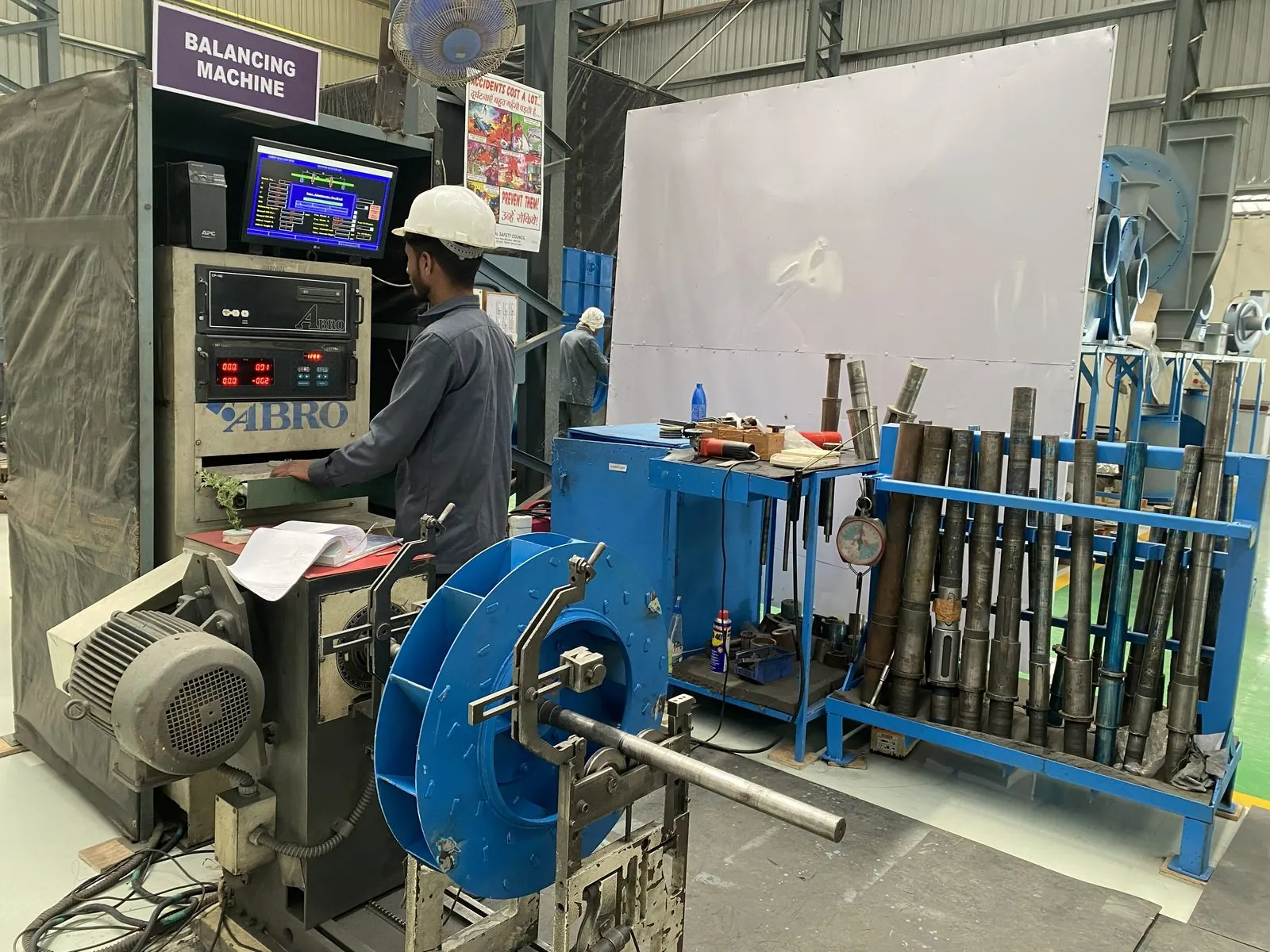
Every fan is performance-tested in-house to the IS 4894 / ISO 5801 / AMCA 210 method on our 200 HP VFD test rig, and dynamically balanced to ISO 21940 G6.3 as standard (G2.5 / G1.0 on application). Fans above the rig's 200 HP are run at derated speed and scaled to the specified duty by the fan laws. To be precise: that in-house testing is to the IS 4894 / ISO 5801 / AMCA 210 method, not AMCA-certified; CE is self-declared per 2006/42/EC and 2014/35/EU, and ATEX Zone 2/22 is self-declared per 2014/34/EU (Category 3) where the area classification calls for it — those are self-declarations of conformity, not third-party certifications. Our only third-party certification is ISO 9001:2015.