Grease coats everything in a kitchen fan. How do you make it cleanable?
We build the flow path to be opened and washed on a schedule rather than sealed shut. That means bolted-in access doors on the casing, a drain plug at the volute low point, and a wheel and inlet cone that withdraw for cleaning instead of a welded assembly no one can reach. On the wetted surfaces we use smooth 304 or 316L stainless steel or a food-grade coating so condensed grease releases on a wash instead of baking on. The point is simple: a fan that cannot be cleaned becomes the fire load, so cleanability is designed in, not left to site.
Is grease-duct fire a real risk, and can your fan handle it?
Yes, accumulated duct grease is a genuine fire load, and a flare-up at the range can carry flame up the grease duct. Where the duty calls for it we build a fan rated to move hot products of combustion on fire mode: casing and bearings selected for elevated temperature, rated up to 500 °C at the ceiling of our envelope, heat-rated wiring, and a discharge arrangement that carries flame clear of the roof and fresh-air intakes. To be precise, we state that as tested-to-standard construction, not a fire-rating certification we hold. The best fire defence is still a low standing grease load, which is why the cleaning access and drainage matter as much as the heat rating.
The fan sits above our dining room. What sound level can you meet?
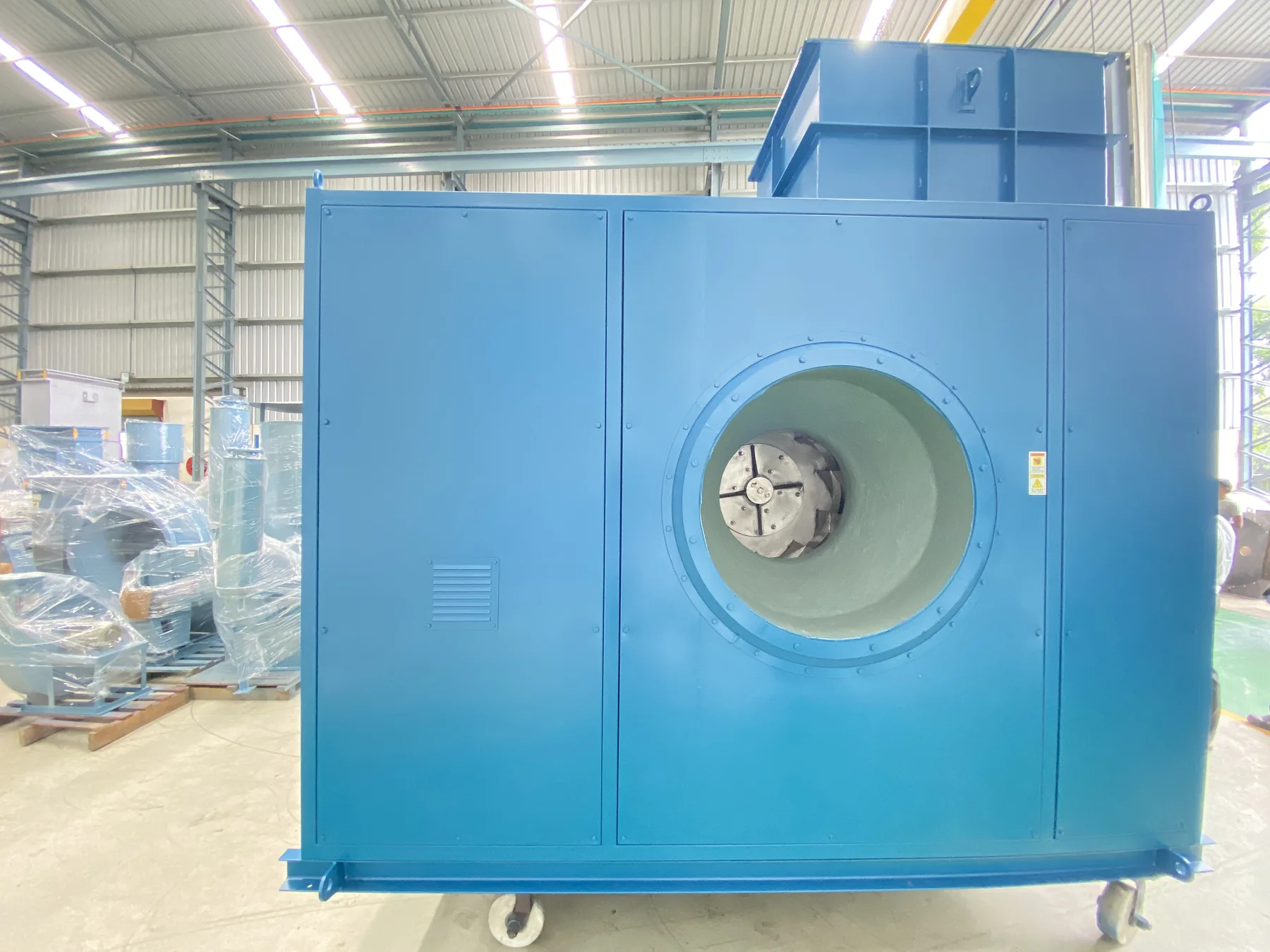
As standard we design to below 85 dB(A) at 1 m. Below 80 dB(A) is achievable on application with inlet and outlet silencers plus an acoustic-treated casing, and below 75 dB(A) with a custom acoustic enclosure. We default to a backward-curved or airfoil wheel because it runs quieter than a forward-curved wheel at the same duty, and we add casing-wall acoustic lagging where the fan sits directly above or beside occupied space. Tell us the sound limit and where the fan sits, and we predict and engineer to it.
What material should the wheel and casing be for greasy cooking air?
For normal grease-laden cooking effluent we use mild steel with a food-grade coating as standard, and 304 or 316L stainless steel on the wetted surfaces where grease release, frequent washdown or a corrosive effluent justifies it. Stainless is the usual choice on continuous central-kitchen and food-processing extract. Where a grease-fire mode is specified, the casing steps up to IS 2062 or SA 516 Gr 70 for the rated temperature. We size the material to your effluent and cleaning regime, not a default.
Should I specify VFD or a damper for control?
VFD is our default. Kitchen extract turns down meaningfully between peak service and off-peak, and speed control holds hood capture rate while saving fan power, rather than running the fan flat out and throttling it with a damper. It also lets the extract track a demand signal from the hood. An isolation or shut-off damper still has a place for isolation during cleaning or fire mode. We quote whichever your installation and controls call for.
Can you supply the roof or wall exhaust unit, not just a ducted fan?
Yes. We build ducted centrifugal fans and powered roof or wall ventilators (upblast or downblast) with a weatherproof cowl and bird screen, discharge routed clear of fresh-air intakes. The engineering is the same either way — cleanable flow path, quiet wheel, and the discharge arrangement set to your roof penetration and installed footprint. Tell us the mounting and the discharge point and we build to it. The sibling roof / wall exhaust page covers the general-ventilation version of the same unit.
This is a lighter duty than a furnace fan. Do you still make it to order?
Yes. It is a lighter duty than furnace draught, but the cleanliness, grease-fire and noise requirements are exacting and specific to your kitchen, so we still engineer the fan to your duty point rather than pull a catalogue near-fit. Your flow, static, effluent, cleaning regime, fire-mode requirement, discharge arrangement and sound limit all go onto the GA drawing you sign off before we cut metal. We have executed commercial-exhaust duty on a handful of jobs, and the engineering discipline is identical to our heavy-duty work.
Do you performance-test before dispatch, and what standards actually apply?
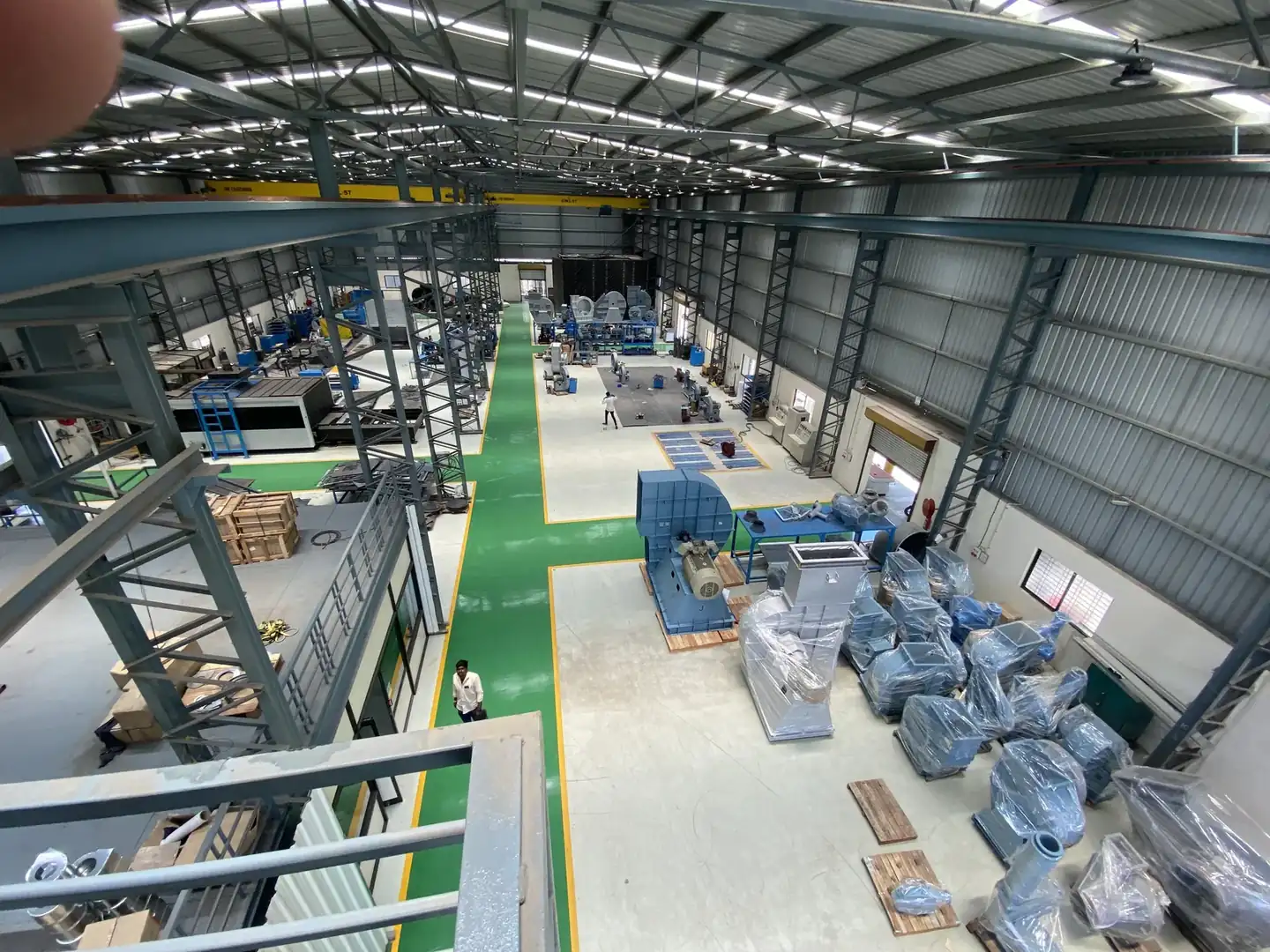
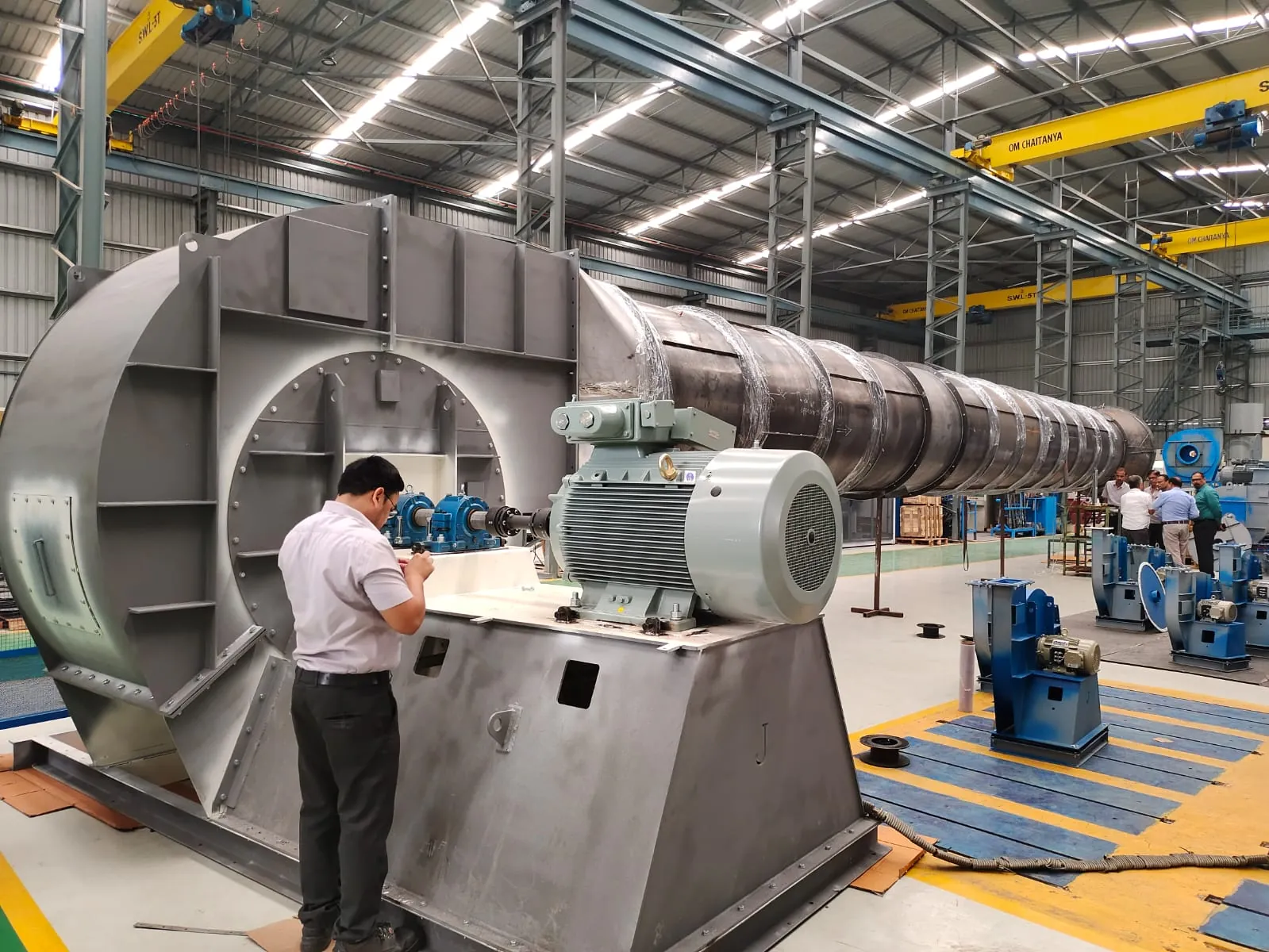
Yes. Every fan is performance-tested in-house to the IS 4894 / ISO 5801 / AMCA 210 method on our 200 HP VFD test rig, and dynamically balanced to ISO 21940 G6.3 as standard, with G2.5 or G1.0 on application. Fans above the rig's 200 HP are run at derated speed and scaled to the specified duty by the fan laws. To be precise about the claims: that is testing to the AMCA 210 method in-house, not an AMCA certification, and we are not an AMCA member; any grease-fire rating is stated as tested-to-standard construction, not a fire-rating certification; and CE and ATEX, where relevant, are self-declared per the EU directives (ATEX Zone 2/22, Category 3, per 2014/34/EU), not third-party certified. Our only third-party certification is ISO 9001:2015. A standard commercial-exhaust fan offers in 3 to 5 working days and runs roughly 8 to 12 weeks order-to-dispatch.