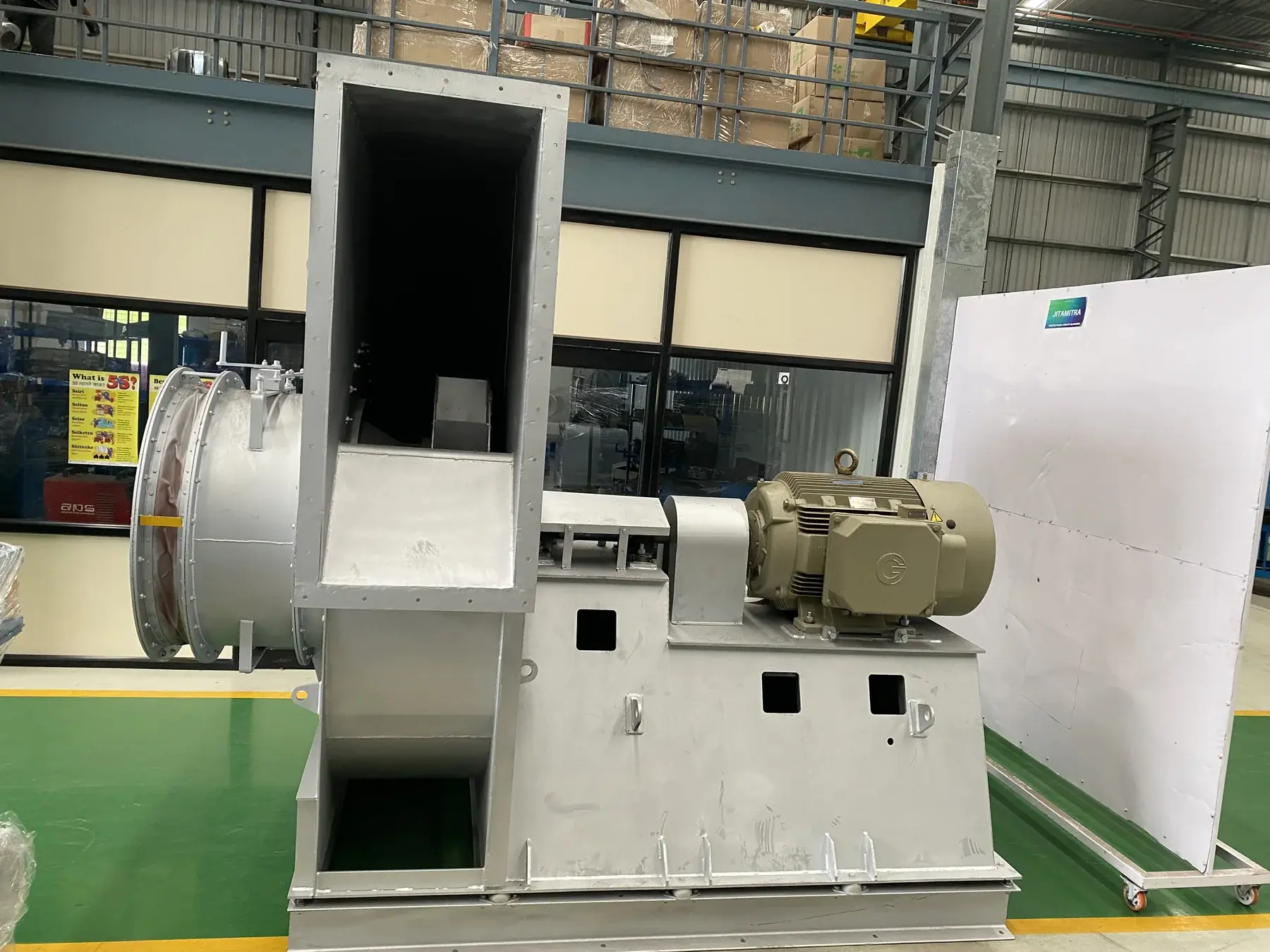
Grain-handling centrifugal fan built for combustible-dust duty on the Jitamitra shop floor
Home  /  Industries  /  Agriculture & Grain
Industries

Fans for grain drying, handling and dust control.

A grain-drying, storage and milling operation runs a fan duty that looks tame and is not: dryer and aeration air, dilute-phase pneumatic conveying, dust extraction and pulse-jet bag-filter draught. The temperatures are modest — most dryer air runs 60–120 °C — but the dust is the danger. Fine grain dust is combustible, and a fan that sparks or overheats in a dust cloud can start a deflagration that runs the length of an elevator. We build to that reality across the whole flowsheet, and to a proven fan range that spans the full envelope below — up to 2,25,000 CMH, 2,000 mmWC, 425 HP and 500 °C. Tell us your duty; we engineer to it.

60–120 °Ctypical dryer air
Zone 22ATEX self-declared
spark-resistantcombustible grain dust
2,25,000 CMHmax flow
15,000+
fans built since 2011
200 HP
VFD test rig · IS 4894 / AMCA 210
95%
on-time delivery (ERP statistics)
3
working days to quote
DRYER & AERATION AIR · PNEUMATIC CONVEYING · DUST EXTRACTION · PULSE-JET DRAUGHT
Our executed range

Fans we've built for Agriculture & Grain

A sample of units we've engineered, built and dispatched — each to a customer's duty point. Customer names and identifying marks are withheld. Click any photo to enlarge.

Jitamitra Air Filtration & Pretreatment fan — real dispatched build
Jitamitra Pharmaceuticals fan — real dispatched build
Jitamitra Air Filtration & Pretreatment fan — real dispatched build
Jitamitra Sugar fan — real dispatched build
Jitamitra Industrial Fans & Blowers (Manufacturer) fan — real dispatched build
Jitamitra Air Filtration & Pretreatment fan — real dispatched build

Browse our rich executed product range →

Where the fans sit

One grain plant, three jobs the fans do — and every one of them moves combustible dust.

Across a grain terminal the fans do three distinct jobs: they push warm air through the dryer and the storage bin to condition the crop, they convey grain and meal from point to point, and they collect the dust that every transfer point throws off. The common thread is that the air is carrying fine grain dust — light, combustible, and prone to caking on the wheel — so ignition control and build-up management, not temperature, decide the design.

The duties we run on a grain plant

The fan duties across a grain-drying and handling plant — and the role each one plays.

A grain terminal needs a family of fan duties, from the warm dryer air down to the pulse-jet draught on the bag filters. The underlying fan engineering is proven across our range; on grain we bring a small number of executed duties, and we engineer each fan to its own air, moisture and combustible-dust classification — not adapted from a catalogue near-fit.

The fans we deploy here

Three fan types cover the grain flowsheet — matched to the dust and the pressure.

The wheel is chosen by how much dust it must shed and how much pressure it must make: a rugged radial for the dirtiest dust-extraction and conveying duty, a backward-curved plate wheel for the efficient dryer and aeration air, and an aerofoil for the cleanest, high-volume ventilation air. All three build across the same envelope — to 2,25,000 CMH, 2,000 mmWC, 425 HP and 500 °C — and all three can be built to an ATEX construction where the area classification calls for it.

Why grain fan duty is hard

Three things in grain dust decide whether the fan is safe and stays in balance.

Grain fan duty is deceptive: the gas is cool, so the failure mode is not heat — it is the dust. Fine grain dust is combustible, it cakes on the wheel and it comes off the crop wet and sticky, and each of the three attacks the fan differently. Engineer for all three and the fan runs safely and stays in balance for years. Engineer for the duty point alone and it becomes an ignition risk, or it fouls and shakes itself apart within 12–24 months.

01 — DEFLAGRATION

Combustible grain dust

Grain, flour and by-product dust is combustible, with a minimum ignition energy low enough that a spark, a rubbing wheel or a hot bearing inside a dust cloud can start a deflagration that propagates through the ducting and the elevator.

How we engineer it out

An ATEX construction sized to the area classification — spark-resistant build to the recognised A/B/C construction levels, non-sparking wheel and inlet materials, generous wheel-to-casing clearance so metal never rubs, earthing and bonding across the assembly, and bearings kept cool and outside the airstream. ATEX Zone 22 (Category 3D) is self-declared per 2014/34/EU for combustible-dust duty.

02 — BUILD-UP

Fine dust caking & imbalance

Fine grain dust is light and sticky — it cakes on the blades and in the wheel passages, and because it builds up unevenly it throws the rotor out of balance, driving vibration up until the bearings and the wheel suffer, and the caked layer is itself a fuel bed if it overheats.

How we engineer it out

A radial wheel geometry that resists build-up and self-cleans in the airstream; inspection and cleanout doors so the wheel can be checked and washed down on a maintenance stop; and dynamic balancing to ISO 21940 G6.3 as standard so the fan starts from a low residual, giving the widest margin before build-up matters.

03 — MOISTURE

Moist, sticky grain fines

Grain coming off the field or out of a wet dryer stage carries moisture, so the fines are damp and sticky rather than dry and free-flowing — they plaster onto the wheel and casing, and where warm moist air later cools it can condense and start mild corrosion on the casing wall.

How we engineer it out

Blade geometry and surface finish chosen so damp fines do not key onto the wheel; casing drains at the low points; and corrosion-resistant material or coating on the wetted surfaces where the air is warm and moist — 316L or an epoxy/coated finish on request — with cleanout access so any layer that does form is removed, not left to grow.

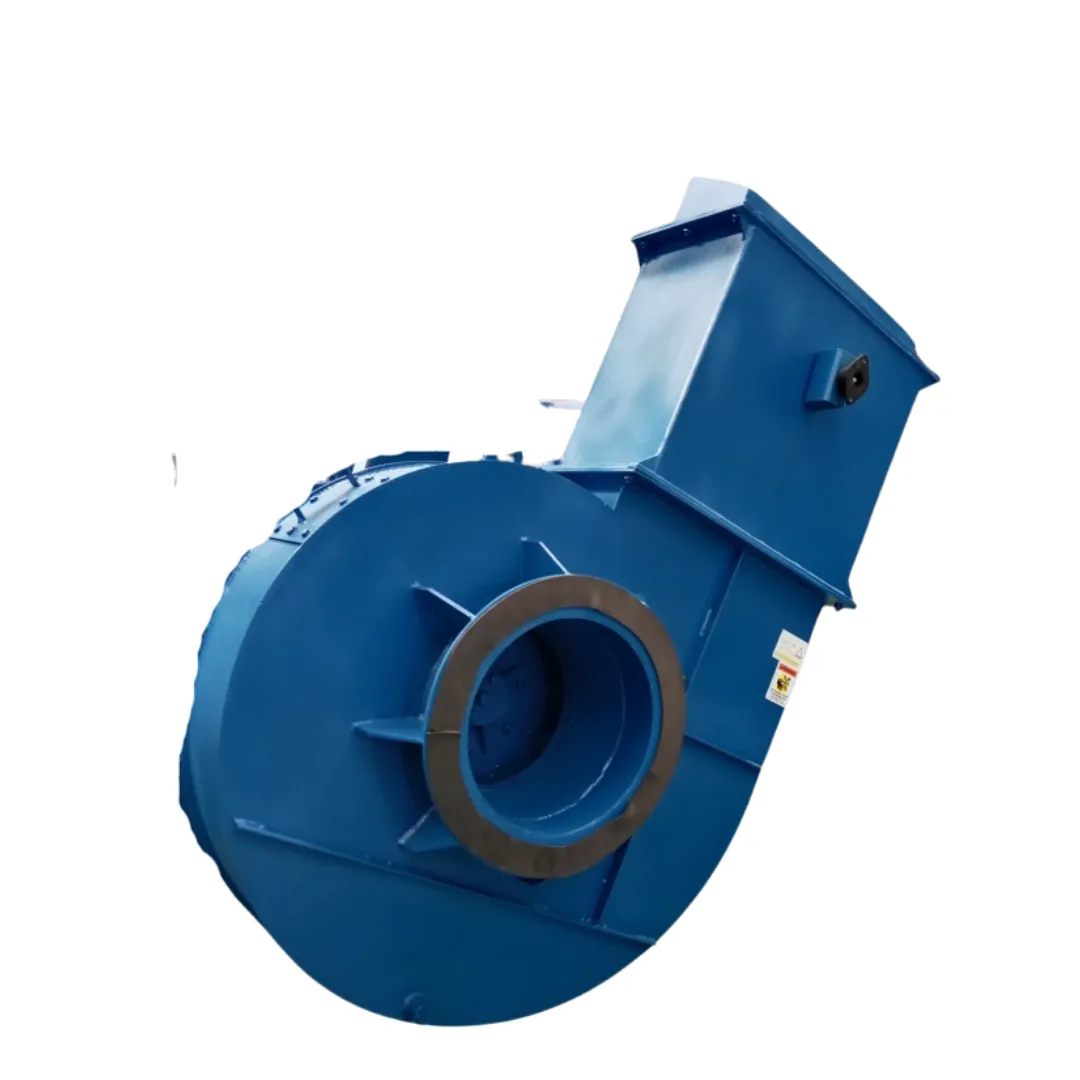
Centrifugal bag-filter draught fan on the clean side
How we design for the line

Every ignition-control, build-up and metallurgy choice is documented on the GA drawing you sign off — before we cut metal.

We don't sell a catalogue near-fit onto a grain plant. Each fan is engineered to its own duty — the dryer air to its volume and temperature, the conveying fan to its pressure, the dust-extraction fan to its combustible-dust classification — at your operating point.

  • Combustible-dust construction — Where the area is classified, an ATEX build to the recognised spark-resistant construction levels — non-sparking wheel and inlet materials, generous wheel-to-casing clearance so metal never rubs, earthing and bonding across the assembly, and bearings kept cool and outside the airstream. ATEX Zone 22 (Category 3D) is self-declared per 2014/34/EU.
  • Build-up-resistant wheel — A radial wheel geometry that self-cleans and resists caking of fine grain dust; inspection and cleanout doors so the wheel can be checked and washed down on a maintenance stop; and dynamic balancing to ISO 21940 G6.3 as standard (G2.5 / G1.0 on application) for the widest margin before build-up unbalances the rotor.
  • Moisture & corrosion handling — Surface finish and blade geometry chosen so damp fines do not key onto the wheel; casing drains at the low points; and corrosion-resistant material or coating on the wetted surfaces where the air is warm and moist — 316L or an epoxy-coated finish on request — for the wet dryer stages and cool bin vents.
  • Single source across the plant — One engineering partner for the whole flowsheet — dryer and aeration air, pneumatic conveying, dust extraction and bag-filter draught — with a proven fan range spanning the full envelope, so the fans, spark-resistant scope, wear parts and drives carry one convention across the terminal.
Standards & conformity

Stated precisely — because procurement checks.

What our marks mean, in the words that survive an audit.

Performance

Tested to the IS 4894 / ISO 5801 / AMCA 210 method, in-house on our 200 HP VFD rig. Tested-to-method — not AMCA-certified.

Quality system

ISO 9001:2015 — third-party certified. Our only third-party certification.

CE conformity

Self-declared per 2006/42/EC + 2014/35/EU. A self-declaration, not a notified-body certificate.

ATEX conformity

Self-declared, Zone 2/22, Category 3, per 2014/34/EU, where the area classification calls for it.

Oil & gas duty

Designed and built to API 673 as project-specific scope.

Welding

ASME Sec IX qualified welders + WPS for every joint.

Balance

ISO 21940 — G6.3 minimum, G2.5 / G1.0 on application.

Vibration

ISO 14694 fan-specific limits; ISO 20816 general evaluation method.

Questions engineers ask

Grain-plant fan questions, answered straight.

Grain dust is combustible. Do you build fans for an ATEX-classified grain plant?
Yes. Where the area is classified for combustible grain dust we build a spark-resistant, ATEX construction sized to the zone: non-sparking wheel and inlet materials, generous wheel-to-casing clearance so metal never rubs, earthing and bonding across the whole assembly, and bearings kept cool and outside the airstream so nothing inside a dust cloud can become an ignition source. To be precise, ATEX Zone 22 (Category 3D) is self-declared per 2014/34/EU for combustible-dust duty — a self-declaration of conformity, not a third-party certification. Tell us your zone and dust classification (St class, minimum ignition energy) and we engineer the fan to it.
Fine grain dust cakes on the wheel and unbalances it. How do you manage that?
Two ways. First, a radial wheel geometry that resists build-up and self-cleans in the airstream, so fine dust does not key onto the blades. Second, inspection and cleanout doors so the wheel can be checked and washed down on a maintenance stop, and dynamic balancing to ISO 21940 G6.3 as standard (G2.5 or G1.0 on application) so the fan starts from a low residual imbalance and has the widest margin before any build-up begins to matter. On the dirtiest conveying and extraction duty the radial wheel is chosen specifically because it sheds dust rather than collecting it.
What temperatures do your grain-dryer and aeration fans handle?
Most grain-dryer air runs 60 to 120 °C, and aeration air is near-ambient, so temperature is rarely the limiting factor on a grain plant — the combustible dust is. That said, the same fan range is rated for continuous duty up to 500 °C across the envelope, so if you run a high-temperature dryer stage or a biomass-fired hot-air generator we simply select up the metallurgy and add a shaft cooling disc above about 350 °C. The fan is built for your stated air temperature, not a generic rating.
Can you supply the fans across the whole grain flowsheet, or only one duty?
Across the whole flowsheet. We engineer dryer and aeration air, dilute-phase pneumatic conveying, dust extraction on the transfer points and elevator boots, building dilution ventilation, combustion air for the dryer burner, and the pulse-jet draught on the bag filters. Each fan is engineered to its own air, moisture and combustible-dust classification — the clean aeration fan and the dirty extraction fan are different machines — but they come from one partner, on one engineering convention across the plant.
Can you build a replacement to match our existing grain fan's duty and footprint?
Yes. We reverse-engineer to the existing duty point (flow, static pressure, air temperature, density and dust load), bearing centres, inlet/outlet orientation and foundation bolt pattern so the unit drops onto the existing base and ducting — whether it is a dryer fan, a conveying blower, a dust-extraction fan or a bag-filter draught fan. Made to your installation, not a nearest-catalogue substitute. Send the old GA, the nameplate and a curve if you have one, and we match it — including the spark-resistant scope if the area is classified.
Do you performance-test the fans, and what about AMCA, CE, ATEX and quality certification?
Every fan is performance-tested in-house to the IS 4894 / ISO 5801 / AMCA 210 method on our 200 HP VFD test rig, and dynamically balanced to ISO 21940 G6.3 as standard (G2.5 / G1.0 on application). To be precise: that in-house testing is to the IS 4894 / ISO 5801 / AMCA 210 method, not AMCA-certified; CE is self-declared per 2006/42/EC and 2014/35/EU, and ATEX Zone 22 (Category 3D) for combustible grain dust is self-declared per 2014/34/EU — a self-declaration of conformity, not a third-party certification. Our only third-party certification is ISO 9001:2015.

Across the range

Where Agriculture & Grain fits — the fans we deploy, the duties we run, and adjacent industries.

The same engineering, viewed three ways — by fan family, by duty, and by industry. Follow the cross-references.

Take it further

Specs an engineer can use — not a brochure.

Ready to quote?

Send us the duty point. We'll quote in 3 working days.*

Flow, static, gas temperature, application — or attach a spec, GA drawing or a multi-fan schedule. Engineer to engineer.

Get a quote → Email the desk

ISO 9001:2015 quality system · performance-tested to IS 4894 / ISO 5801 / AMCA 210 method · witnessed FAT on request, at no cost.

*For our standard range, additional days required for special projects